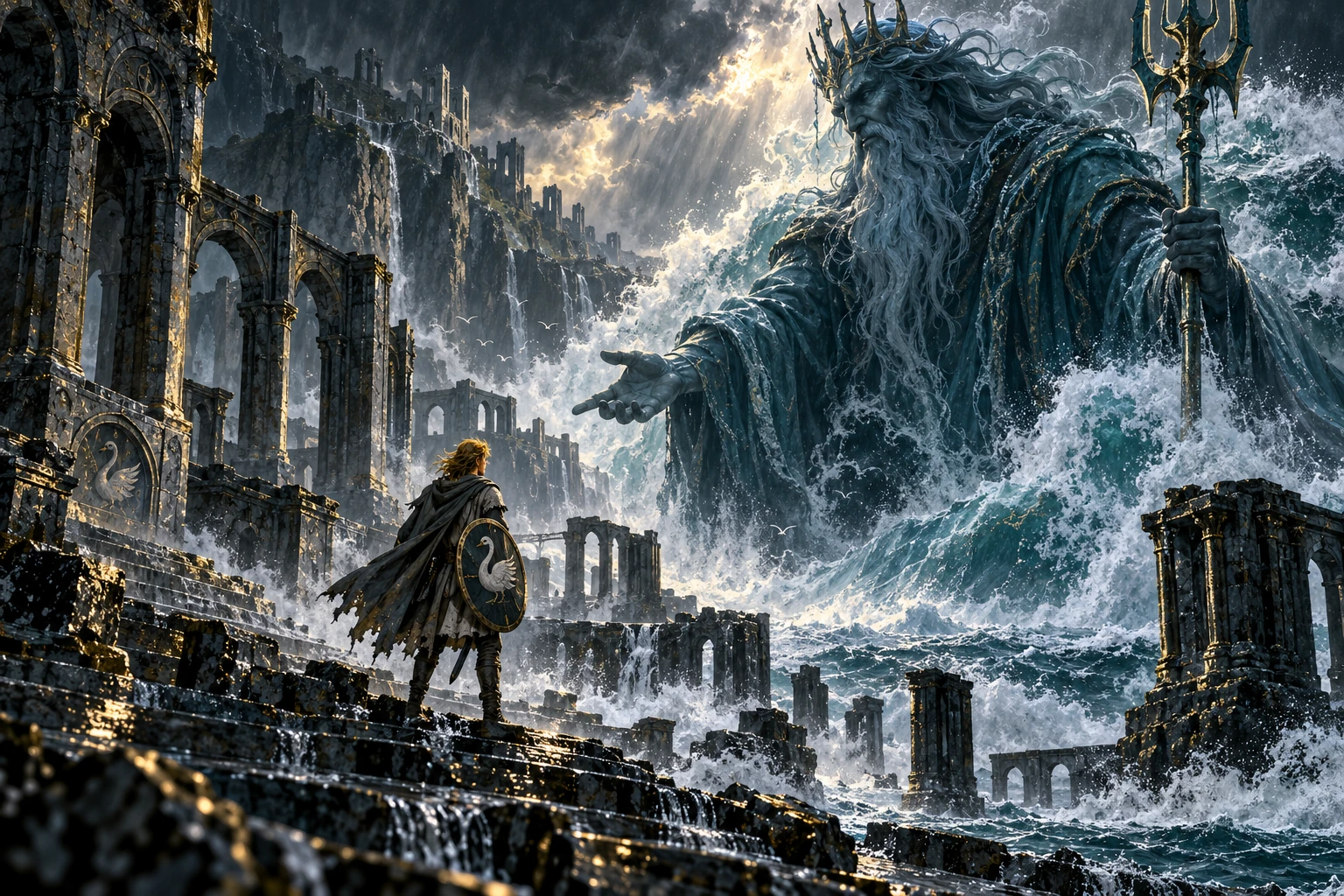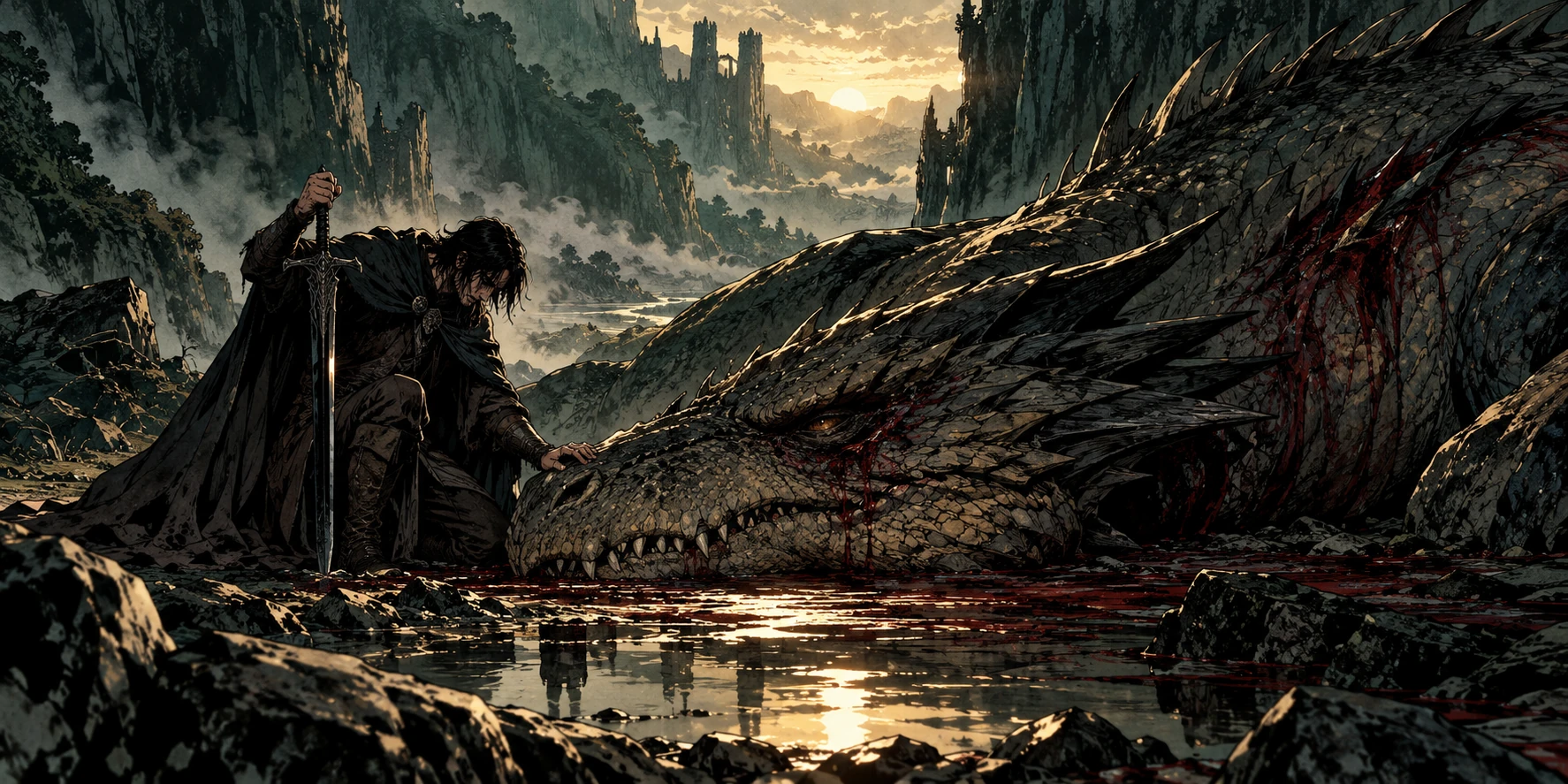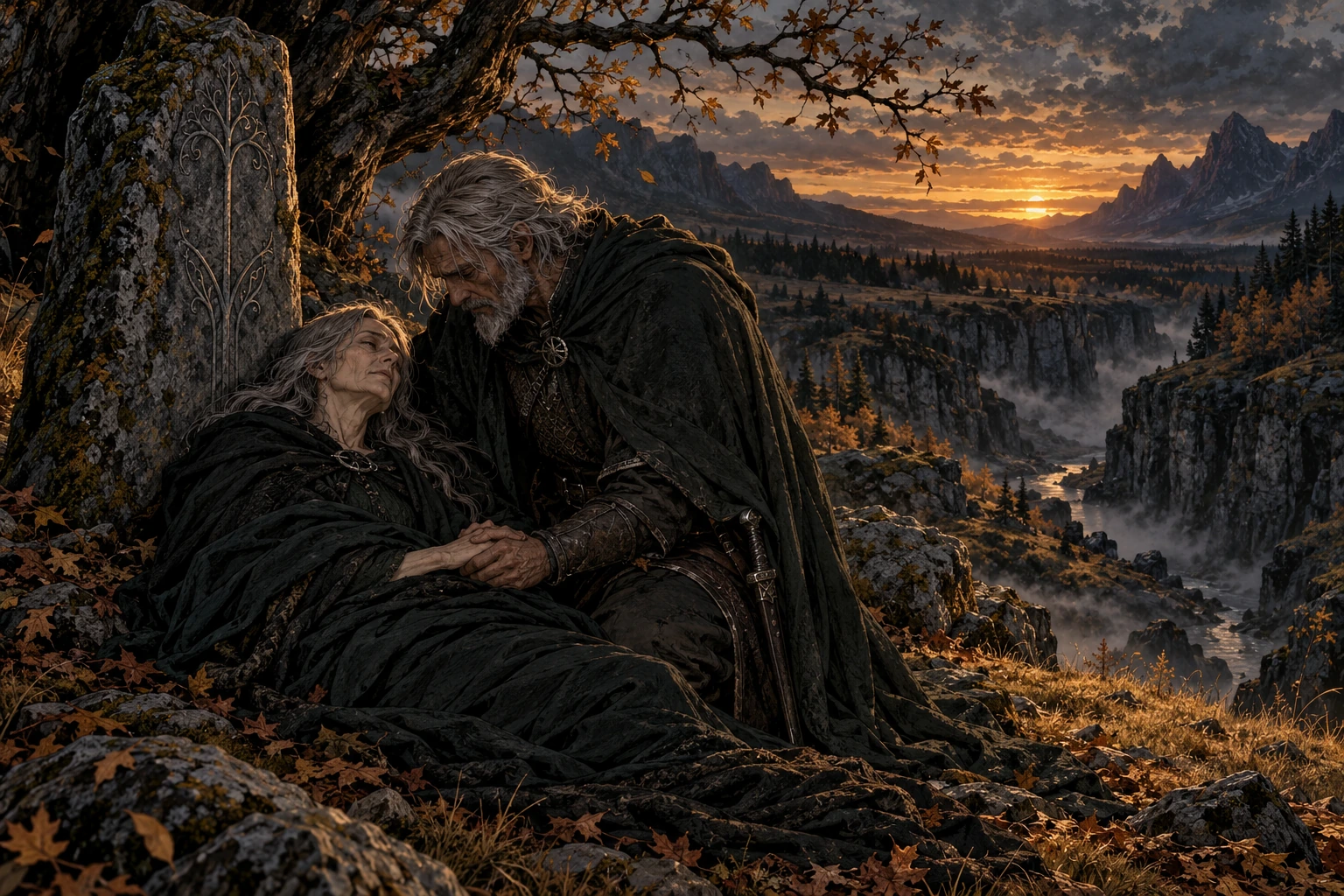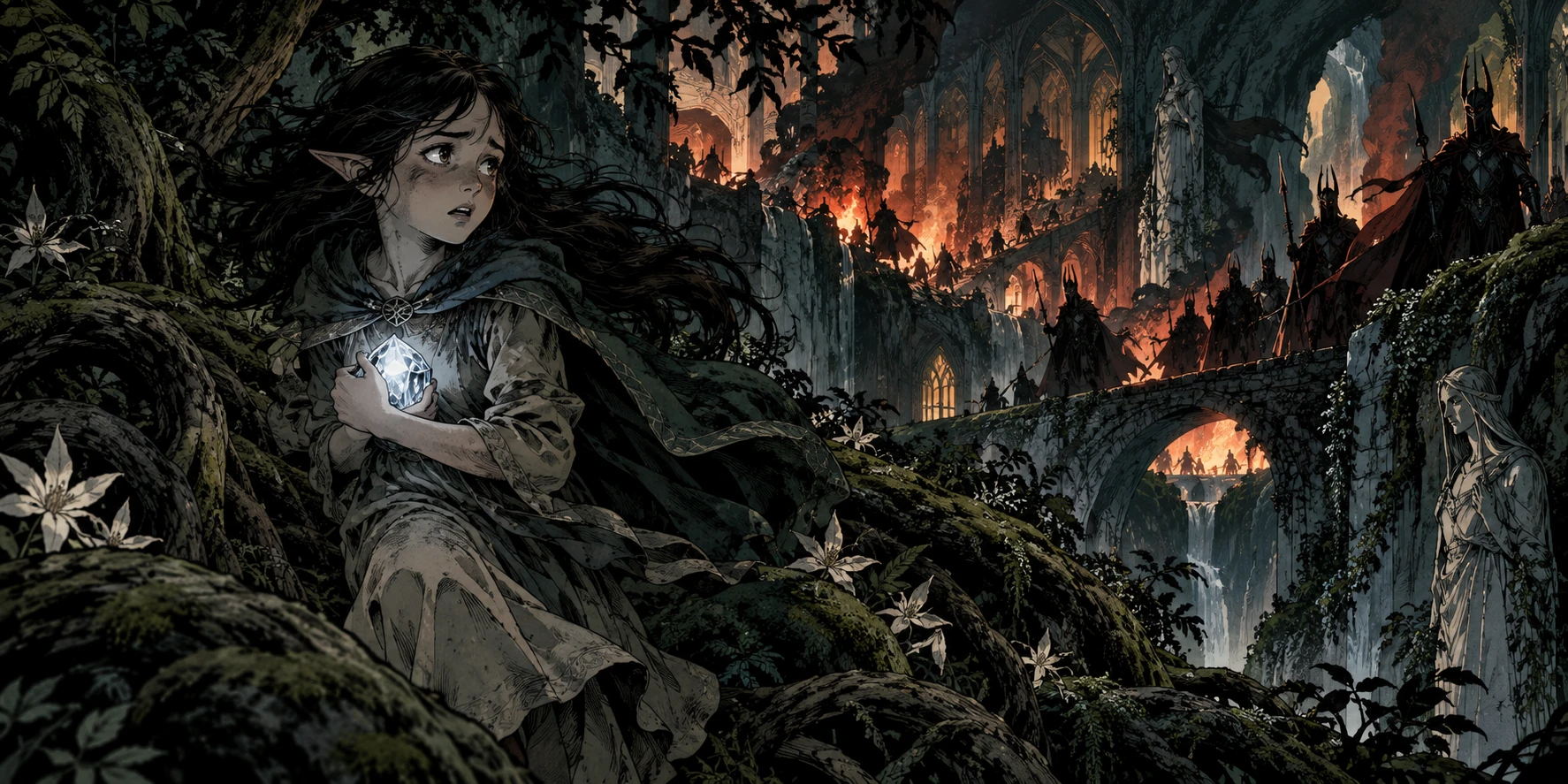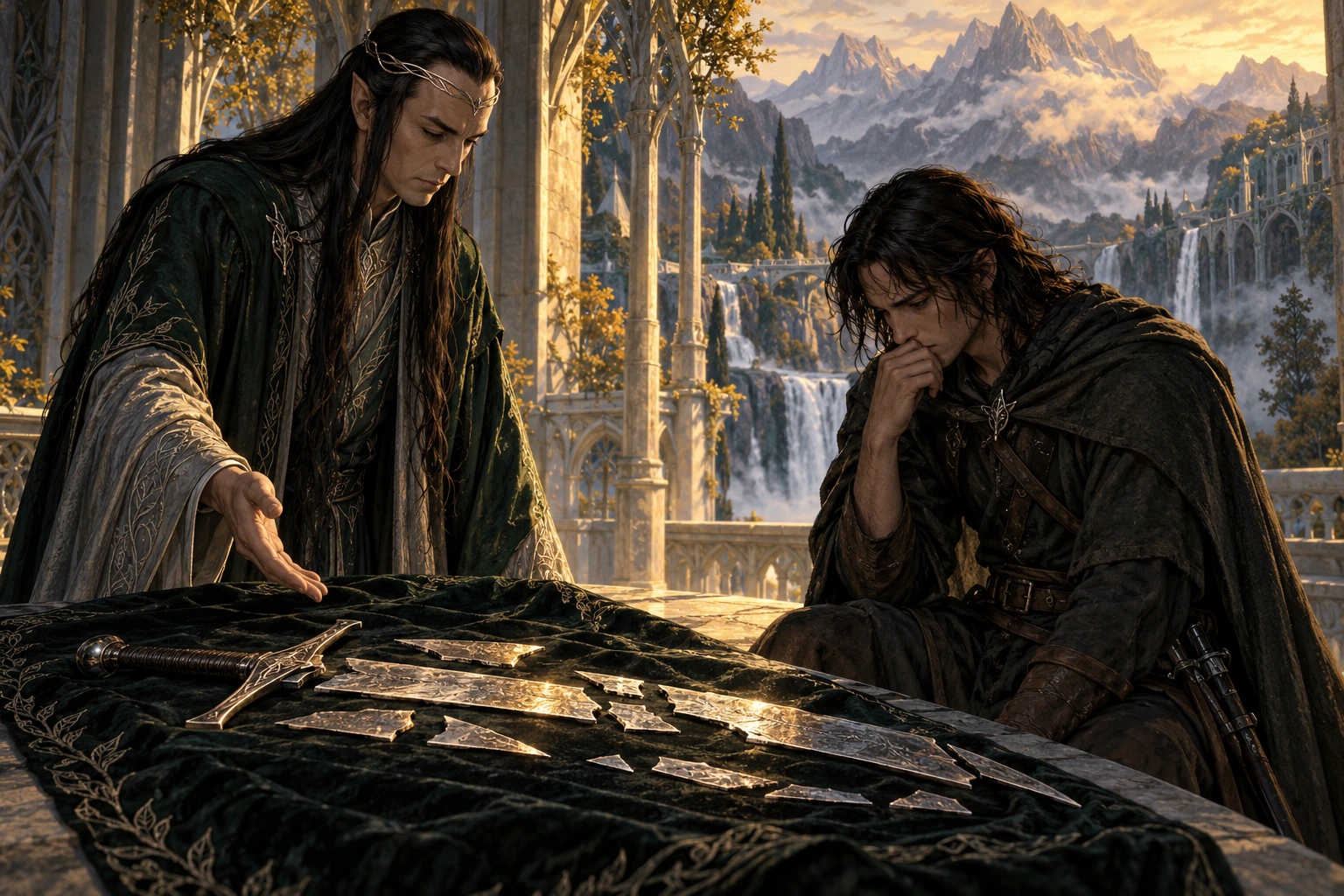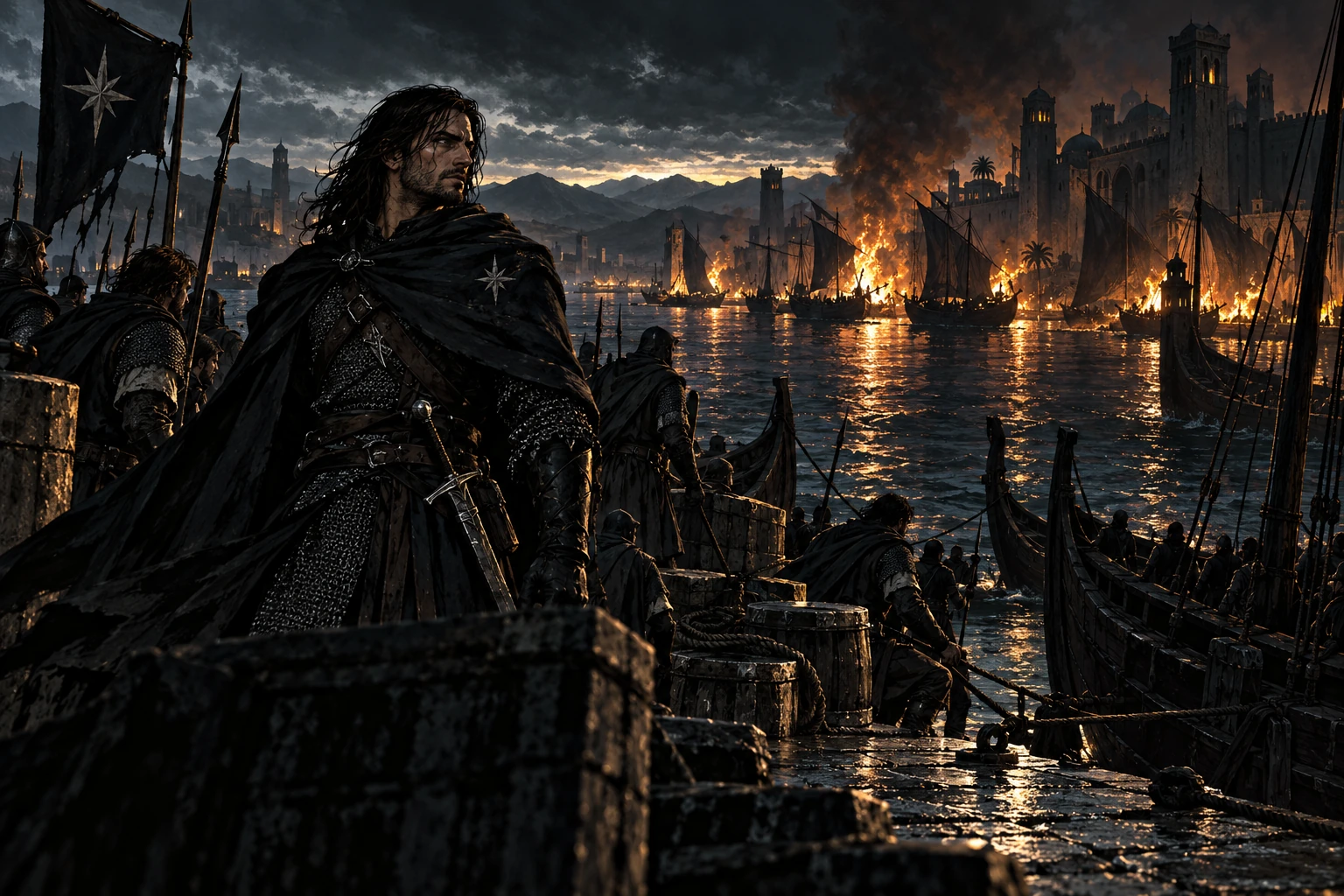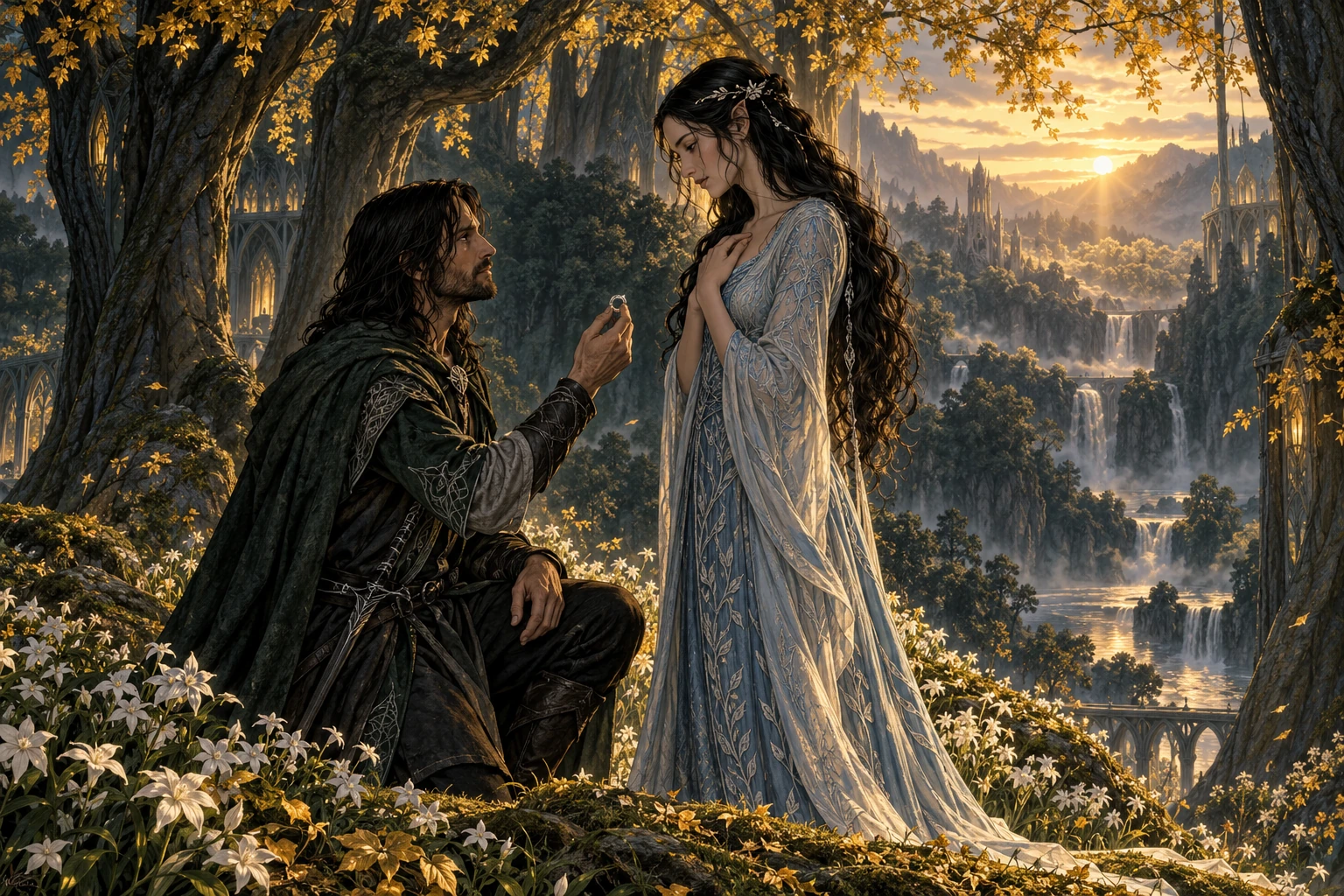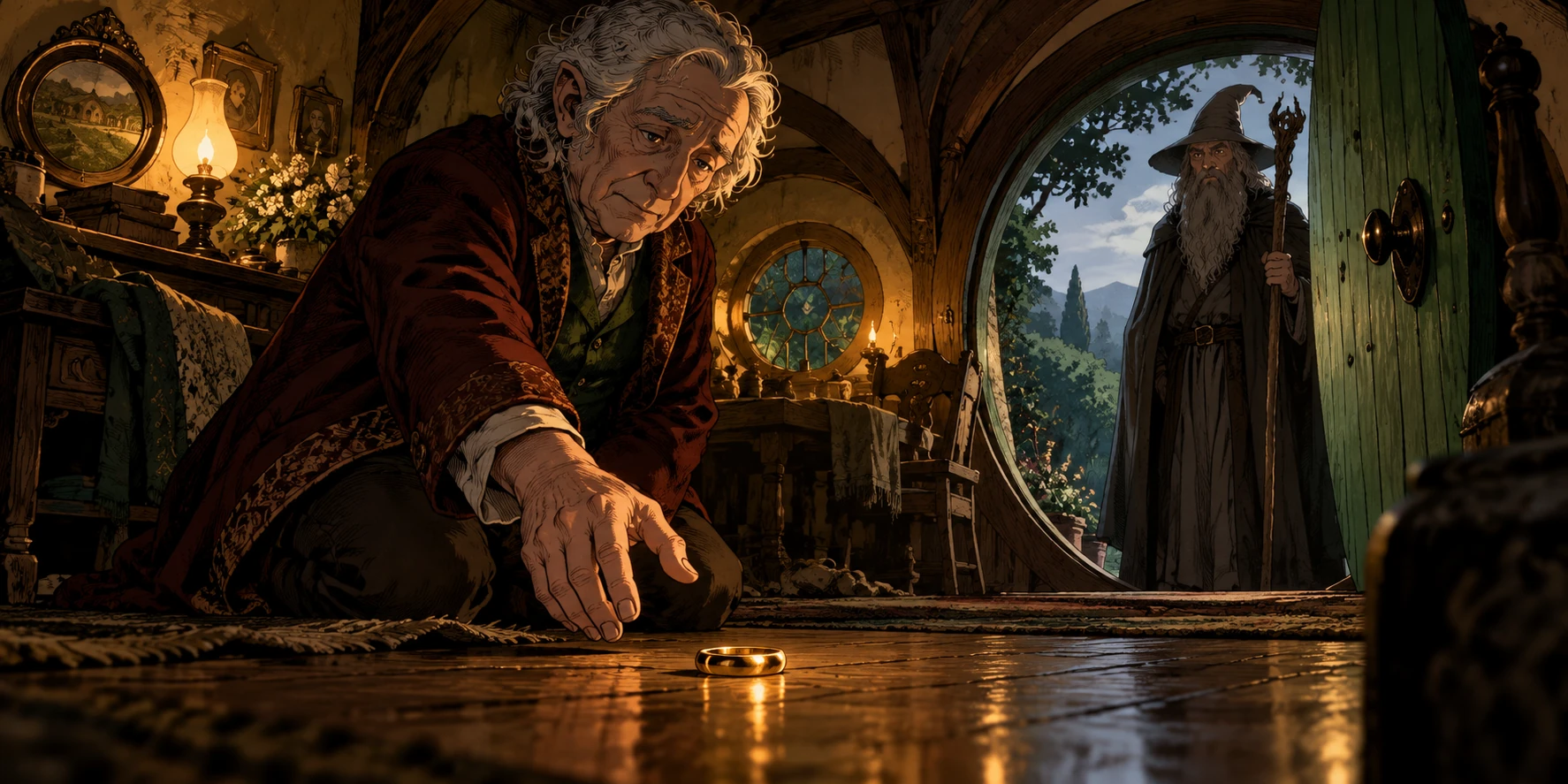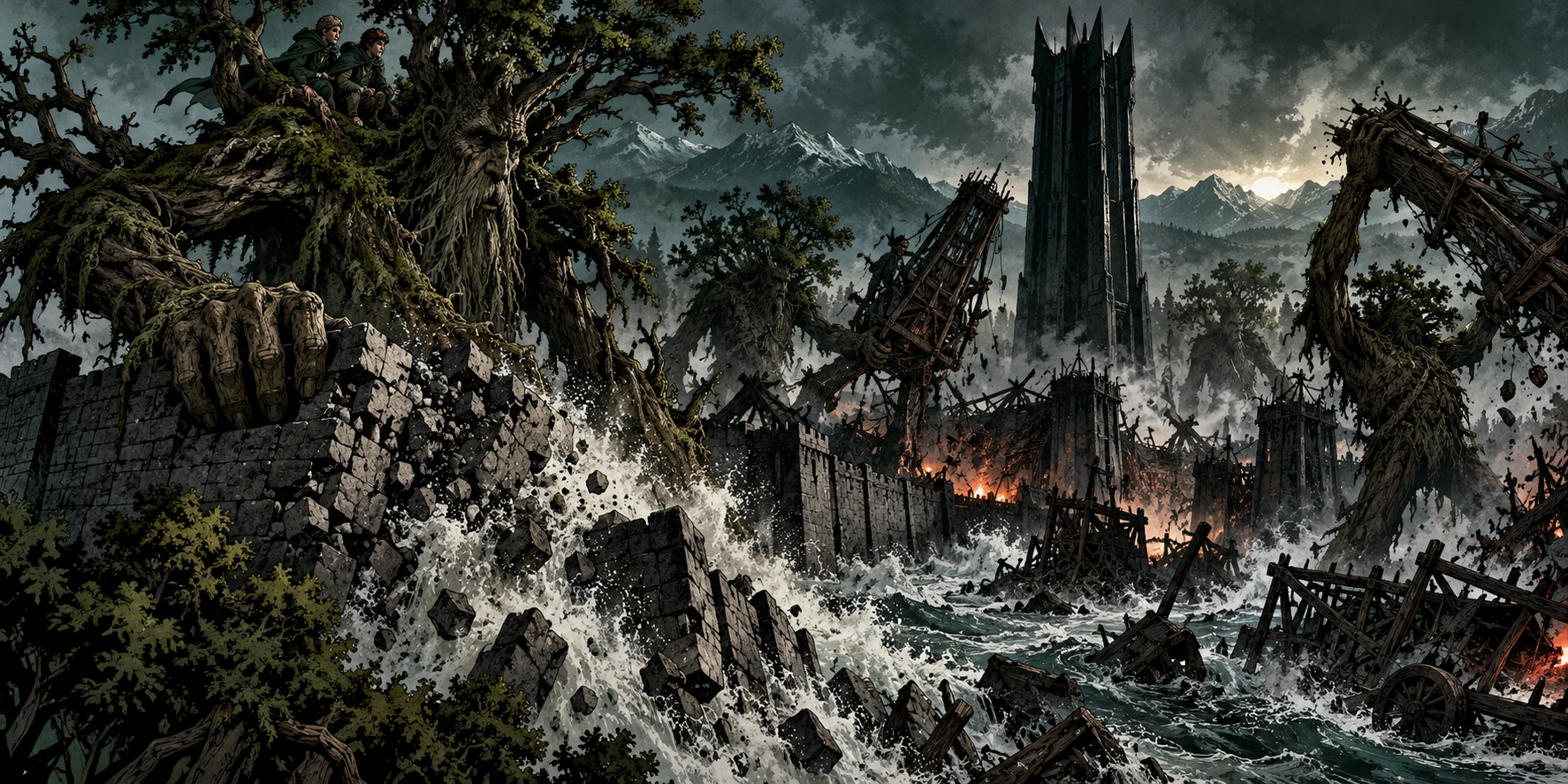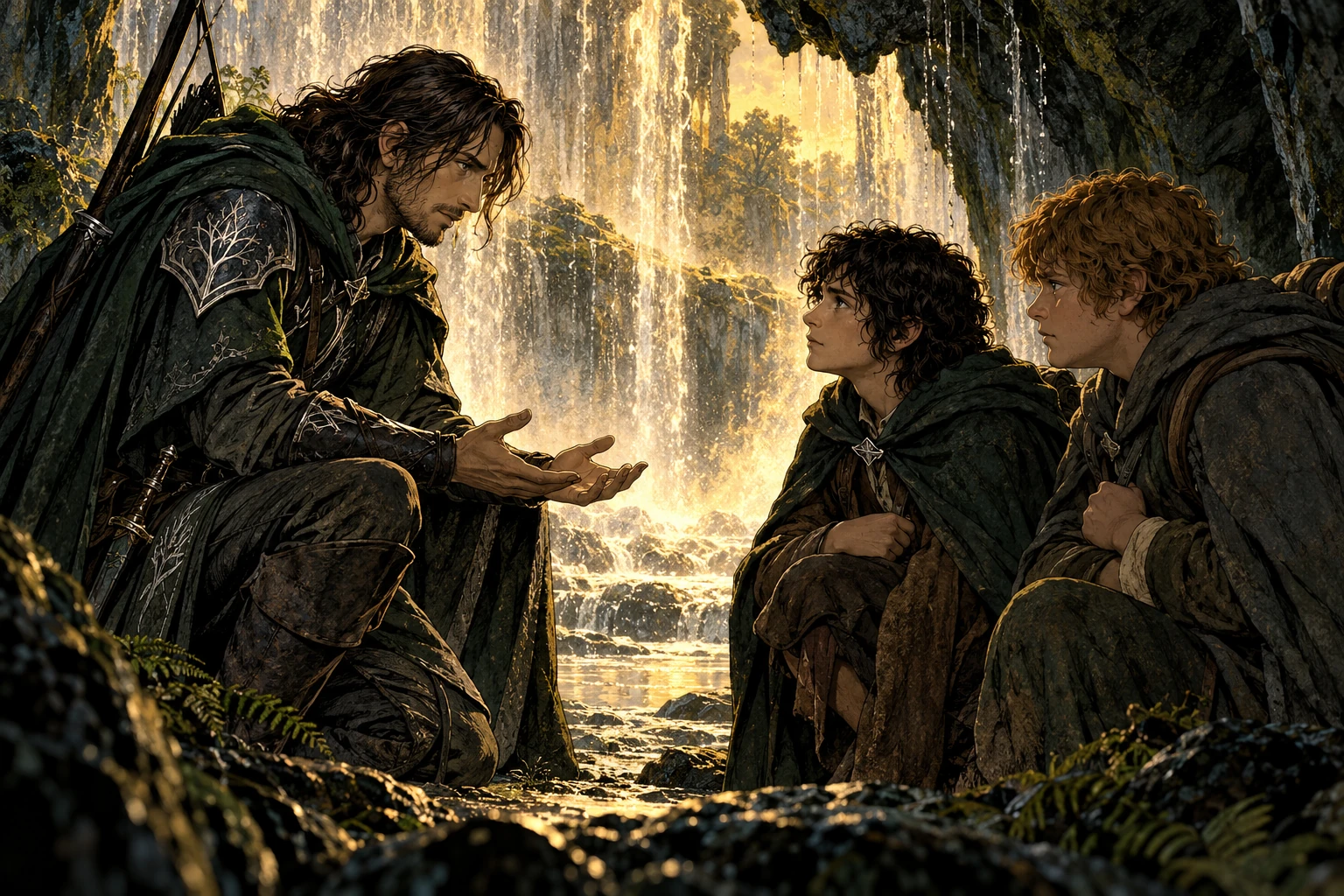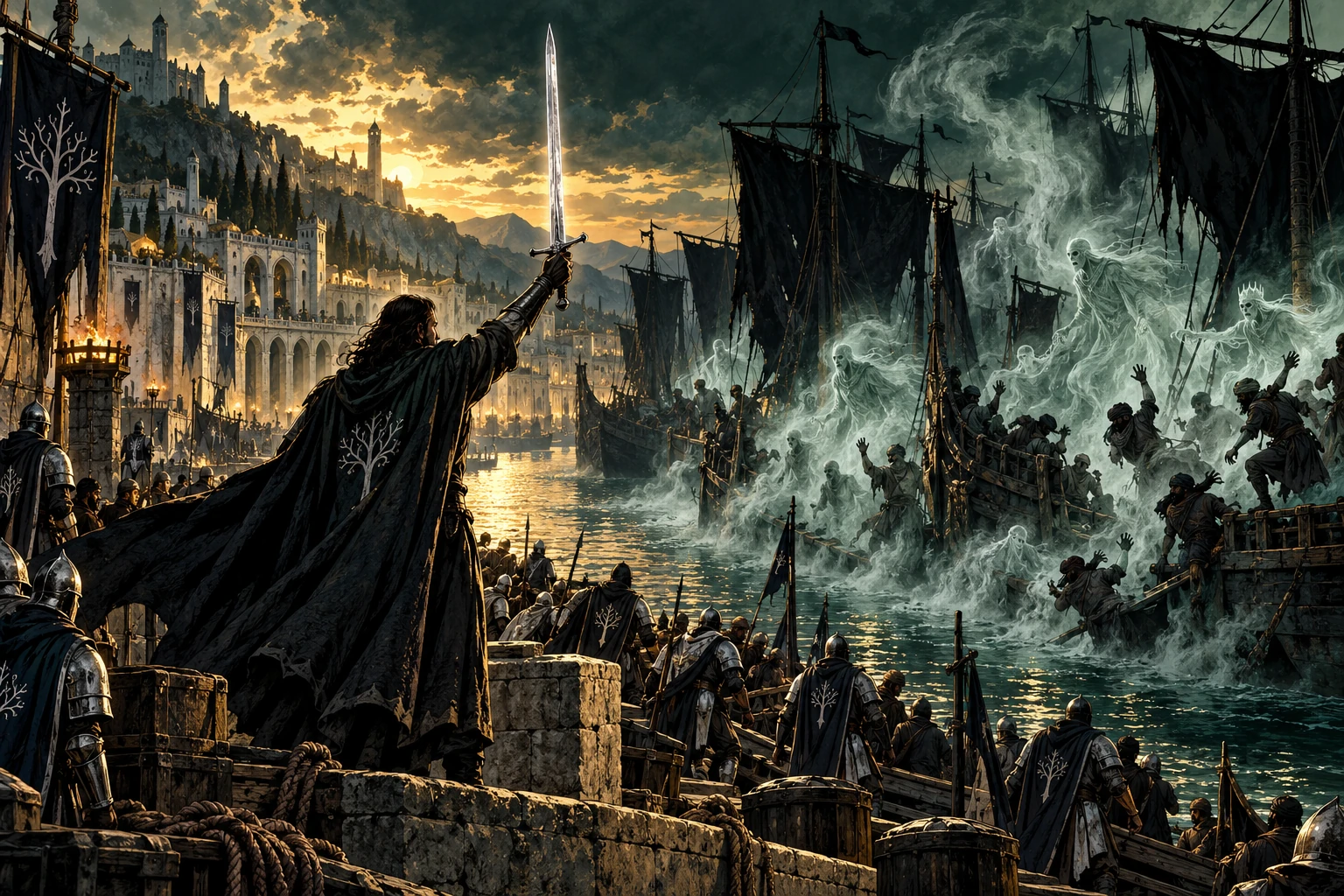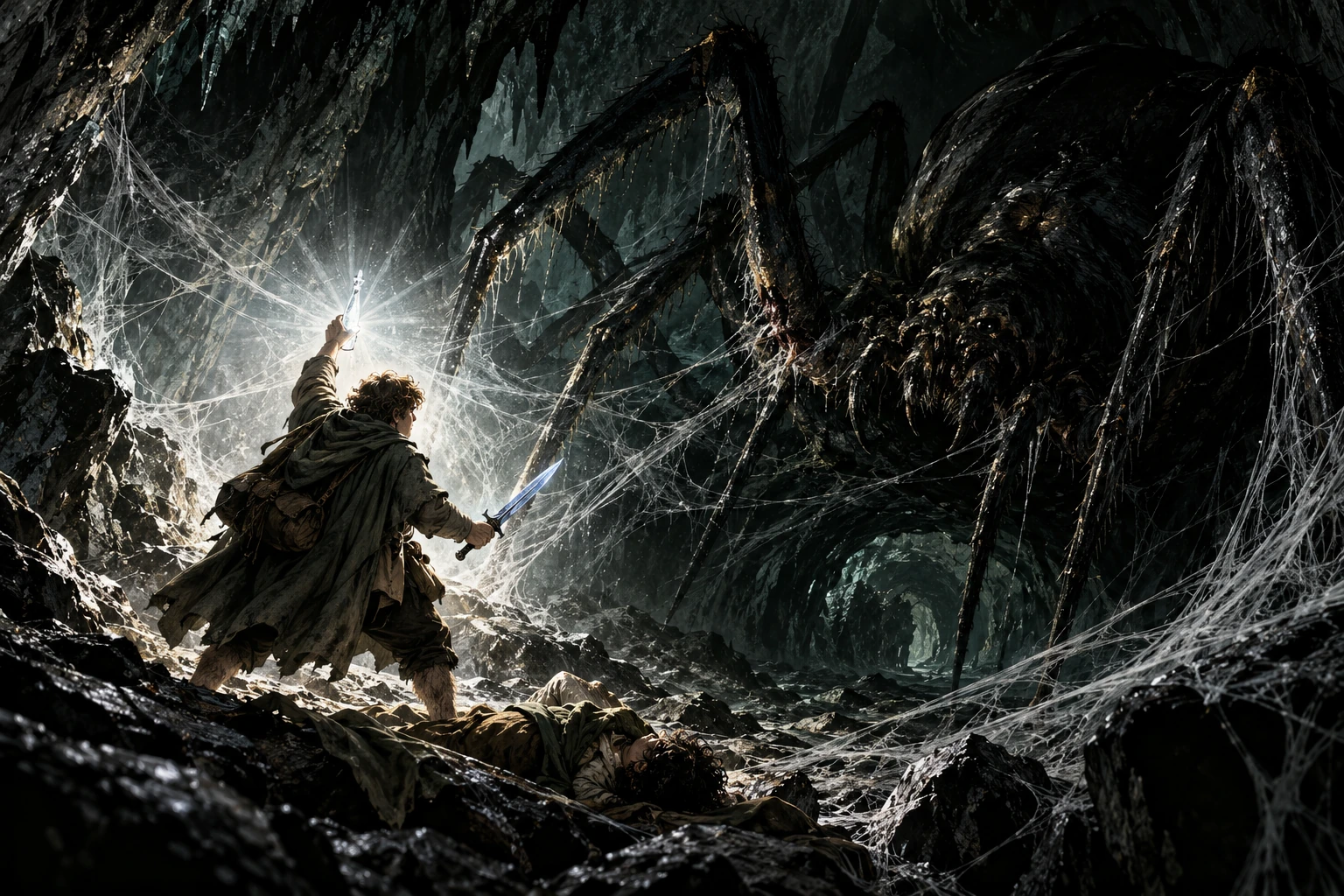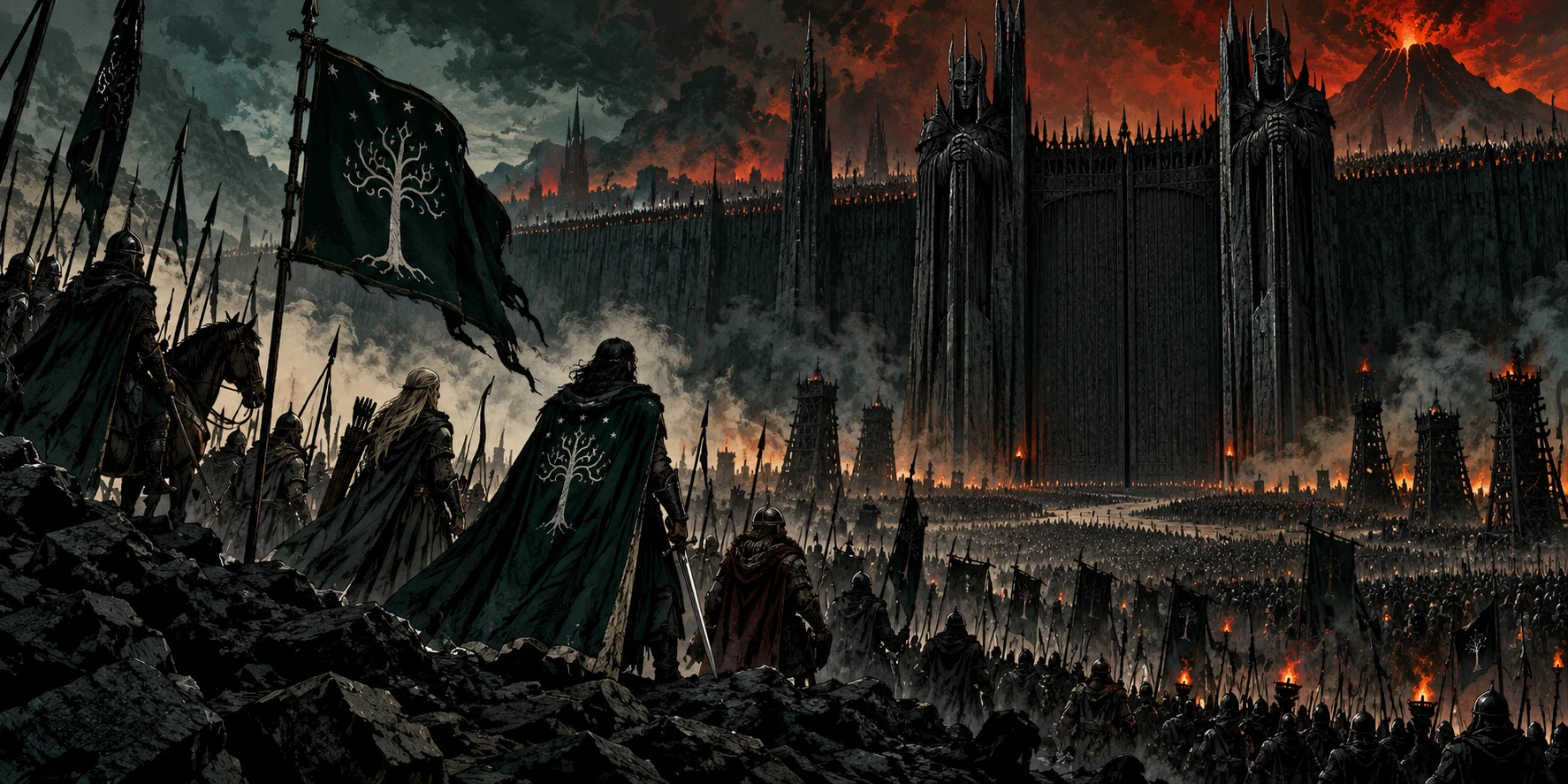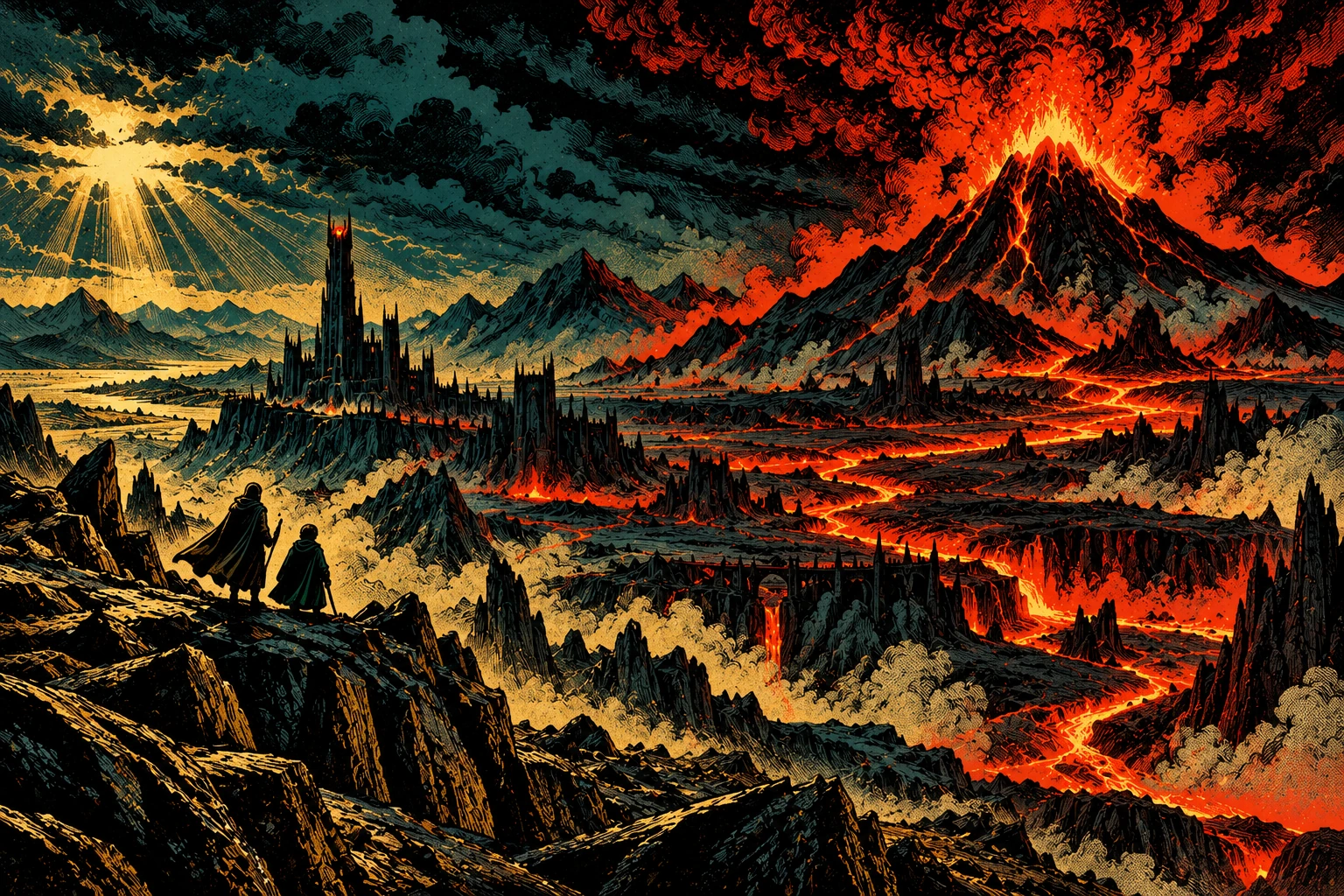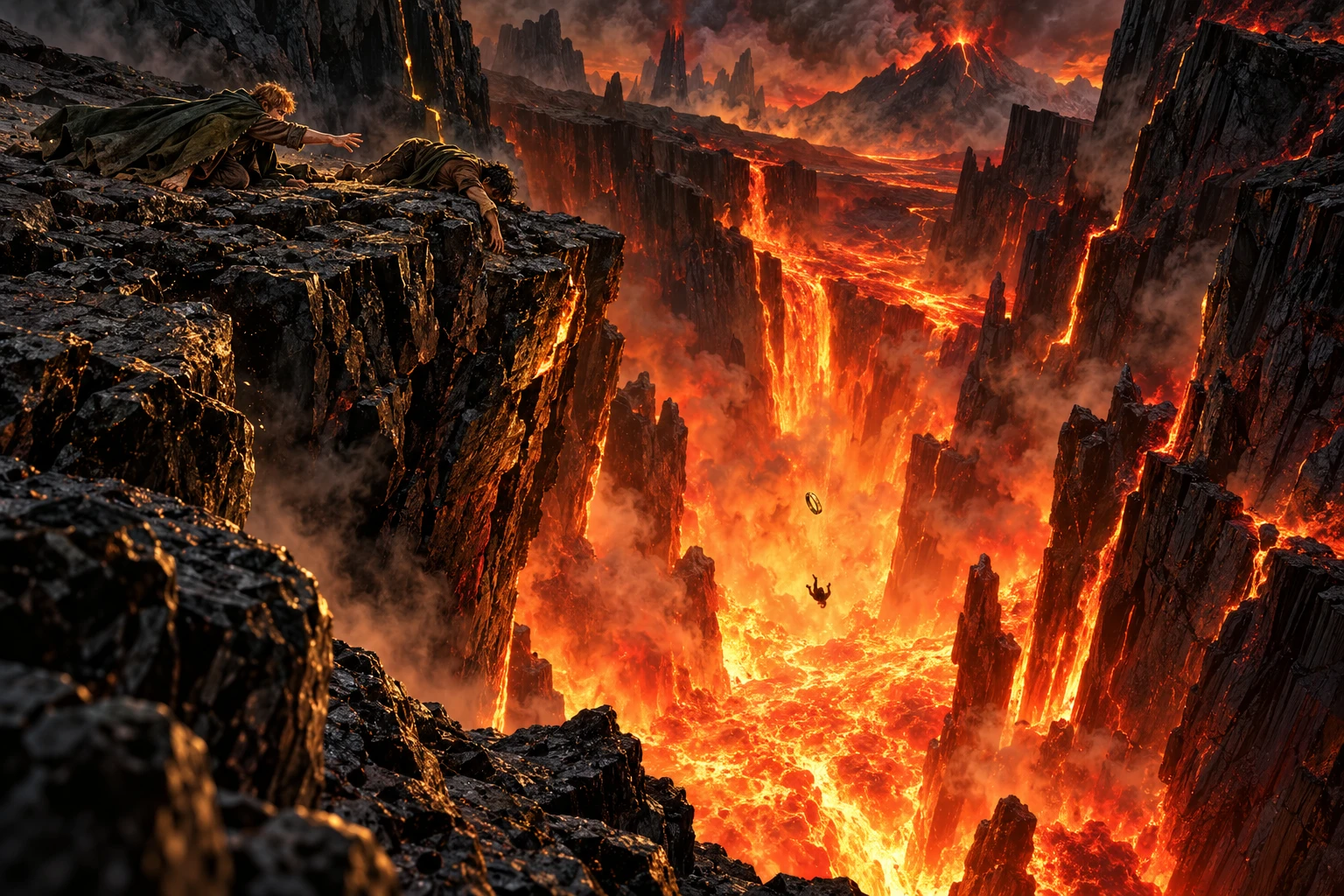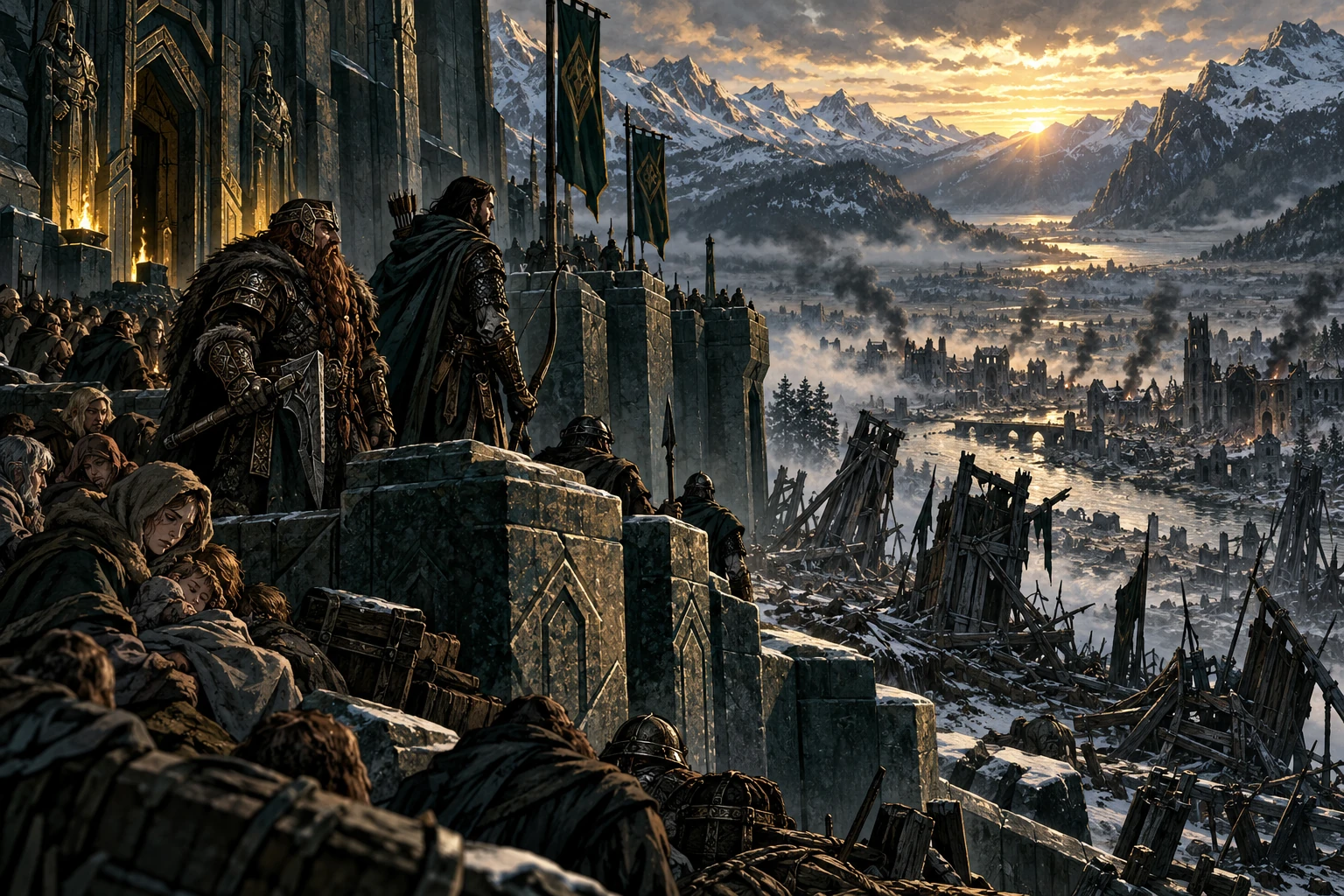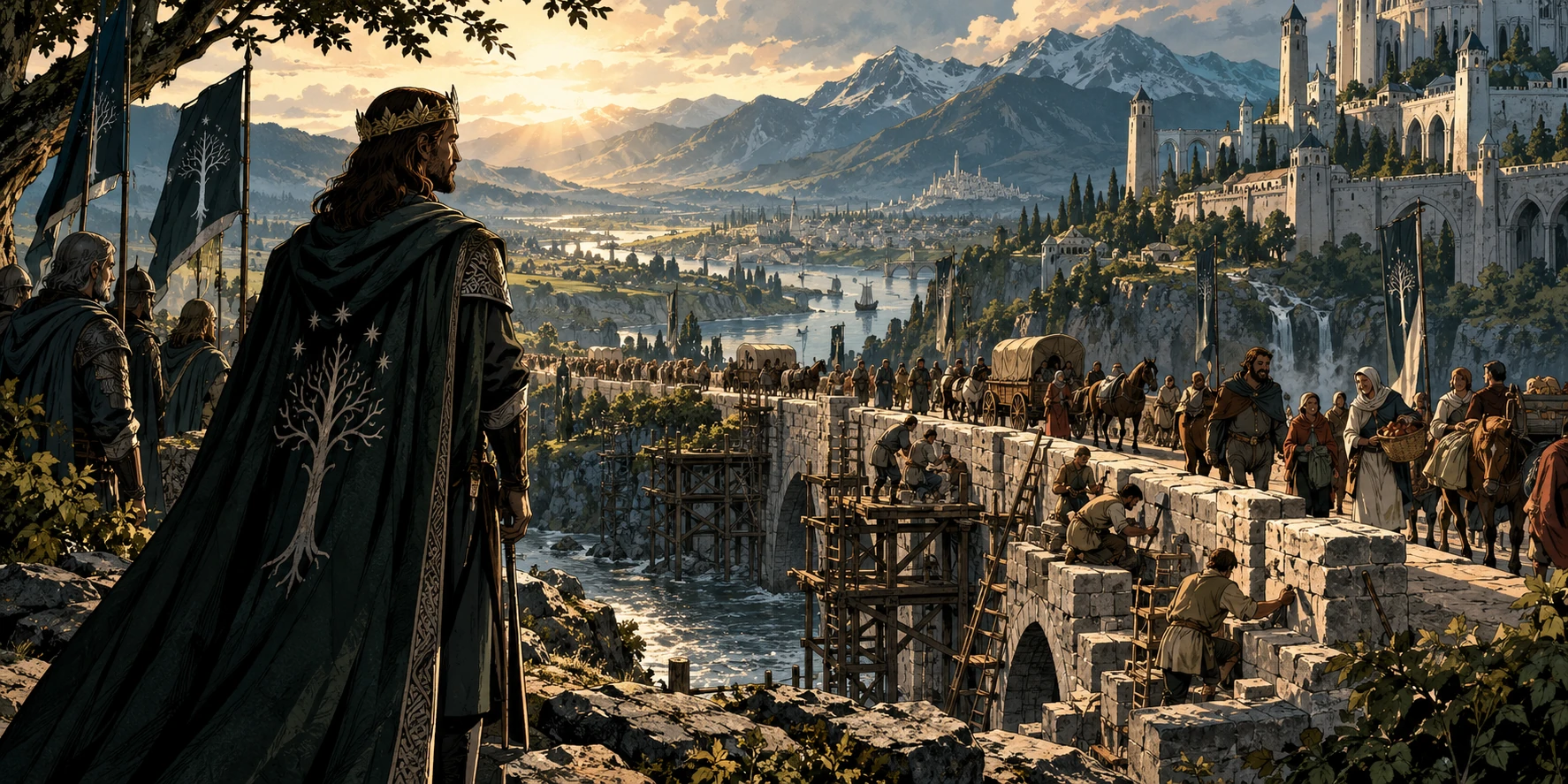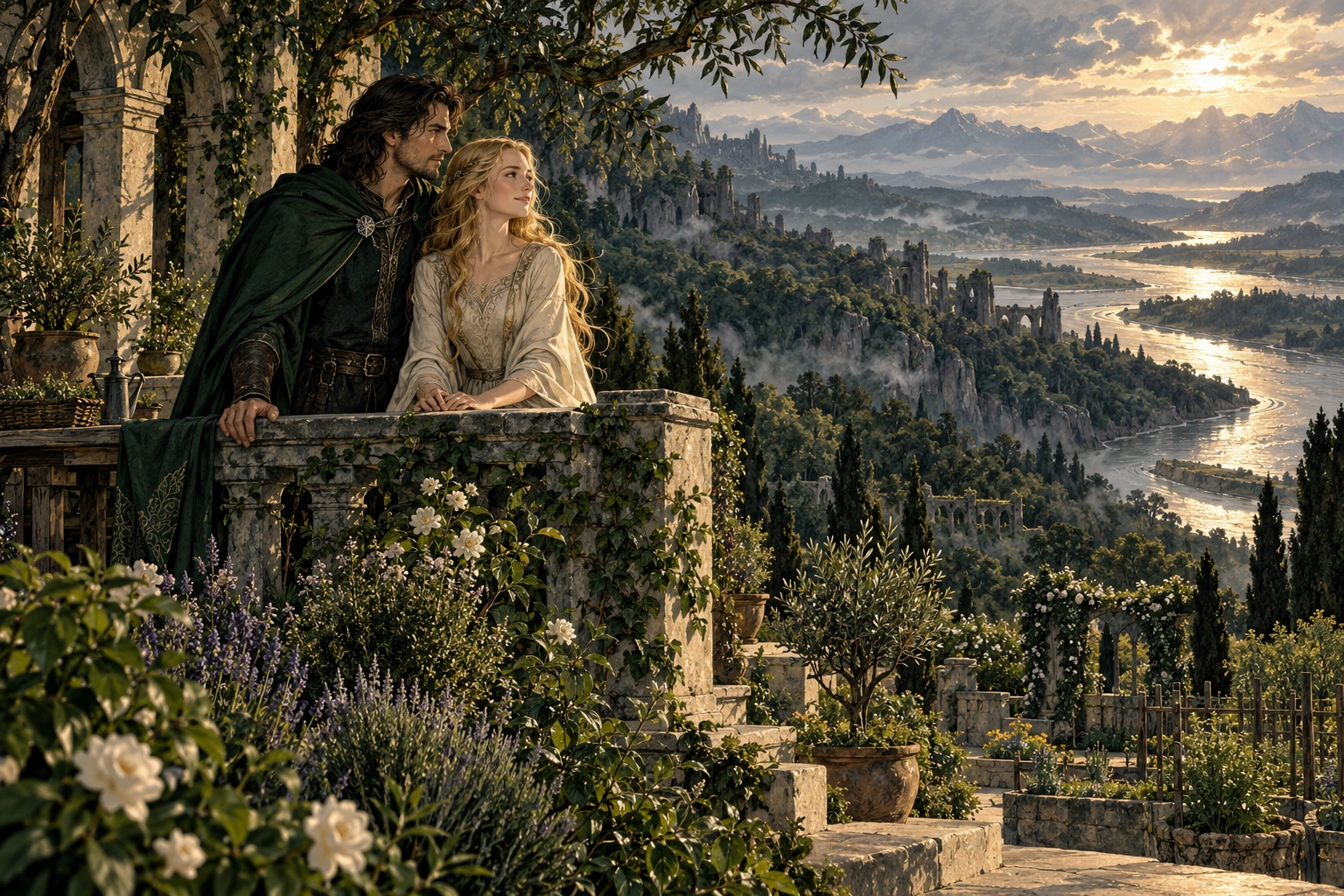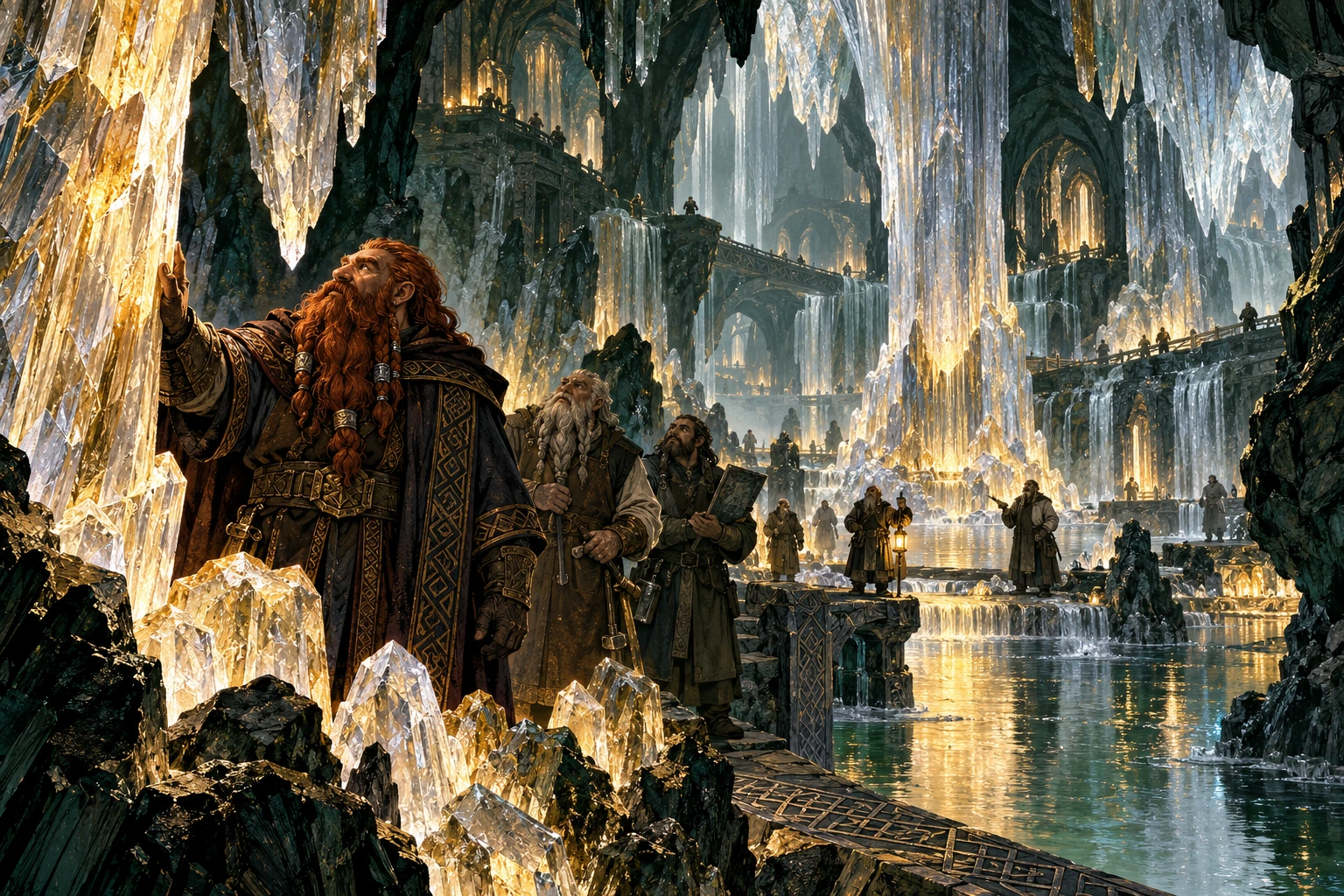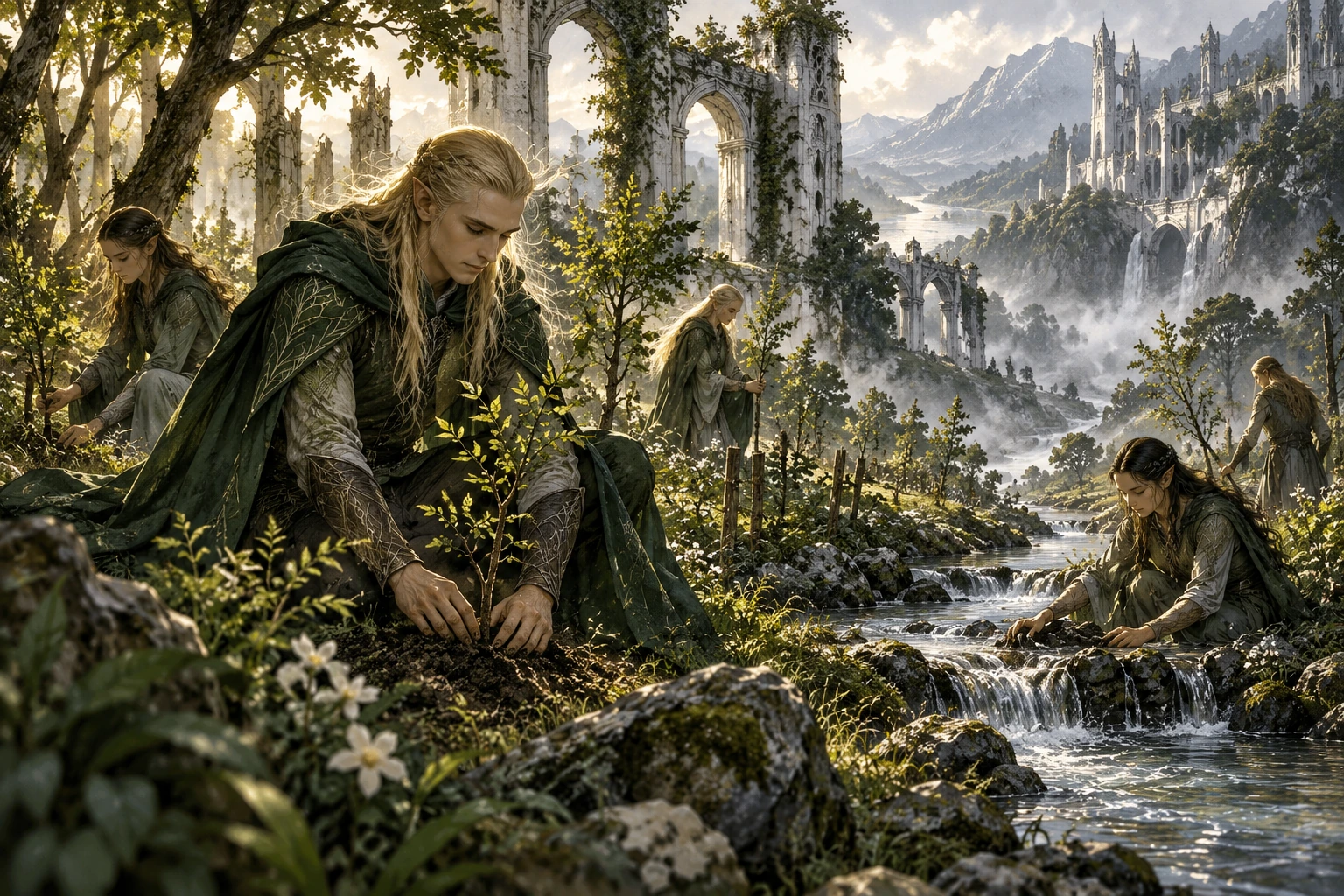

The Arda ChronicleA HISTORY OF LIGHT & SHADOW
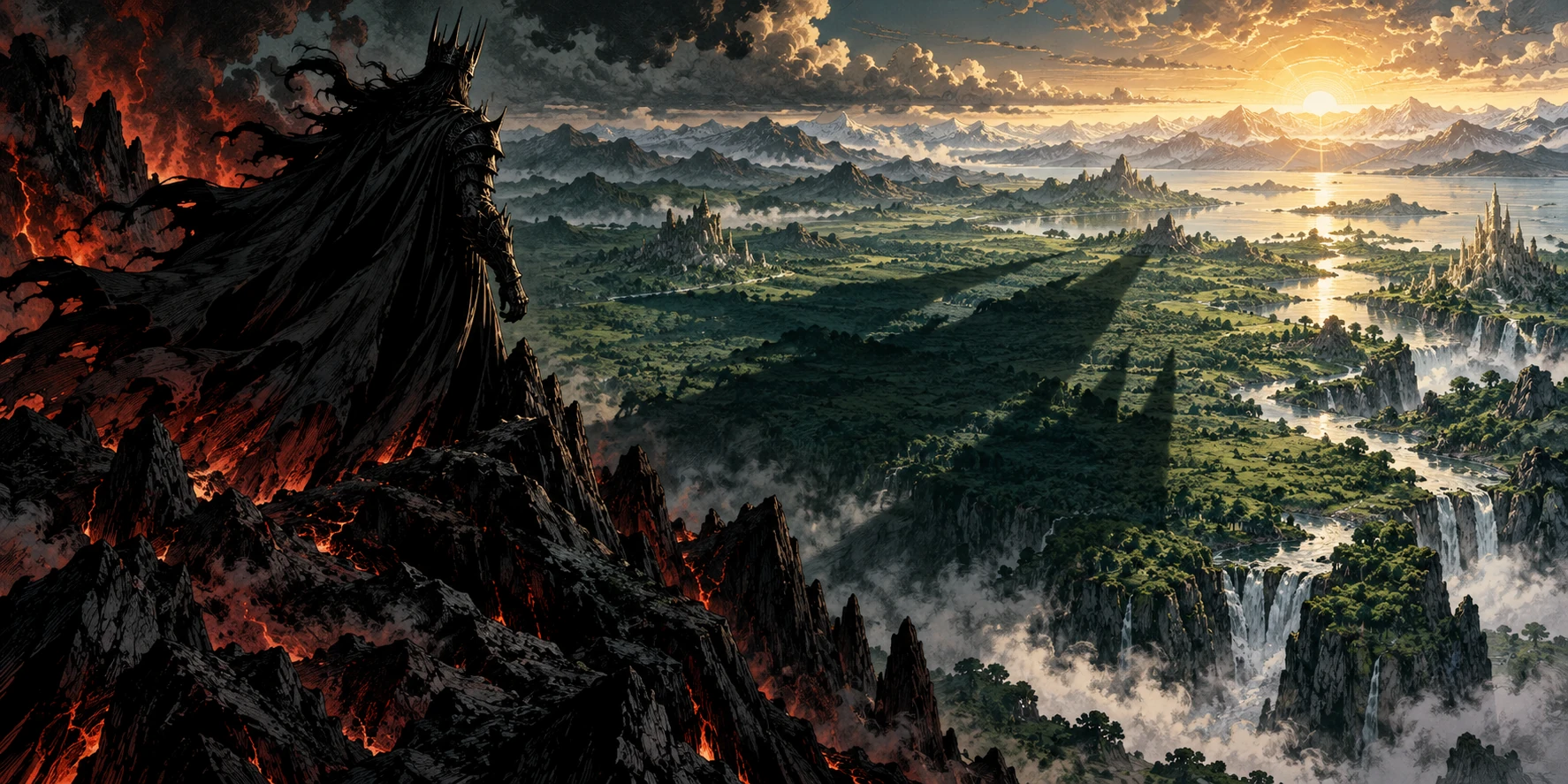
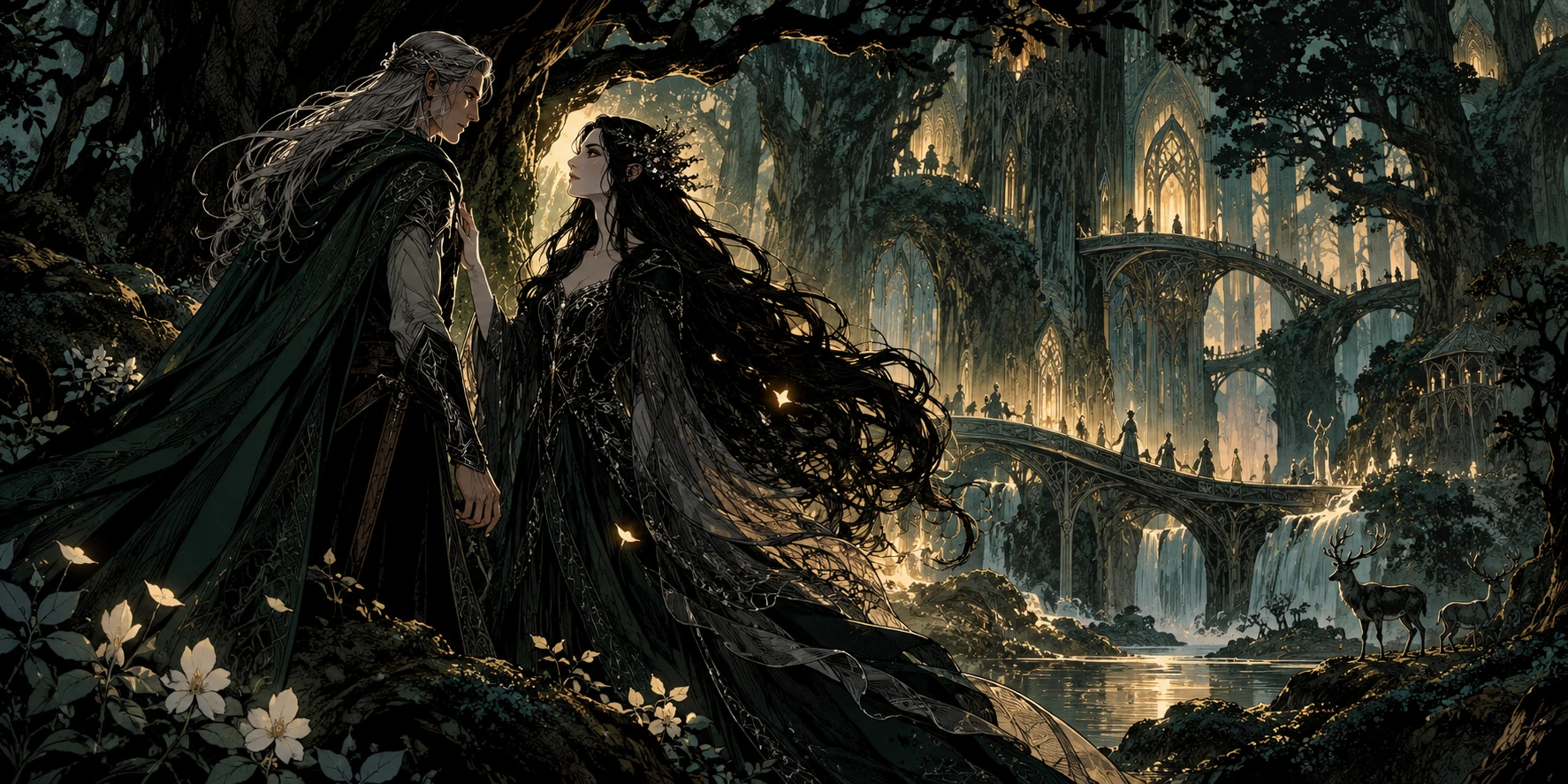
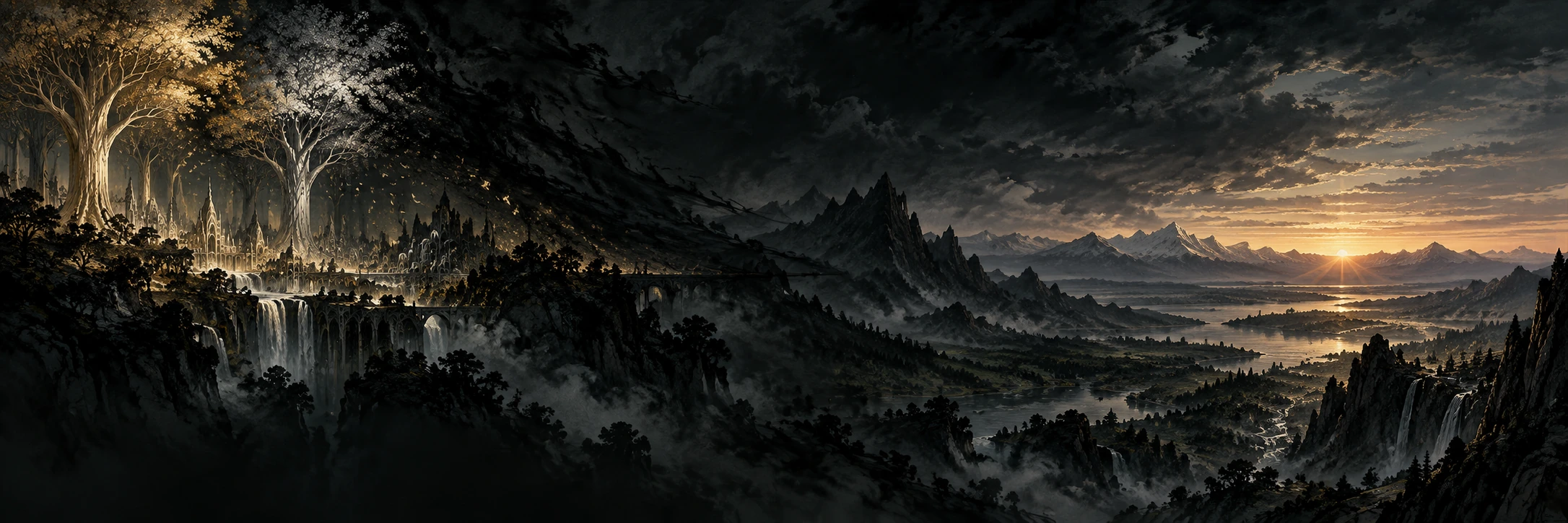
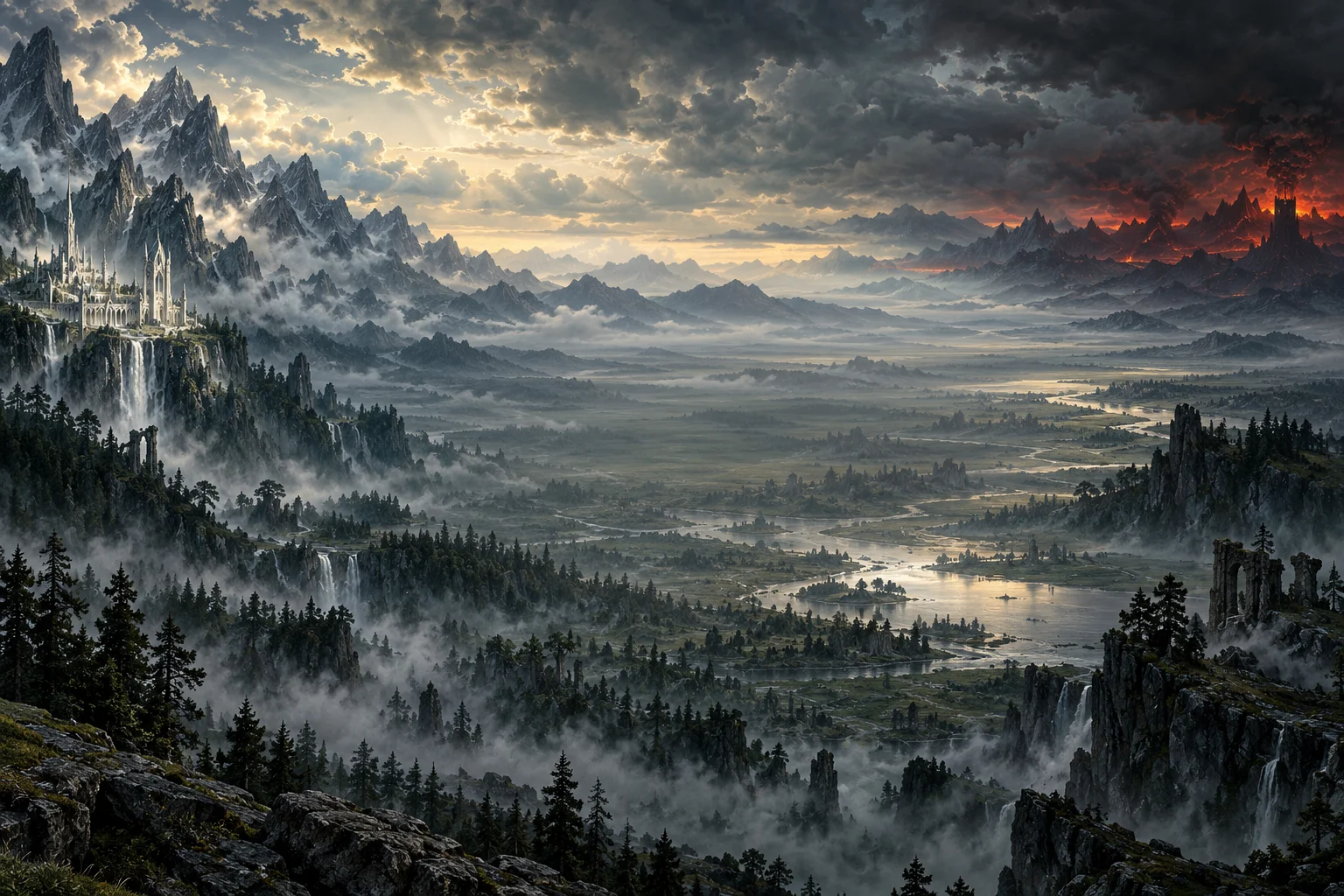
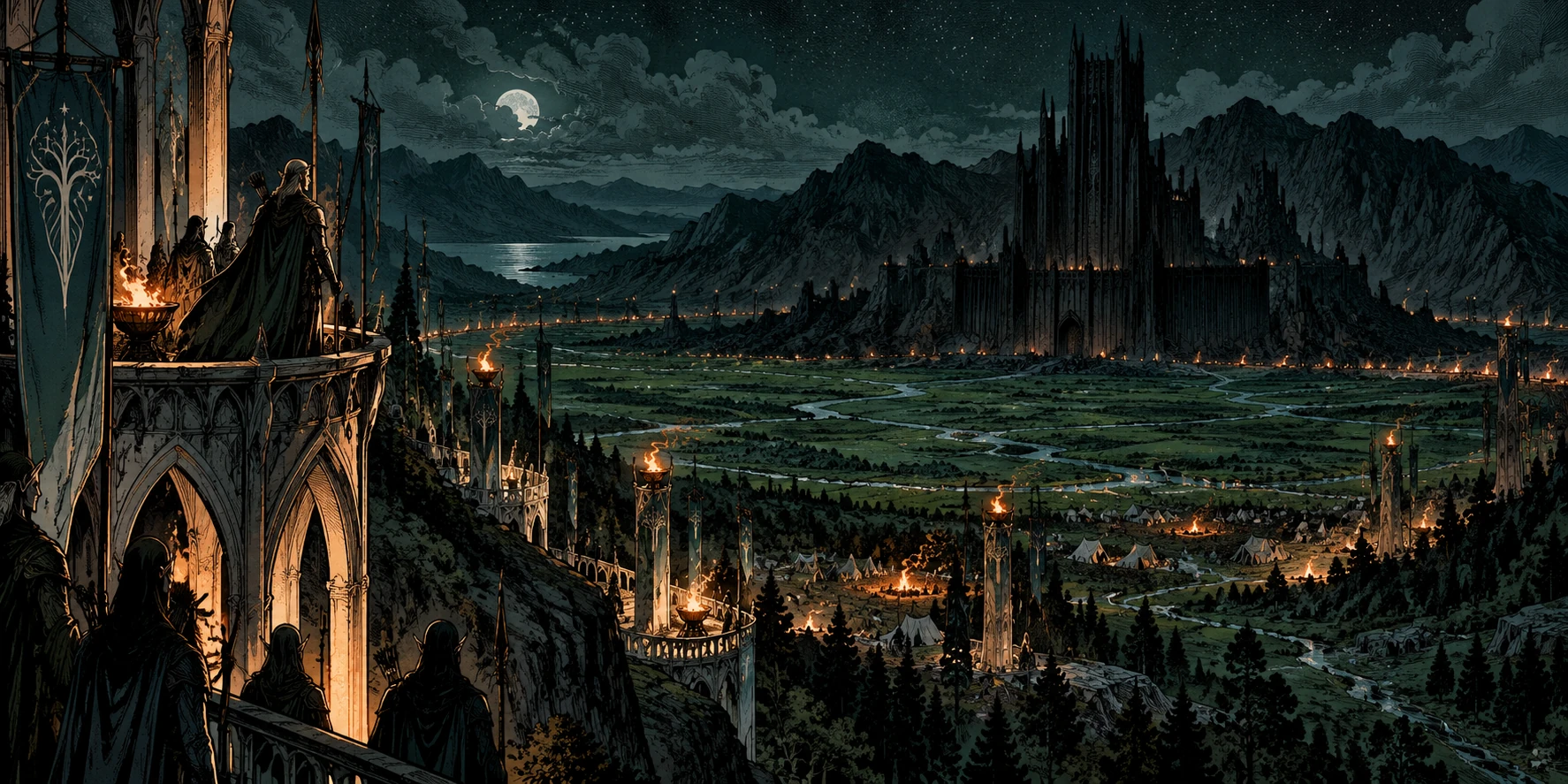
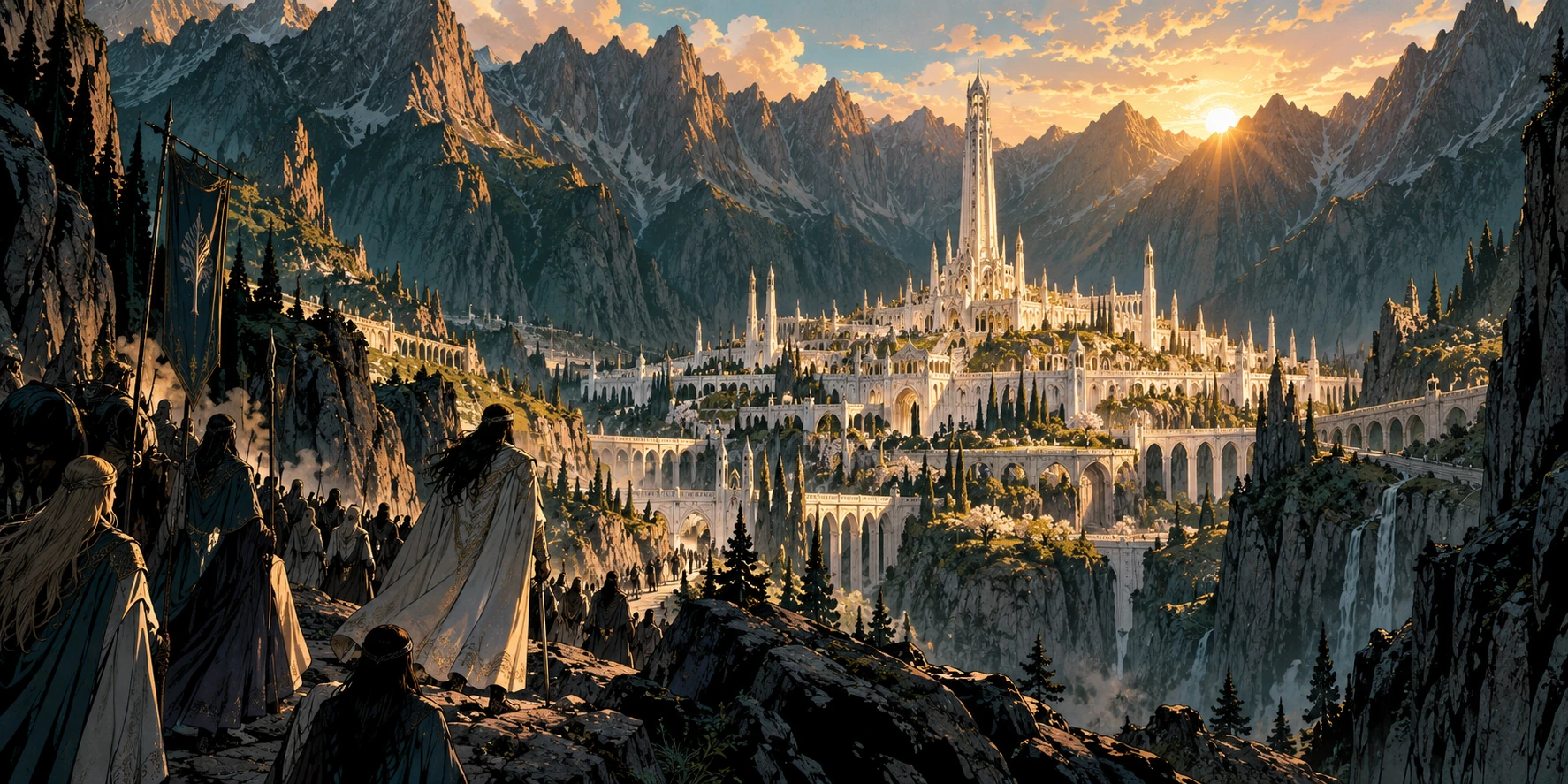
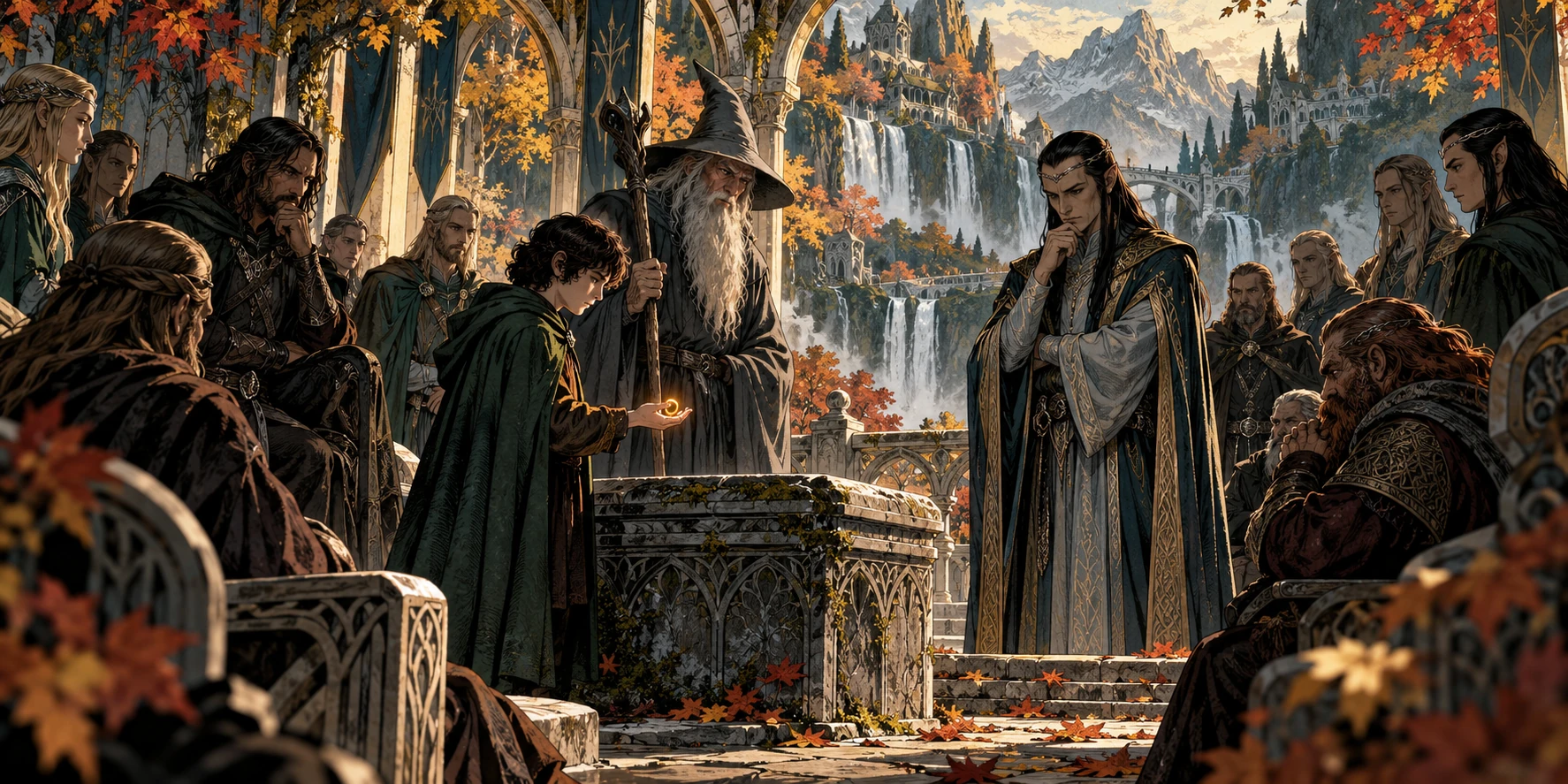
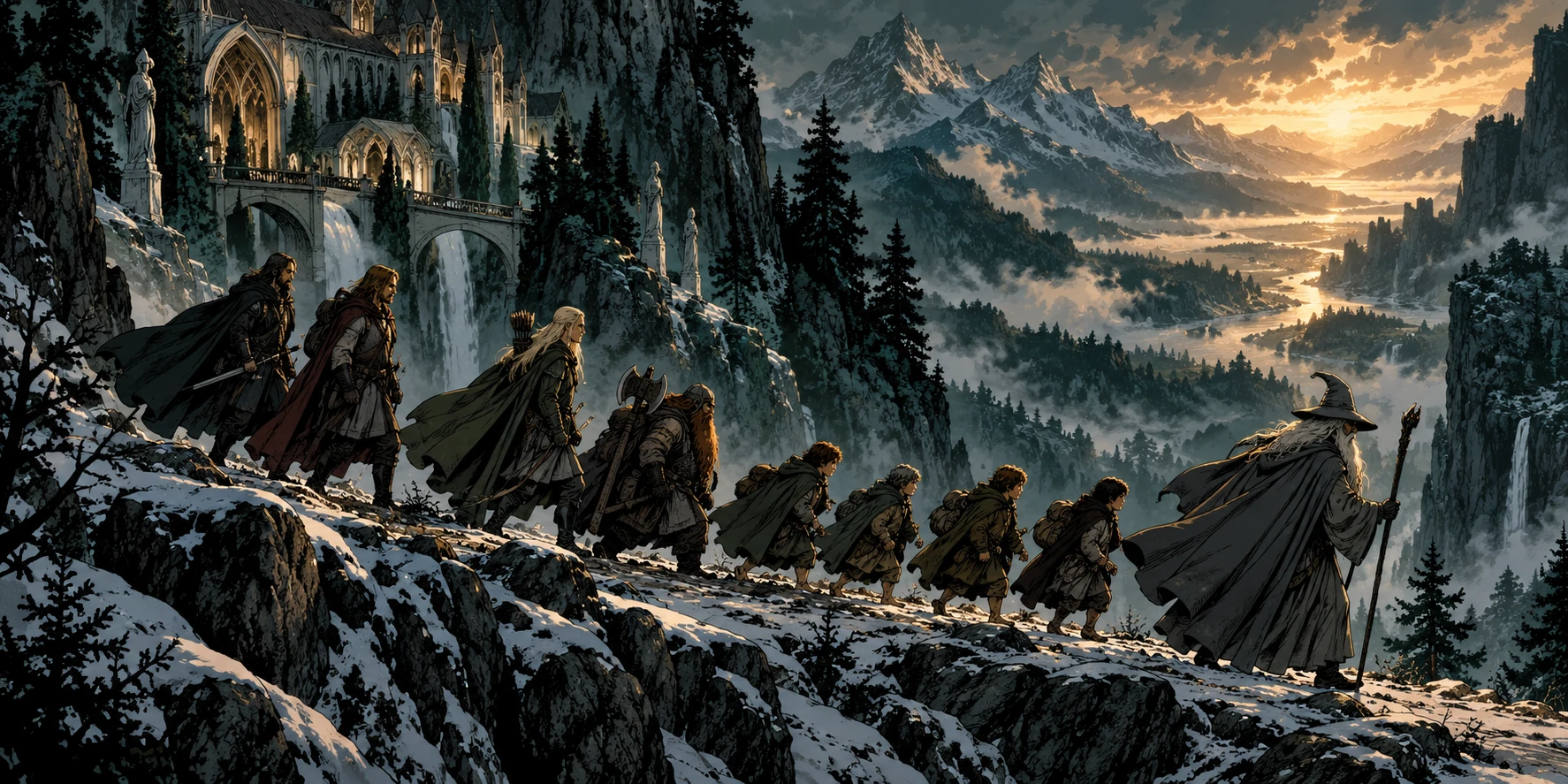
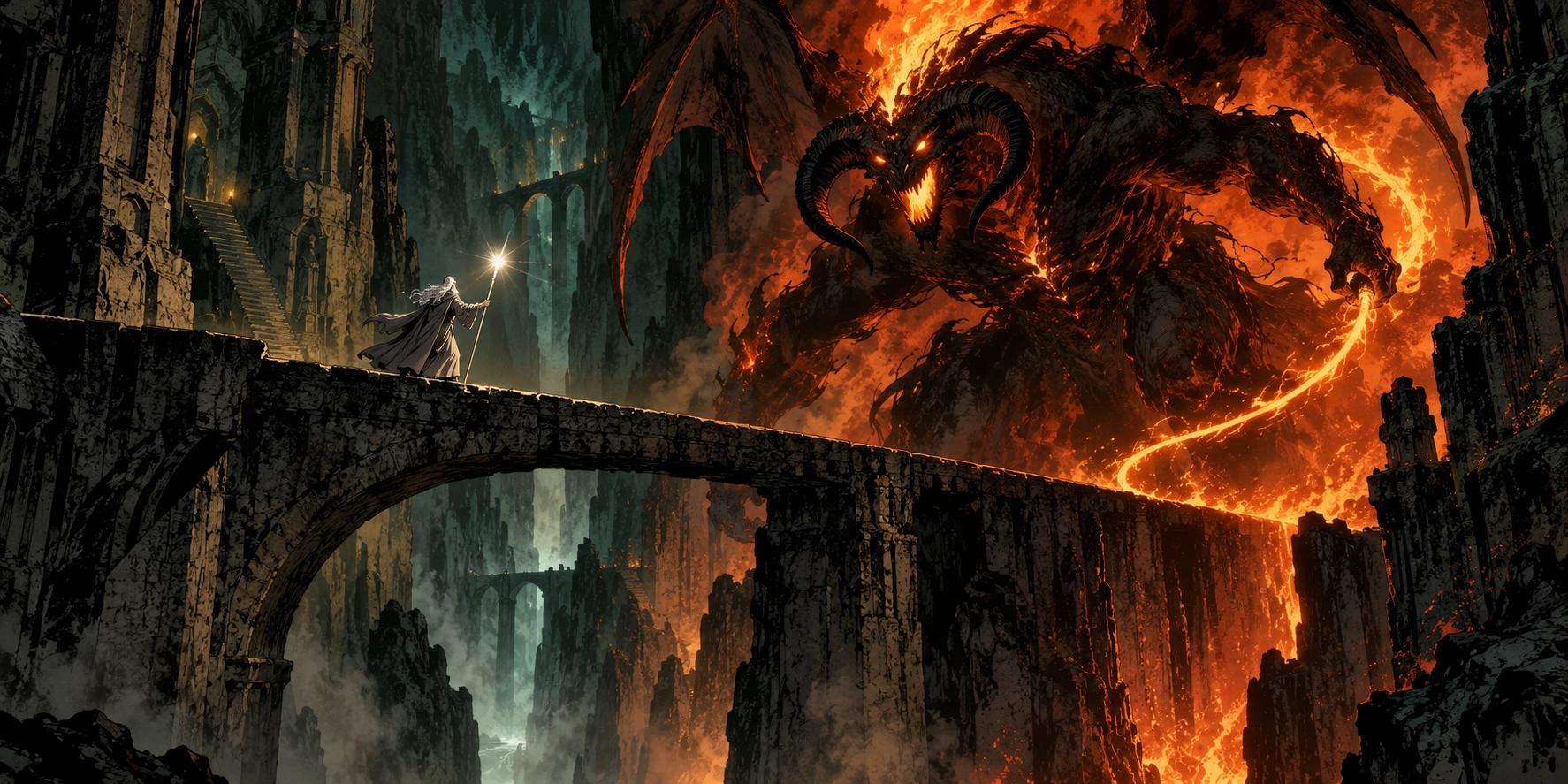
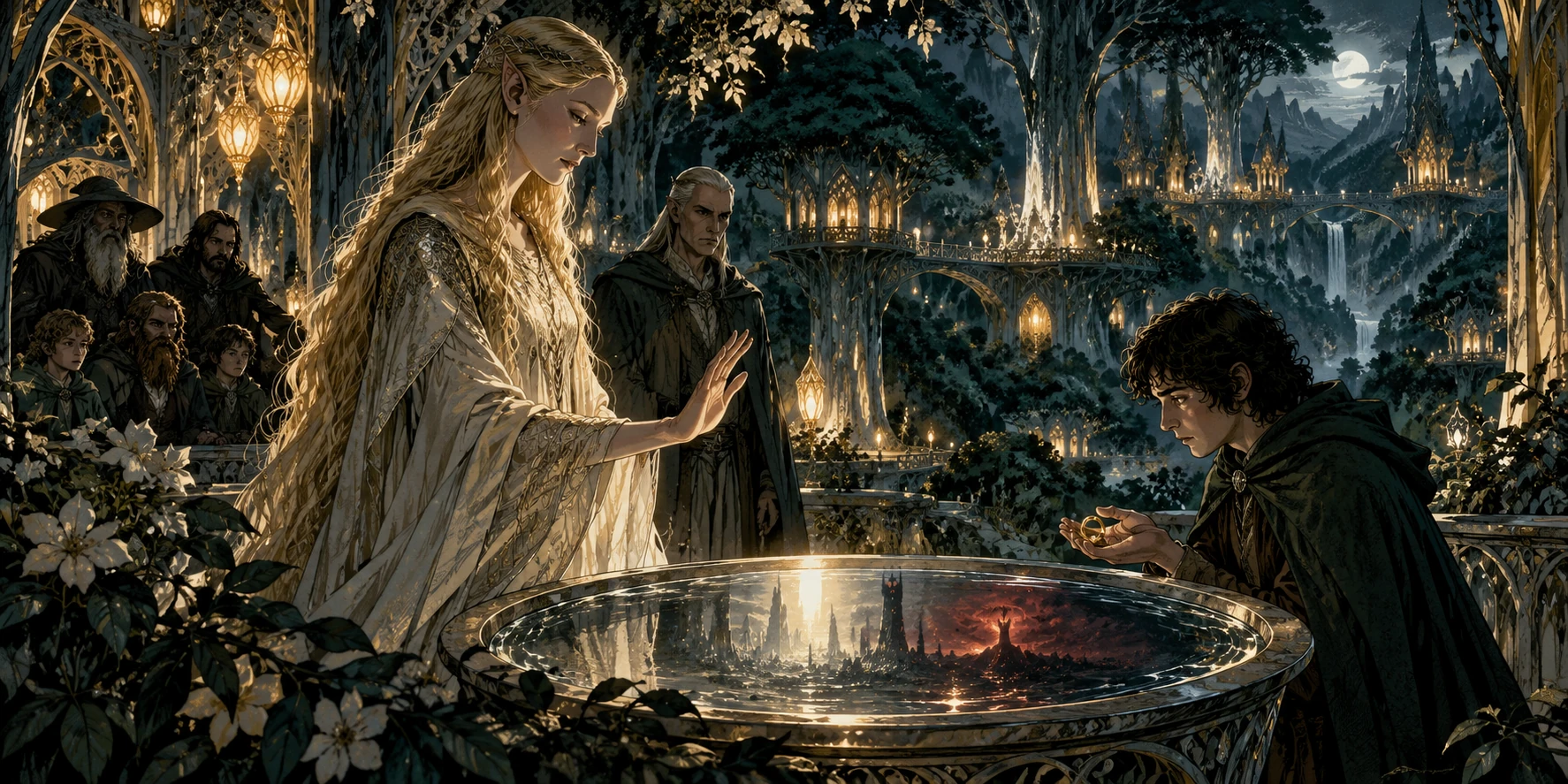
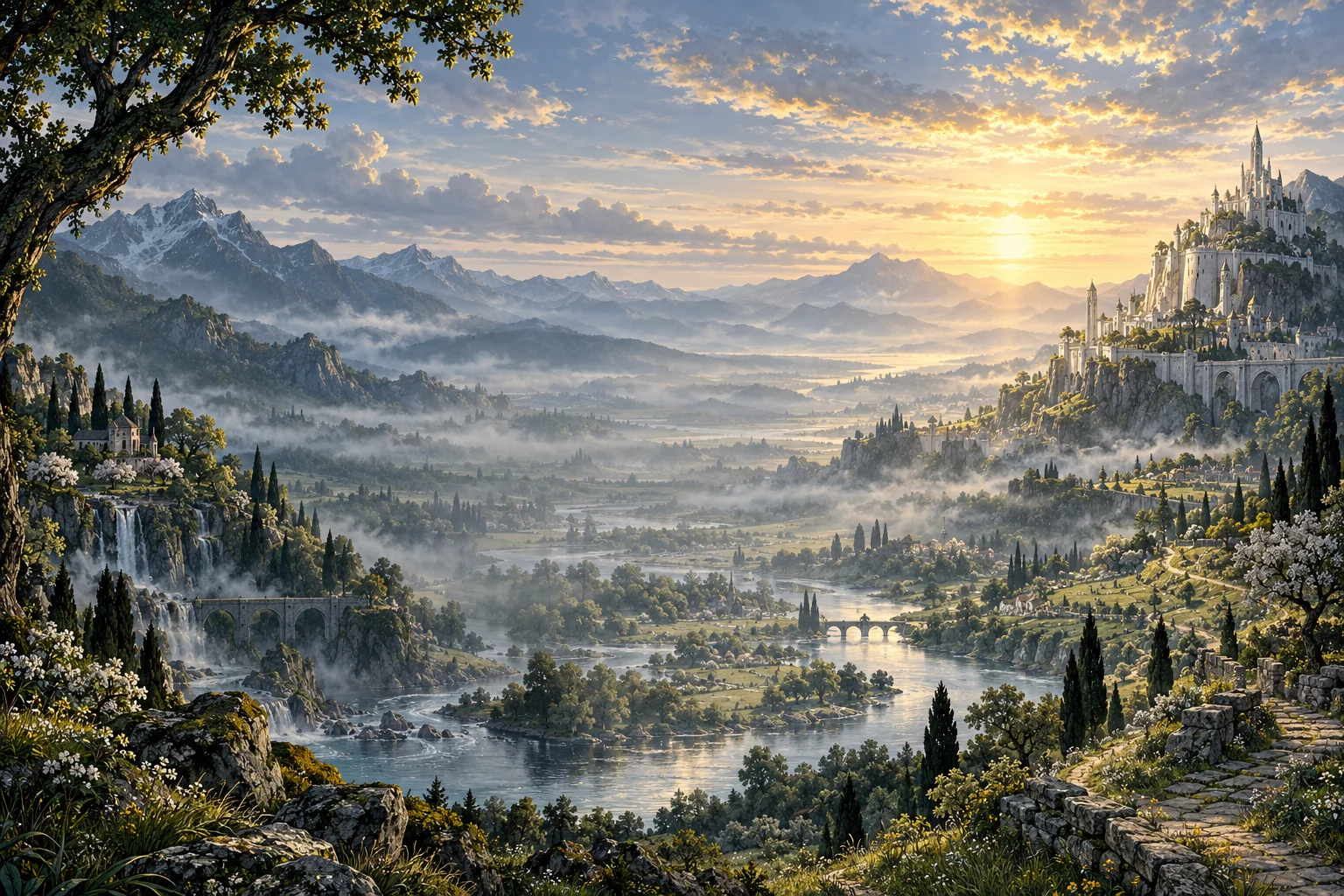
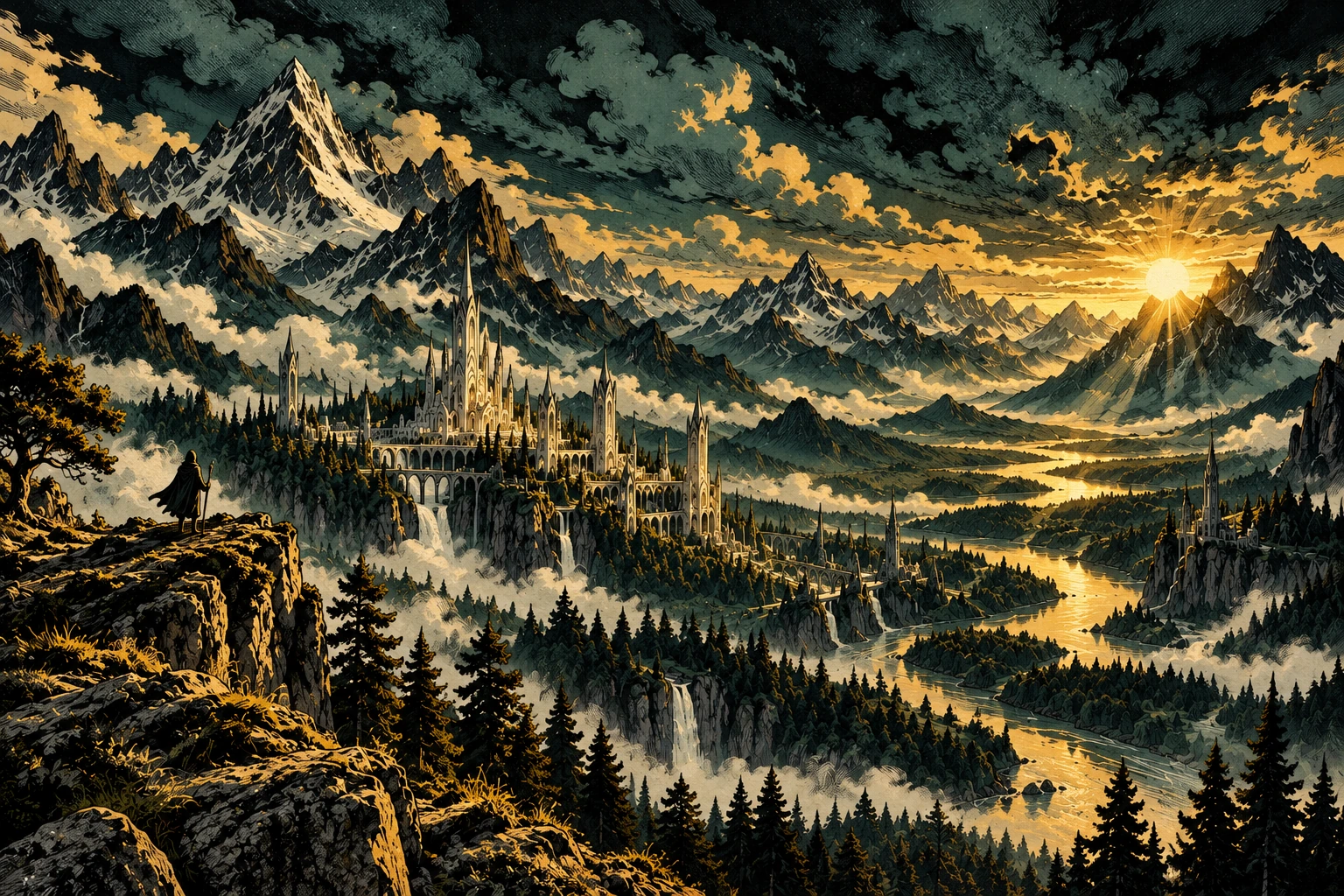
An ink-illustrated Elven citadel in a vast mountain valley
From the first song to the last ship

A chronicle ofMiddle-earth

A world shaped by longing, broken by power,
and saved by those who asked for neither.

Follow the timeline
The illustrated histories

133 moments · Five eras · One unfolding story

An illustrated atlas

Every road has a place.

Explore three richly painted maps and 76 animated journeys. Find the hidden kingdoms of Beleriand, cross the Sea to Númenor, or trace the Fellowship’s road. Open a map here—or locate any story as you read.

PROLOGUE / Before the Years of the Sun

Before the Sun

A world is sung into being. Light grows, is loved, and is stolen. The first great tragedy begins when grief becomes a claim of ownership.

The Elder Days
Where the story begins

Arda is the world of the story. The Valar are among the spirits who enter it and help give it shape. Their labours take them from Middle-earth to Aman, across the Great Sea. Melkor, one of the mightiest spirits, wants to bend what they make to his own will.

Before time
The Music of the Ainur · The creation of Arda
The creation of Arda

The Music of the Ainur

Who & where

Eru Ilúvatar is the creator, and the Ainur are the spirits he first brings into being.

Eru Ilúvatar brings forth the Ainur. Their great music foreshadows a world of beauty, sorrow, and a hope no discord can wholly overcome.

This opening is a creation story rather than a scene in an already existing country. The music gives form to a vision; Ilúvatar then brings the universe into actual being. The world contains beauty and freedom, but also the damage that comes from Melkor’s attempt to bend the shared theme toward himself. Later conflicts over kingdoms, jewels, and the Ring grow from this first conflict of purposes.

Melkor wants a music of his own. The conflict between making something beautiful and trying to own its future begins before the world itself.

Go deeper into the lore

The world is called Eä. Those of the Ainur who enter it begin the long labour of shaping Arda.
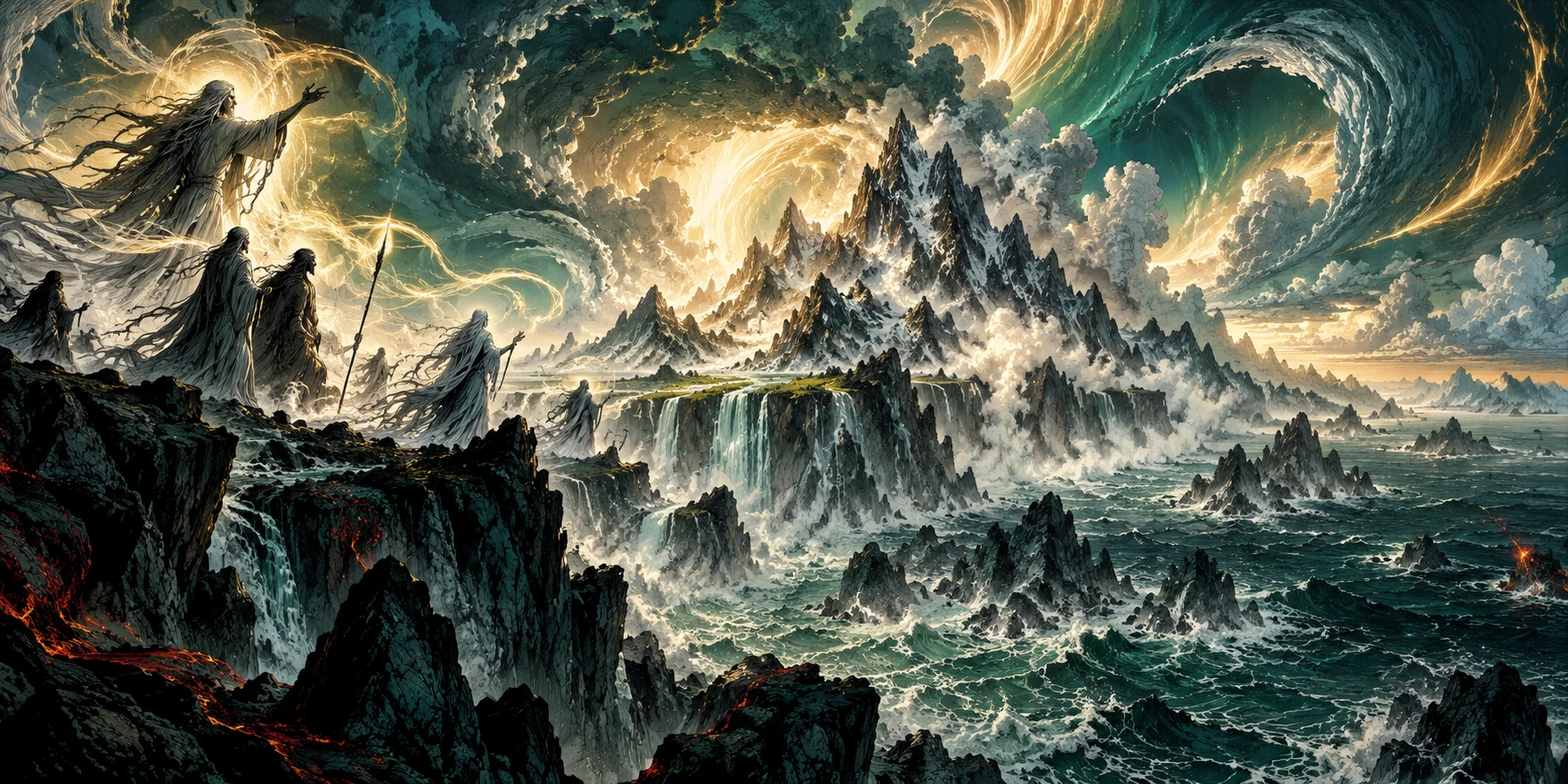
The shaping of Arda
The Powers Enter the World · The Valar & the Maiar
The Valar & the Maiar

The Powers Enter the World

Who & where

Ilúvatar is the creator. The Ainur are spirits he creates; Valar and Maiar are names for those who enter the world.

Some of the Ainur enter the world they have seen in vision. The greatest become known as the Valar; other spirits who assist them are the Maiar. They begin shaping land, sea, air, and living things.

Arda is the world as a whole. Middle-earth is one region within it, not the name of the entire universe. The Valar are powerful created beings, not rival creators equal to Ilúvatar. Their work is to bring the vision into being, but Melkor wants the world to answer to him.

This distinction explains why later figures as different as Gandalf, Sauron, and the Balrogs can share a spiritual origin without sharing a purpose.

What is the difference between the Ainur, the Valar, and the Maiar?

The Ainur are spirits created by Eru. Among those who enter the world, the greatest are called the Valar. Other spirits of the same order, called Maiar, include Melian, Sauron, and the spirits who later come as Wizards.

Before the Elves
Melkor & the First Shadow · Melkor · later called Morgoth
Melkor · later called Morgoth

Melkor & the First Shadow

Who & where

Morgoth means the Black Enemy; it is the name Fëanor later gives to Melkor.

Melkor, greatest in native power among the Ainur, disrupts the work of the others. His desire to create independently turns into a need to possess and spoil what he cannot truly originate.

Melkor is the first Dark Lord. Sauron, the villain familiar from The Lord of the Rings, begins as his servant and is a lesser spirit. Many of the horrors of later ages are remnants of this first rebellion, including the Balrogs: spirits corrupted into beings of terror and flame.

The story will repeatedly distinguish creation from domination. Making a beautiful thing does not give anyone a right to control every life touched by it.

Before the Trees
The Lamps of the Valar · Arda before the Sun
Arda before the Sun

The Lamps of the Valar

Who & where

Melkor is the first Dark Lord; the Valar are the powers trying to shape a habitable world.

Illuin and Ormal illuminate the young world. Melkor breaks the great Lamps, ending the first ordered spring of Arda and leaving the Valar to withdraw into the West.

The Lamps are immense lights raised to illuminate the young world before the Two Trees and before the Sun. Their destruction breaks an early arrangement of the lands. The withdrawal of the Valar into Aman, the western continent, creates the separation between the Blessed Realm and Middle-earth that later voyages will try to cross.

The first great light is destroyed, but creation continues. The Valar make a new home in the West, leaving a growing distance between their realm and Middle-earth.

Go deeper into the lore

The destruction transforms the shape of the lands. Valinor becomes the dwelling of the Valar, while Middle-earth lies beneath the stars.

Years of the Trees
The Light of the Two Trees · Valinor
Valinor

The Light of the Two Trees

Who & where

Telperion is the silver Tree; Laurelin is the golden Tree. Both grow in Valinor in the West.

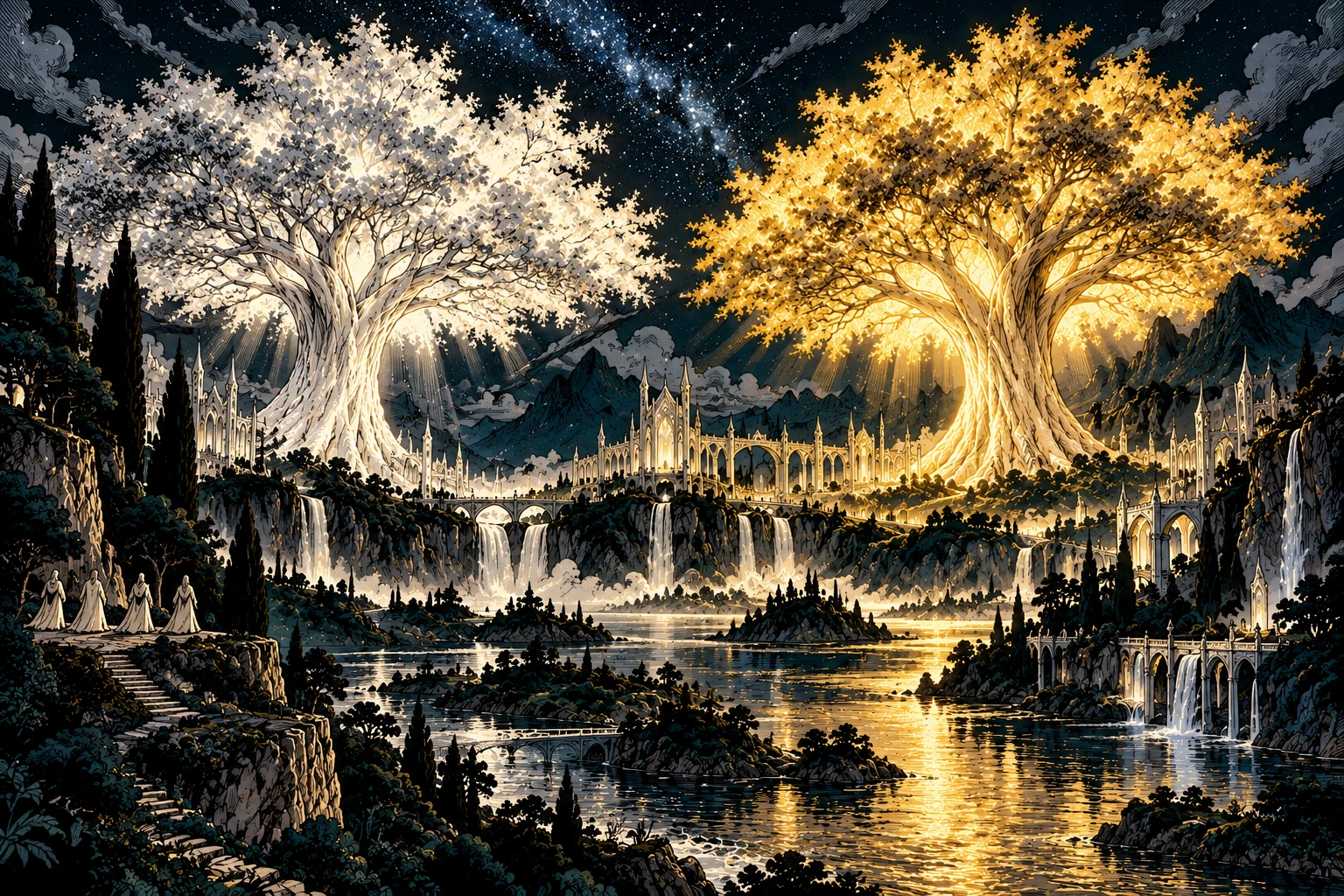
In Valinor, Telperion and Laurelin flower in silver and gold. Their mingling light measures the days of the Blessed Realm.

The Trees illuminate the realm where many Elves come to dwell, while Middle-earth remains beneath the stars. Fëanor, a brilliant and proud Elven craftsman, later preserves their mingled light in the Silmarils. To understand the wars of the First Age, it matters that the jewels contain something that can no longer be replaced after the Trees die.

Their light will outlive the Trees in the Silmarils. That survival turns a lost beauty into the most fiercely contested treasure of the First Age.

Why this matters Follow the consequences
Light becomes an inheritance

Fëanor preserves the Trees’ light in three jewels. When that light is lost, the jewels become both a surviving wonder and the object of a disastrous struggle.

Continue to The Silmarils & the Exile
Years of the Trees
Aulë & the Seven Fathers · The origins of the Dwarves
The origins of the Dwarves

Aulë & the Seven Fathers

Who & where

Aulë is the Vala associated with making and craftsmanship. The Dwarves remember him as their Maker.

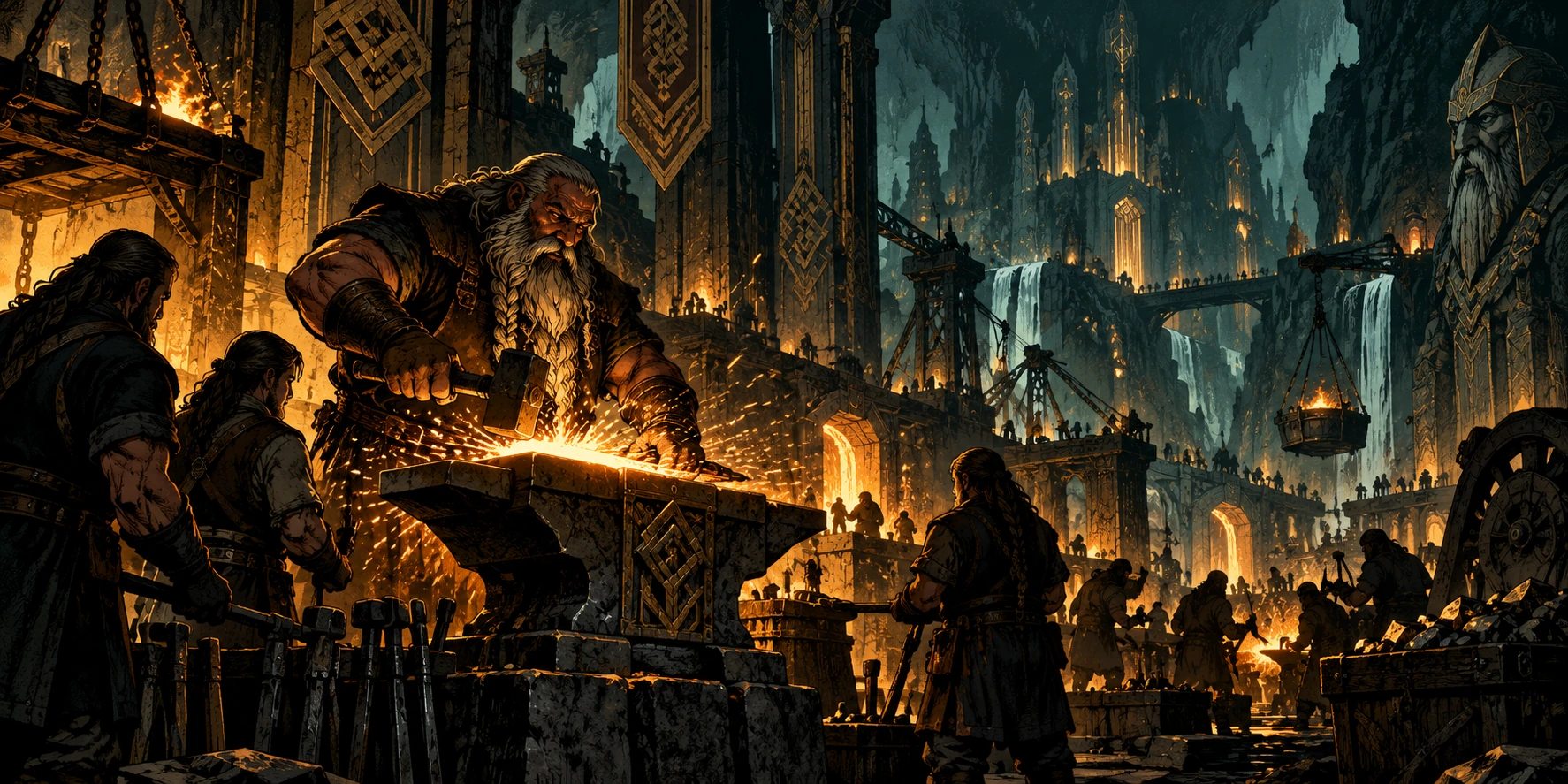
Impatient for the coming of the Children, Aulë makes the Dwarves beneath the mountains. Ilúvatar grants them independent life, but bids them sleep until after the Elves awaken.

Aulë can shape bodies, but independent life is Ilúvatar’s gift. When confronted, he is willing to undo what he has made rather than claim authority he does not possess. The Dwarves are accepted as adopted children and sleep until after the Elves awaken. Their origins explain both their affinity with stone and craft and their distinct place among the peoples of Middle-earth.

Aulë is willing to surrender his work rather than defy its true Creator. His humility offers an early answer to the possessiveness that will ruin so many others.

Go deeper into the lore

The Dwarves remember Aulë as Mahal, their Maker. Their endurance and love of craft become a lasting force in the histories of the mountains.

Before the Children awaken · a promise
The living world · the promise of the Ents · Yavanna’s Plea for the Forests
The living world · the promise of the Ents

Yavanna’s Plea for the Forests

Who & where

Yavanna is the Vala who cares for growing things. Aulë, her husband, loves craft; Manwë is chief among the Valar.

Hearing of the Dwarves, Yavanna fears for trees that cannot flee the axe. She asks that living things should have defenders of their own. Through Manwë comes the assurance that shepherds of the trees will awaken.

This is the ancient promise behind the Ents, not a claim that Treebeard is already walking through a precisely dated forest. They will be living people with judgement, speech, and their own concerns. The great Eagles are also associated with Manwë’s care and watchfulness. Much later, Saruman will treat trees as fuel and the Ents will answer him. Their resistance belongs to a world with a history beyond the quarrels of its kings.

The forest that rises against Isengard is fulfilling an old concern: who will speak for lives that power treats as raw material?

Before the First Awakening
Varda Kindles the Heavens · Varda · the Star-kindler
Varda · the Star-kindler

Varda Kindles the Heavens

Who & where

A Vala is one of the great powers shaping Arda. Varda is also praised by the Elves as Elbereth.
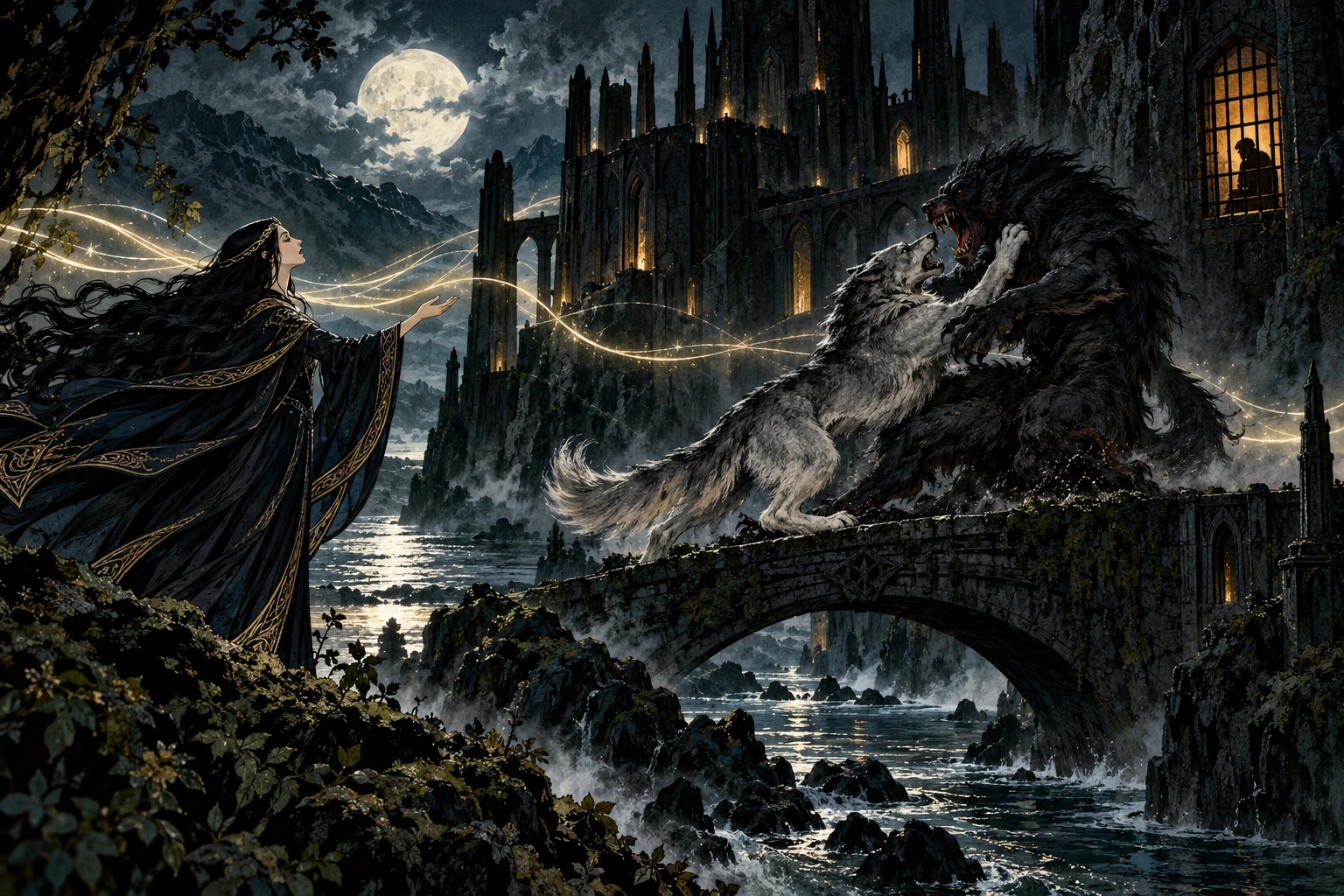
Varda, the Vala associated with the stars, sets greater lights in the sky before the Elves awaken. Their first experience of the world will be beneath those stars, not beneath the Sun.

The First Age begins with the awakening of the Elves, long before the numbered Years of the Sun used in much of this timeline. The Years of the Trees measure events in the West, while Middle-earth remains under starlight. These overlapping systems are why the earliest chronology cannot be read like a modern calendar.

The Elves’ love of starlight is an inherited memory of the world as they first encountered it.

Under the stars
The Awakening of the Elves · Cuiviénen
Cuiviénen

The Awakening of the Elves

Who & where

The Elves are the first of the Children of Ilúvatar to awaken. Cuiviénen is their eastern place of origin.

Beside the waters of Cuiviénen, the first Elves awaken beneath the stars. Their long journey will bind them to the fate of the world.

Elves do not age and die as humans do, although they can be slain and can suffer profound grief. Their lives remain bound to the world and its history. The Valar’s invitation to the West will give some of them direct knowledge of Valinor, while others choose or come to remain in Middle-earth. Those different experiences shape later Elven cultures. Oromë discovers them, but Melkor has already spread fear. To protect the newly awakened people, the Valar make war on his northern fortress of Utumno, capture him, and bring him bound to Aman. His imprisonment makes the great westward invitation possible. It is a first defeat, long before his final expulsion at the end of the First Age.

The Elves first see the world by starlight, and remember that beauty long afterward. Their awakening also draws the attention of powers who would protect them—or dominate them.

The Great Journey
The Sundering of the Elves · Vanyar · Noldor · Teleri
Vanyar · Noldor · Teleri

The Sundering of the Elves

Who & where

Oromë is the Vala who discovers the Elves. The Vanyar, Noldor, and Teleri are major groups among those who begin the journey west.

Oromë summons the Elves westward. Some remain, some pause along the road, and others cross the sea: distance and choice give rise to the many Elven kindreds.

The invitation produces several partings, not a single division into good and bad Elves. Some decline from the beginning; others halt along the route or are delayed. The Noldor become especially associated with craft and learning, while the Teleri have many branches. Readers will later meet kingdoms whose names make more sense as outcomes of these journeys.

Those who leave and those who stay do not share the same experience of the world. These partings become the cultures, languages, and divided loyalties of later histories.

Go deeper into the lore

The Avari decline the summons. Among those who begin the journey, some never reach Aman; the divisions are journeys and histories as much as names.

Are Noldor, Teleri, and Sindar different peoples?

They are names for groups of Elves whose paths diverged. The Noldor reached Aman. Some of the Teleri reached Aman too, while others stayed in Middle-earth. The Sindar are the Elves of Telerin origin who settled in Beleriand, where Thingol became their king.

During the Great Journey
Thingol & Melian’s Hidden Realm · Doriath · Beleriand
Doriath · Beleriand

Thingol & Melian’s Hidden Realm

Who & where

Beleriand is the western land where most First Age stories unfold. Doriath is one of its great Elven realms.

Elwë, one of the leaders travelling west, meets Melian in the woods of Beleriand and remains with her. Known later as Thingol, he becomes king of the woodland realm of Doriath.

Melian is a Maia, a spirit who takes bodily form. Their daughter is Lúthien, whose love for the mortal Beren will help unite the destinies of Elves and Men. Melian’s protective power shelters Doriath, but no boundary can entirely protect a kingdom from greed, grief, or choices made within it.

Doriath introduces a branch of Elven history that did not follow Fëanor from the West, yet becomes bound to the fate of his jewels.

Years of the Trees · after Melkor’s captivity
Valinor · freedom used for deception · The Enemy Is Unchained
Valinor · freedom used for deception

The Enemy Is Unchained

Who & where

Melkor is the first rebel power, later named Morgoth. Fëanor and Fingolfin are half-brothers among the Noldor; Finwë is their father.

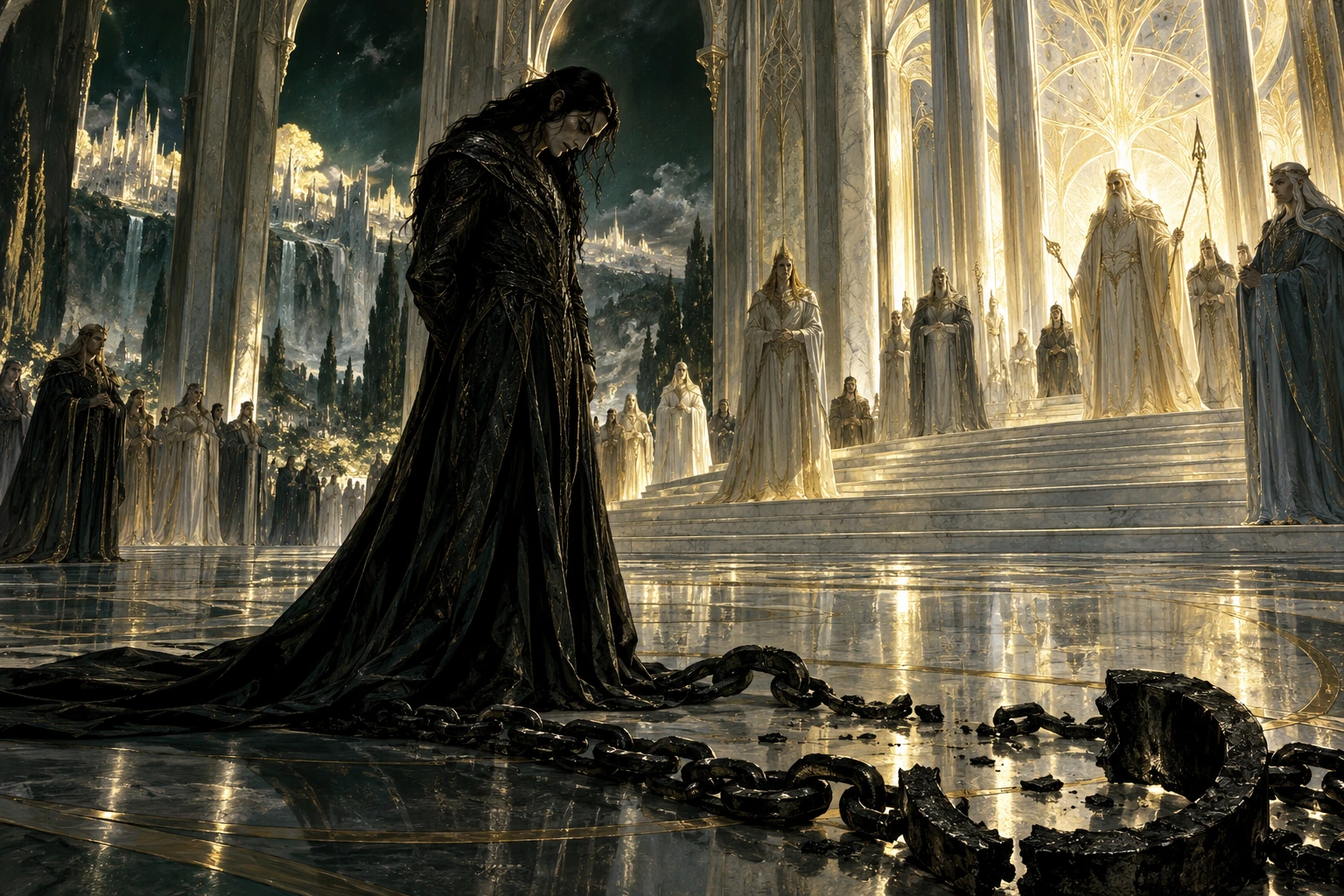
After a long captivity, Melkor professes repentance before the Valar. Released into Valinor, he hides his hatred behind helpful words and feeds suspicion among the Noldor.

His earlier capture explains how he can now move among the Elves in the Blessed Realm. He encourages fear that the Valar are holding them back and sharpens rivalries within Finwë’s family. Fëanor’s distrust of Fingolfin grows into an armed threat, bringing Fëanor a period of exile at Formenos. Finwë goes with his son. These fractures matter when Melkor later joins Ungoliant: the murder at Formenos and theft of the Silmarils strike a family and a people already divided by his lies.

The disaster begins before the Trees go dark: a defeated enemy learns to turn another people’s fears into weapons.

The darkening of Valinor
The Silmarils & the Exile · The flight of the Noldor
The flight of the Noldor

The Silmarils & the Exile

Who & where

Fëanor made the Silmarils. Morgoth is the new name he gives Melkor, who has stolen them.

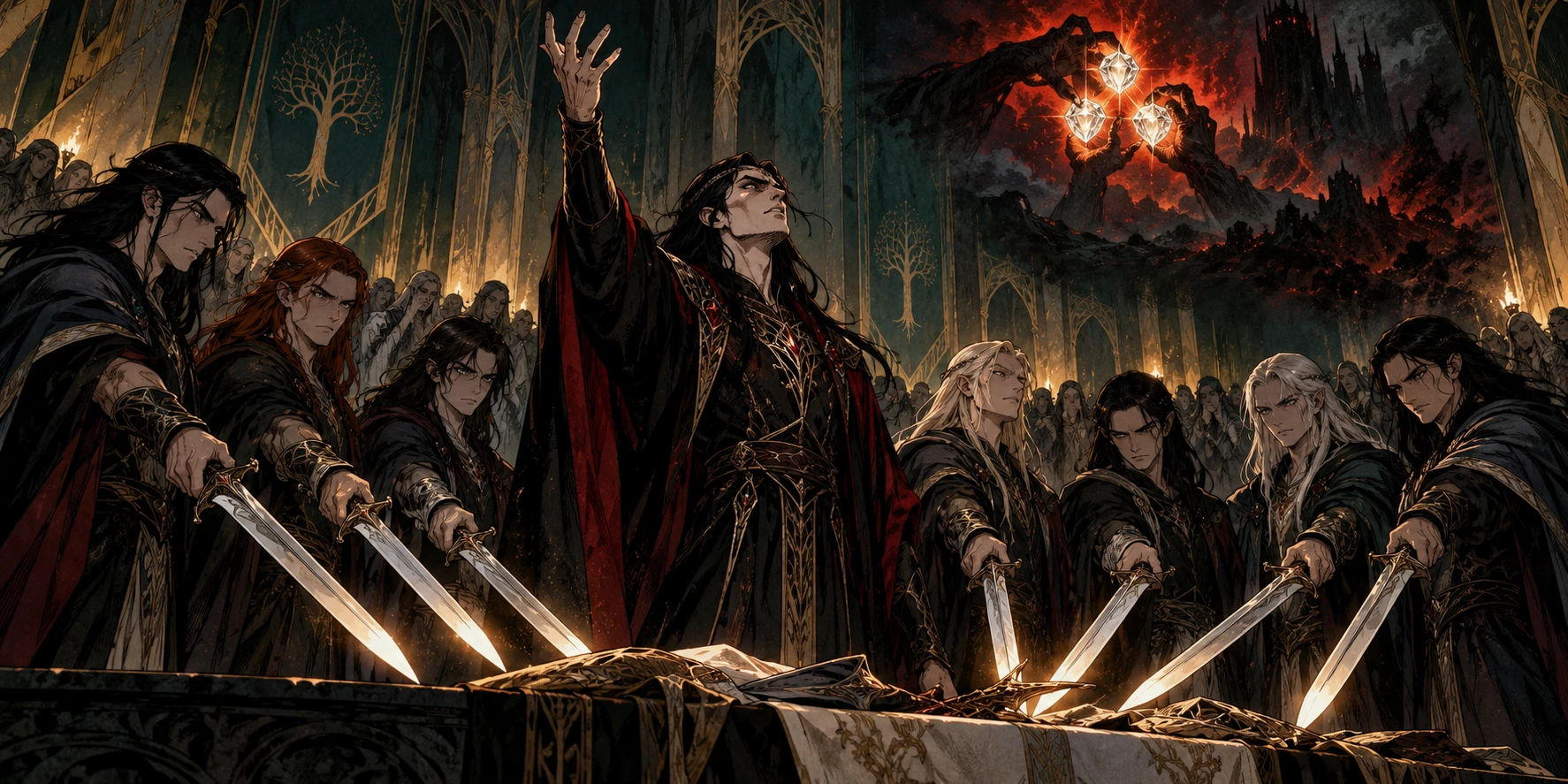
Fëanor preserves the light of the Trees in three jewels. When Morgoth steals them, an oath draws the Noldor into exile and war.

Ungoliant, a monstrous being in spider-like form, helps destroy the Two Trees. Morgoth also kills Finwë, Fëanor’s father. Loss of parent, homeland’s light, and treasured work become inseparable in Fëanor’s response. He and his sons swear an oath that treats anyone holding a Silmaril as an enemy, setting up conflicts with allies as well as with Morgoth.

Fëanor and his sons swear to reclaim the jewels from any who withhold them. An oath meant to answer one wrong creates new wrongs, including violence against other Elves.

Go deeper into the lore

Morgoth and Ungoliant destroy the Two Trees. The last flower and fruit are later made into the Moon and Sun.

Why this matters Follow the consequences
An oath outlives its first enemy

The sons of Fëanor promise to recover the Silmarils from anyone who holds them. Their claim eventually brings violence to other Elven peoples.

Continue to The Oath Reaches the Woods
The return to Middle-earth
The Kinslaying & the Ice · Alqualondë · the Helcaraxë
Alqualondë · the Helcaraxë

The Kinslaying & the Ice

Who & where

The Noldor are an Elven kindred renowned for knowledge and craft. The Helcaraxë is the perilous grinding ice of the far north.

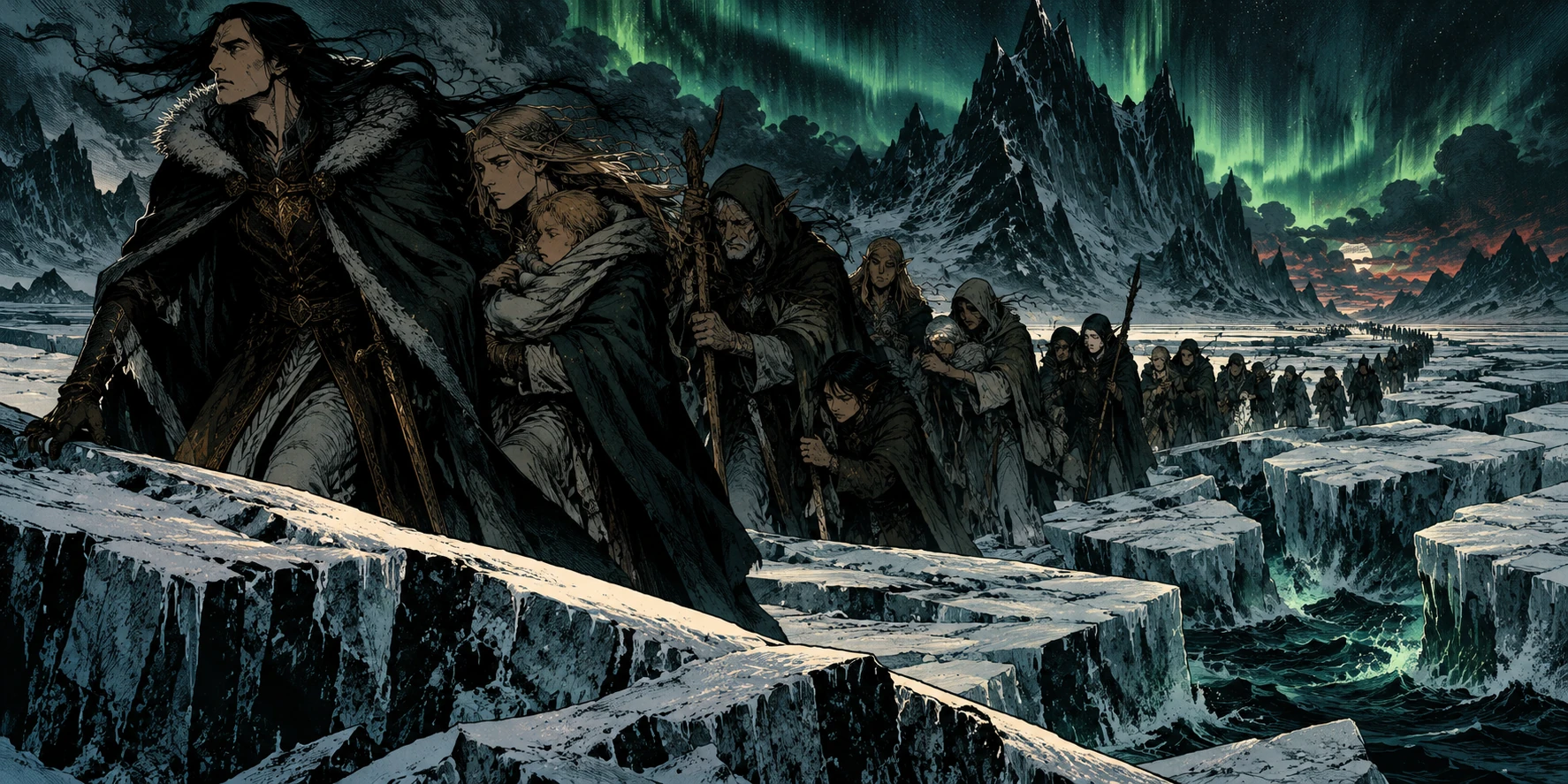
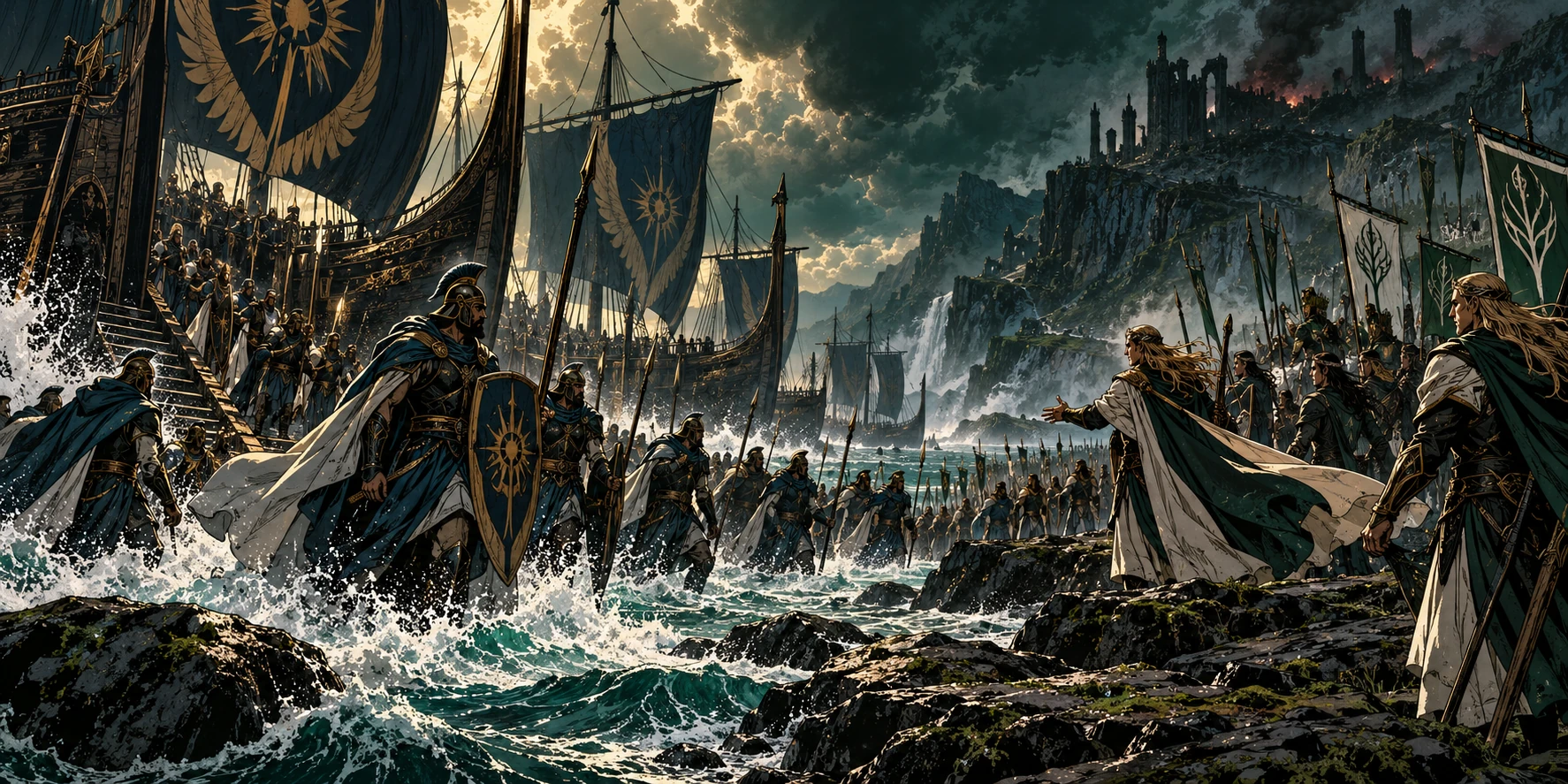
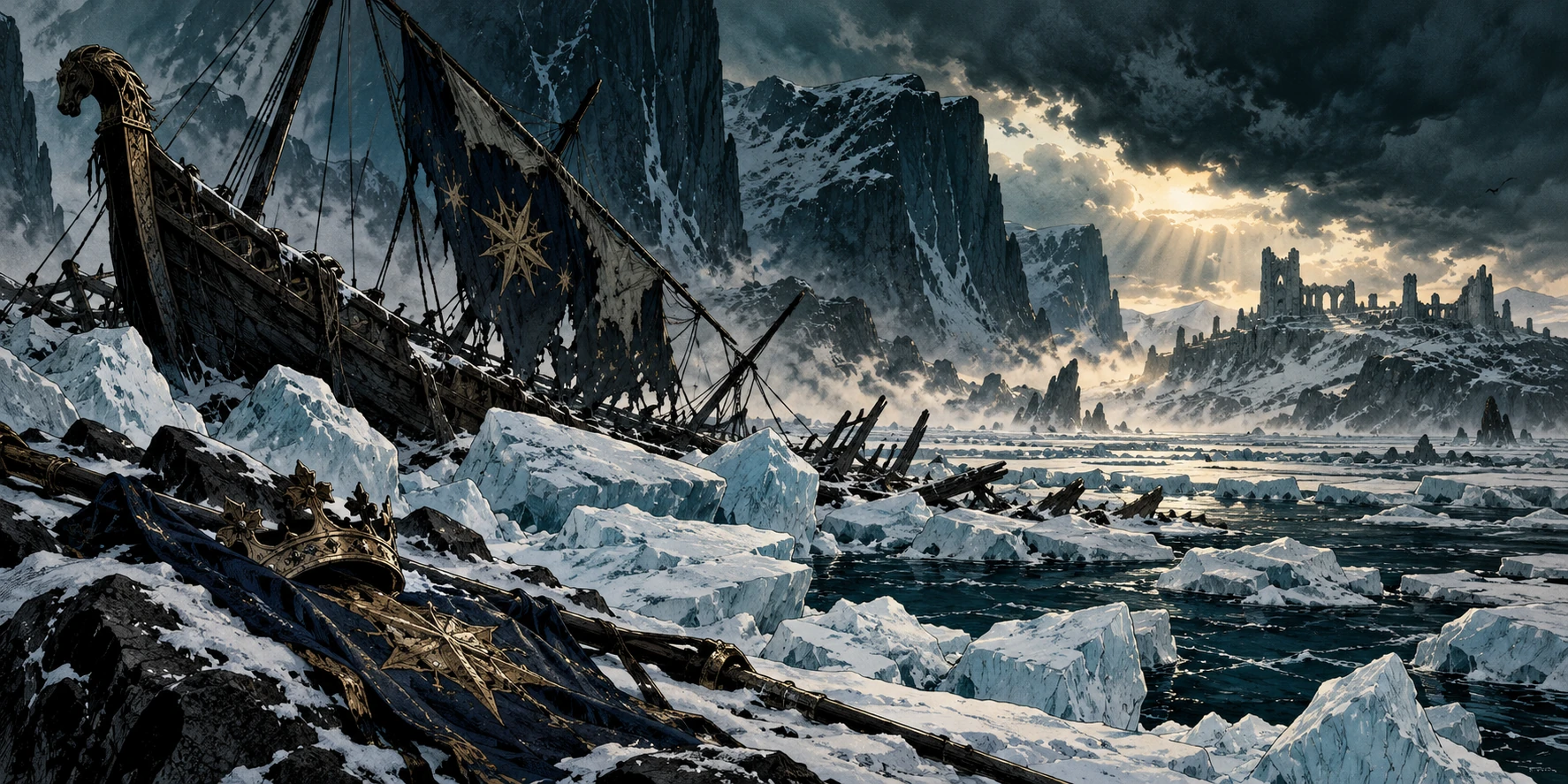
The Noldor need ships to pursue Morgoth. At Alqualondë, Fëanor’s followers attack the Teleri when they refuse to surrender theirs. Later, Fingolfin’s people endure the deadly northern ice to reach Middle-earth.

The Teleri are fellow Elves, many of them mariners. This first Kinslaying means the rebellion is not simply a heroic march against an evil enemy. Fëanor’s oath and impatience divide his own people and stain their cause before the long wars even begin. Fingolfin is Fëanor’s half-brother and a rival leader among the Noldor. Fëanor burns the stolen ships at Losgar, abandoning Fingolfin’s people to the deadly crossing of the Helcaraxë. He drives onward too recklessly after reaching Middle-earth and is mortally wounded by Balrogs under Gothmog. His sons inherit both his leadership and his terrible oath.

The exile carries both the courage to resist Morgoth and a history of injuries that will prevent the Elves from standing fully together.

Go deeper into the lore

Mandos pronounces a doom upon the rebellion. Finarfin, another of Finwë’s sons, turns back and receives pardon; not every Noldo continues into exile. The judgement does not make each later wrong unavoidable, but it warns that a war begun with violence against kin will carry grief within it.

Why this matters Follow the consequences
A rescue begins to mend a feud

The crossing leaves the Noldor divided. Fingon’s decision to rescue Maedhros gives their rival houses a chance to stand together.

Continue to A Hand Reaches Across the Feud
And so the story turns

The stolen jewels draw the Noldor east. Beyond the sea, the war for Beleriand is about to begin.

Continue into the first age
A symbolic passage from the fading Trees to a distant sunrise.
Between the ages

The old light gives way.

The old light is lost. Beneath a new Sun, exiles and newly awakened Men enter the wars of Beleriand.

Enter the first age
CHAPTER I / The Years of the Sun · 1–590

The wars of the jewels

The exiled Elves build beautiful kingdoms beneath a new Sun. Their struggle against Morgoth becomes a history of great courage, broken promises, and the few survivors who carry hope onward.

The First Age
The story so far

Morgoth has taken the Silmarils from Valinor to Angband, his fortress north of Beleriand. Fëanor and his sons have sworn to recover the jewels, and the Noldor, an Elven people known for their craft, have crossed into a land where Thingol already rules the woodland kingdom of Doriath. They share an enemy, but the oath leaves room for conflict over who may hold the jewels.

F.A. 1
The First Sunrise · The awakening of Men
The awakening of Men

The First Sunrise

Who & where

Men are mortal humans. Their awakening adds a new people to a conflict that began before them.

The Sun rises over Middle-earth, and Men awaken in the east. In Beleriand, the returning Noldor begin their long struggle against Morgoth.

The Moon and Sun are made from the last flower and fruit of the dying Trees. This is why the beginning of solar dating is not the beginning of the First Age itself. Most numbered First Age events in this chronicle belong to its final centuries, when the exiled Noldor and their allies wage war in Beleriand. In the published Silmarillion account, Men awaken in Hildórien in the East. Their eventual death is a different fate from the Elves’ bond to Arda; it becomes both a source of fear and a freedom that later Númenóreans misunderstand.

The world now has a new light and a new people. Men enter a history already scarred by the quarrels of immortals, yet their short lives will change its direction.

Why does the First Age appear to begin after the prologue?

The Chronicle changes from the Years of the Trees to dates counted from the first rising of the Sun. The First Age in Tolkien’s wider chronology already includes the awakening of the Elves. The section break marks a change in the calendar and the setting of the story.

First Age 5–7
Fingon searches alone for Maedhros, Fëanor’s eldest son, whom Morgoth has chained high on Thangorodrim. With an Eagle’s help he brings his cousin home, though freeing him costs Maedhros his hand.
Thangorodrim

A Hand Reaches Across the Feud

Who & where

Fingon belongs to the family abandoned at the ice. Maedhros belongs to the family that abandoned them.

Fingon searches alone for Maedhros, Fëanor’s eldest son, whom Morgoth has chained high on Thangorodrim. With an Eagle’s help he brings his cousin home, though freeing him costs Maedhros his hand.

After Fëanor’s death, Morgoth offers terms to his sons. Maedhros tries to outwit the enemy at a parley, but is captured and hung by one hand on Thangorodrim. Fingon’s rescue crosses the feud between their fathers. Once free, Maedhros yields the high kingship of the Noldor to Fingolfin. This reconciliation lets the divided exiles build a common defence, although it cannot release Fëanor’s sons from their oath.

An act of friendship briefly repairs what vengeance has broken.

F.A. 60
The Siege of Angband · Dagor Aglareb
Dagor Aglareb

The Siege of Angband

Who & where

The Noldor are the exiled Elves; Angband is Morgoth’s northern stronghold.

The Noldor hold Morgoth within his northern fortress after the Glorious Battle. For centuries, watchfires burn above the plain and the realms of Beleriand flourish.

The siege establishes a long period during which the Elves can found realms and the human allies later called the Edain can enter their history. But the fortress is too strong to take. A military balance can feel like peace to those growing up within it, even while the enemy is preparing the means to end it. On the coast, Círdan the Shipwright holds the Havens of the Falas at Brithombar and Eglarest. The ports bring the coastal Elves into the defence of Beleriand.

Peace allows cities and friendships to grow, but the enemy is contained rather than defeated. The long watch will end when Morgoth chooses the moment to strike.

Go deeper into the lore

The peace is never complete. Morgoth breeds strength behind the mountains, while the besiegers lack the power to destroy his deep stronghold.

F.A. 116
The Hidden City Rises · Turgon · Gondolin
Turgon · Gondolin

The Hidden City Rises

Who & where

Turgon is an Elven king. Gondolin is his secret city, concealed in the mountain-ringed valley of Tumladen.

Turgon brings his people into Tumladen. Behind a ring of mountains, Gondolin grows in secret: a last reflection of the beauty the Noldor remember from the West.

Turgon seeks a refuge that recalls the splendour of the West. Its people maintain strict secrecy, hoping that a hidden kingdom can outlast the disasters outside. The sea-power Ulmo does not intend its concealment to become an excuse for ignoring the wider struggle. Much later, Tuor will arrive with a warning that the city’s time is ending.

Its walls preserve something precious from the wars outside. Yet isolation cannot settle the fate of Beleriand; what happens beyond the mountains will eventually reach the city.

Go deeper into the lore

Secrecy becomes the city’s protection and its vulnerability. Ulmo’s warnings bind its future to the wider struggle beyond its walls.

F.A. 260
Glaurung Comes Forth · Father of dragons
Father of dragons

Glaurung Comes Forth

Who & where

Glaurung is a wingless dragon bred by Morgoth, unlike the winged dragons of some later stories.

The first of the great fire-drakes emerges from Angband. Still young, Glaurung is driven back, but his appearance heralds a dreadful new weapon in Morgoth’s wars.

His first appearance is premature and he is driven back. The important change is the revelation that the enemy can produce creatures capable of overturning familiar defences. Glaurung will later become a speaking, deceptive enemy whose attacks on minds and families can be as destructive as his fire.

Morgoth has begun making weapons that cannot be answered by courage alone. When the dragon returns at full strength, the balance of the war will change.

F.A. 310
Men Cross into Beleriand · The Edain · Finrod Felagund
The Edain · Finrod Felagund

Men Cross into Beleriand

Who & where

Finrod rules Nargothrond. The Edain are the human allies whose descendants receive Númenor after the war.

Finrod, an Elven king, encounters the people of Bëor after they cross the Blue Mountains. Friendship grows between some of the newcomers and the Elves resisting Morgoth.

Men are mortal humans. The three houses that become especially close allies of the Elves are remembered as the Edain. They are not all the Men in the world, and their alliances do not erase the different loyalties of other peoples. Their descendants will include Beren, Túrin, Tuor, and eventually the rulers of Númenor.

The conflict becomes a shared history. The choices of these short-lived people will carry consequences long after individual Elven kings have fallen.

First Age · before the return in 400
Nan Elmoth · Gondolin · Aredhel, Eöl & Maeglin
Nan Elmoth · Gondolin

Aredhel, Eöl & Maeglin

Who & where

Aredhel is Turgon’s sister and Idril’s aunt. Eöl is an Elven smith of Nan Elmoth; Maeglin is their son and Idril’s cousin.

Aredhel leaves Gondolin to travel in the wider world, but becomes separated from her companions and drawn into Eöl’s woodland domain. Their son Maeglin grows up hearing of the hidden city and longing to see it.

Eöl keeps his household apart from the Noldor and refuses his son’s wish to visit Gondolin. While he is away, Aredhel and Maeglin leave for her brother’s city. Eöl follows them. Turgon welcomes him as kin but will not allow anyone who knows the city’s secret to depart. Eöl tries to kill Maeglin; Aredhel shields her son and dies from the poisoned weapon. Turgon has Eöl put to death. Maeglin remains, winning standing through his knowledge and craft, but his desire for Idril is not returned. His later resentment of Tuor and betrayal to Morgoth grow within this damaged household and his own choices.

The city shelters a grieving son, yet neither its walls nor its welcome can ensure what he will do with the place he has gained.

Go deeper into the lore

The early dates of Aredhel’s departure vary in Tolkien’s developing annals. This chapter keeps the opening broad and places the family’s return in the period traditionally dated to First Age 400. Eöl’s control is not treated as a romantic courtship, and Maeglin’s suffering does not excuse his later betrayal.

Sources & further reading
F.A. 455
The Battle of Sudden Flame · Dagor Bragollach
Dagor Bragollach

The Battle of Sudden Flame

Who & where

Ard-galen is the grassy plain before Angband. Its ruin marks the end of the long siege.

Rivers of fire burst from the north. The siege collapses, Glaurung leads the assault, and the green plain of Ard-galen becomes a desolation of ash.

Morgoth combines rivers of flame, armies, and the mature Glaurung to break the northern defences. The mortal warrior Barahir saves Finrod’s life; Finrod gives him a ring and swears to aid his family in return. That debt will draw Finrod into the quest of Barahir’s son Beren. Strongholds survive, but the long siege has failed and the Elven realms increasingly face the enemy in isolation.

The seeming stability of centuries ends in a single offensive. The free peoples can no longer rely on the siege, and their scattered kingdoms must face a widening war.

Go deeper into the lore

Fingolfin rides alone to Angband and challenges Morgoth. He dies in the duel, but wounds the Dark Lord and becomes a figure of enduring defiance.

After the Sudden Flame
Fingolfin Challenges Morgoth · Fingolfin · the gates of Angband
Fingolfin · the gates of Angband

Fingolfin Challenges Morgoth

Who & where

Angband is Morgoth’s great northern fortress, protected by the peaks of Thangorodrim.

Believing his people ruined, Fingolfin rides alone to Angband and challenges the Dark Lord to single combat. Morgoth kills him, but not before the Elven king wounds him repeatedly.

Fingolfin is High King of the Noldor in Middle-earth. His ride is an extraordinary act of defiance, not a strategy capable of saving the kingdoms by itself. The encounter strips away any comfortable assumption that courage guarantees survival. It also shows that Morgoth, though immensely powerful, can suffer hurt and fear. His son Fingon succeeds him as High King. After Fingon’s death in the Unnumbered Tears, that kingship passes to Turgon, tying the hidden city more closely to the fate of all the exiles.

The Elves inherit a memory of resistance that outlives the king, while the practical task of surviving the war grows harder.

F.A. 465–466
Beren & Lúthien · A love beyond death
A love beyond death

Beren & Lúthien

Who & where

Beren is a mortal Man; Lúthien is the daughter of Thingol and the Maia Melian.

Beren, a mortal fugitive from the ruined northern highlands, meets Lúthien in Doriath. They fall in love, but her father Thingol demands a Silmaril from Morgoth’s crown before he will consent to their marriage.

Thingol expects the impossible price to send Beren away. Instead Beren seeks Finrod’s aid, calling on the promise once made to his father Barahir. Finrod joins him, but Sauron captures their company at his island fortress. In its dungeon Finrod dies defending Beren from a werewolf. Lúthien refuses to leave the quest to others: her decision to seek Beren begins the rescue that follows.

Love achieves what great armies cannot: a jewel is taken from the Dark Lord himself. Their descendants will carry both the Silmaril’s hope and the burden of two kindreds.

Go deeper into the lore

Their tale joins the fates of Elves and Men, and their descendants will shape the histories of Númenor, Rivendell, and Gondor.

Why this matters Follow the consequences
A stolen jewel becomes a beacon

The Silmaril recovered by Beren and Lúthien passes through their descendants to Elwing. Its light accompanies Eärendil’s plea for help in the West.

Continue to The Voyage of Eärendil

The leaves were long, the grass was green

Aragorn’s song of Beren and Lúthien · The Fellowship of the Ring · A Knife in the Dark
First Age · the quest for a Silmaril
Lúthien refuses to wait while others decide Beren’s fate. With Huan, the great hound, she comes to Sauron’s island fortress and challenges its master.
Tol-in-Gaurhoth

Lúthien at the Isle of Werewolves

Who & where

Sauron is still Morgoth’s lieutenant. His stronghold occupies the tower that once belonged to Finrod.

Lúthien refuses to wait while others decide Beren’s fate. With Huan, the great hound, she comes to Sauron’s island fortress and challenges its master.

Sauron comes out in the shape of a great wolf. Huan overcomes him and holds him by the throat, and Lúthien makes him yield command of the tower before she lets him go. He flees in vampire form. Lúthien breaks his hold over the fortress and opens its pits. She finds Beren beside Finrod, who has already died defending him. They bury Finrod on the island before setting out again.

The rescue depends on Lúthien’s courage and power, not simply on the hero who first set out.

First Age · the recovered jewel
Lúthien’s enchantment stills Morgoth’s court while Beren cuts a Silmaril from his crown. At the gate, the wolf Carcharoth bites off Beren’s hand and swallows the burning jewel. Eagles carry the lovers away.
Angband, Doriath & the Halls of Mandos

A Jewel Won, a Mortal Life Chosen

Who & where

Carcharoth is Morgoth’s monstrous wolf; Huan is the hound who has aided Lúthien. Mandos keeps the dead.

Lúthien’s enchantment stills Morgoth’s court while Beren cuts a Silmaril from his crown. At the gate, the wolf Carcharoth bites off Beren’s hand and swallows the burning jewel. Eagles carry the lovers away.

In the later hunt, Huan and Carcharoth kill each other and Beren is fatally wounded. Lúthien dies of grief; before Mandos she sings of their suffering. They are permitted to return together, on condition that she shares Beren’s mortality. Their son Dior carries this union into the ancestry of Elwing, Elrond, and Elros.

Their victory brings a Silmaril out of Angband, but its deepest choice concerns love and death.

F.A. 472
Unnumbered Tears · Nirnaeth Arnoediad
Nirnaeth Arnoediad

Unnumbered Tears

Who & where

The battle joins Elven kingdoms, human allies, and Dwarven forces against Morgoth. Húrin belongs to the human House of Hador.

A great alliance attempts to break Morgoth’s power. Betrayal and overwhelming force turn hope into catastrophe, and Húrin is taken alive after a last stand.

Maedhros tries to coordinate a renewed alliance, but Morgoth’s traps, divided timing, and the treachery of Ulfang’s sons break its attack. Fingon is killed. The brothers Húrin and Huor make a last stand that allows Turgon to escape toward Gondolin; Huor dies, while Húrin is captured alive. Morgoth curses Húrin’s family and holds him captive. Húrin’s son Túrin and Huor’s son Tuor will grow up under the consequences of this same defeat. After Morgoth takes the Falas the following year, Círdan leads survivors to the Isle of Balar. Ships from Balar later try to help the refugees at Sirion.

This is the great lost chance to win by alliance. Afterward, survival depends on hidden places and scattered families rather than a united front.

Go deeper into the lore

The defeat leaves the free kingdoms isolated. The courage of the House of Hador cannot undo the ruin of the alliance.

First Age 473–489
Doriath · Amon Rûdh · the northern woods · Túrin’s Exile & Beleg’s Last Rescue
Doriath · Amon Rûdh · the northern woods

Túrin’s Exile & Beleg’s Last Rescue

Who & where

Túrin is Húrin and Morwen’s son. Beleg is an Elven warrior of Doriath who becomes his loyal friend; Niënor is Túrin’s younger sister.

After Húrin’s capture, Morwen sends their young son Túrin to safety in Doriath. Thingol takes him into his household, but a later quarrel and a fatal accident drive Túrin away before he can learn that the king has pardoned him.

The courtier Saeros attacks Túrin, then falls to his death while fleeing him. Fearing judgement, Túrin joins outlaws. Beleg brings word of Thingol’s pardon, but Túrin will not return. Beleg goes back to Doriath and later rejoins him at Amon Rûdh, bringing healing supplies from Melian and the sword Anglachel from Thingol. For a time the two friends fight together against Morgoth’s forces. When Orcs seize Túrin, Beleg follows them with the help of Gwindor, an Elf who has escaped from Angband. They carry Túrin out of the camp, but Anglachel slips as Beleg cuts his bonds. Túrin wakes in pain and darkness, seizes the sword, and kills the friend who came for him. Gwindor eventually brings the grief-stricken survivor to Nargothrond. This is why Túrin reaches that kingdom as both a capable warrior and a wounded exile.

The dragon’s later victory enters a life already shaped by separation, loyalty, and a terrible mistake.

F.A. 495
The Fall of Nargothrond · Túrin Turambar
Túrin Turambar

The Fall of Nargothrond

Who & where

Nargothrond is an Elven fortress-city beside the River Narog. Túrin, a human exile, has become influential there.

Glaurung breaks the defences of the hidden river kingdom. Túrin’s story moves toward its tragic end beneath the malice of the dragon and Morgoth’s curse.

Gwindor brings Túrin to Finrod’s former kingdom, now ruled by Orodreth. Túrin’s courage and success win influence, and he urges open warfare in place of secrecy. A great bridge makes the hidden stronghold easier for the enemy to reach. Glaurung defeats its army, kills Orodreth, and fixes Túrin in a spell while captives are driven away. The dragon then sends him north with a lie about his mother and sister. Túrin abandons the search for the captive Finduilas, an Elven woman who loves him, and finds that his family has already left its old home.

Túrin’s desire to confront the enemy openly leaves the kingdom exposed. The tragedy is both a war story and a warning about pride beneath unbearable grief.

First Age 495 · a parallel road
Nevrast · the road to Gondolin · Tuor Hears the Lord of Waters
Nevrast · the road to Gondolin

Tuor Hears the Lord of Waters

Who & where

Tuor is Huor and Rían’s son and Túrin’s cousin. Voronwë is an Elf of Gondolin; Ulmo is the Vala of the waters.

While Túrin’s story turns toward ruin, Tuor reaches the abandoned coastal halls of Vinyamar. There he finds arms left by Turgon, and Ulmo charges him to carry a warning to Gondolin.

Tuor has grown up among Elves, endured enslavement, and escaped into a life of wandering. Ulmo brings him together with Voronwë, a mariner saved from shipwreck. Voronwë knows the hidden approach and guides him through the winter to Turgon’s city. The king admits the messenger but rejects the demand to leave his stronghold. Tuor remains, marries Idril, and becomes Eärendil’s father. His arrival therefore supplies both the warning the city refuses and the family through whom hope survives its fall.

Two cousins inherit the same shattered war: Túrin is pursued by a curse, while Tuor is asked to carry a warning someone else must choose to hear.

The tragedy of Túrin
The Dragon’s Last Victory · Túrin · Niënor · Glaurung
Túrin · Niënor · Glaurung

The Dragon’s Last Victory

Who & where

Túrin and his sister Niënor belong to the House of Hador, one of the great families of the Edain.

In Brethil, Túrin begins a new life and eventually kills Glaurung. But the dragon’s dying revelation exposes the catastrophe he has already brought into Túrin’s family.

Morwen and Niënor had come to Doriath seeking safety. When they later search for Túrin near ruined Nargothrond, Glaurung destroys Niënor’s memory. She reaches Brethil as Níniel, and she and Túrin marry without recognising that they are siblings. After Túrin wounds the dragon, Glaurung reveals the truth to her; she throws herself into the Teiglin. Túrin learns what has happened and takes his own life with his sword. Morgoth forces their captive father Húrin to perceive his family’s suffering through the malice of the curse. The tragedy depends on lies, lost knowledge, and disastrous decisions, not on courage being absent. Morwen survives the disaster, but wanders in grief. Húrin remains a captive until after his children are dead; his eventual release will continue, rather than undo, the damage.

A dragon can be slain without every injury being repaired. The histories of the First Age preserve losses that no later victory can simply cancel.

First Age c. 500–502
Brethil · Nargothrond · Doriath · Húrin’s Last Road
Brethil · Nargothrond · Doriath

Húrin’s Last Road

Who & where

Húrin is Túrin and Niënor’s father; Morwen is their mother. The Nauglamír is a Dwarven necklace once kept in Nargothrond.

Morgoth finally releases Húrin, expecting the broken captive to carry further harm into the world. In Brethil he finds Morwen beside the memorial of their children. She dies after their last reunion.

His wandering also betrays the general region of hidden Gondolin to the enemy’s watchers, although Maeglin’s later betrayal is still needed for its destruction. Húrin reaches ruined Nargothrond, kills Mîm, and takes the Nauglamír. He brings it bitterly to Thingol, blaming Doriath for failing his family. Melian helps him see how Morgoth has distorted what he knows. He leaves the necklace as a gift and departs; the account says that afterward he cast himself into the Sea. The necklace is now in Doriath, ready to be joined to the recovered Silmaril.
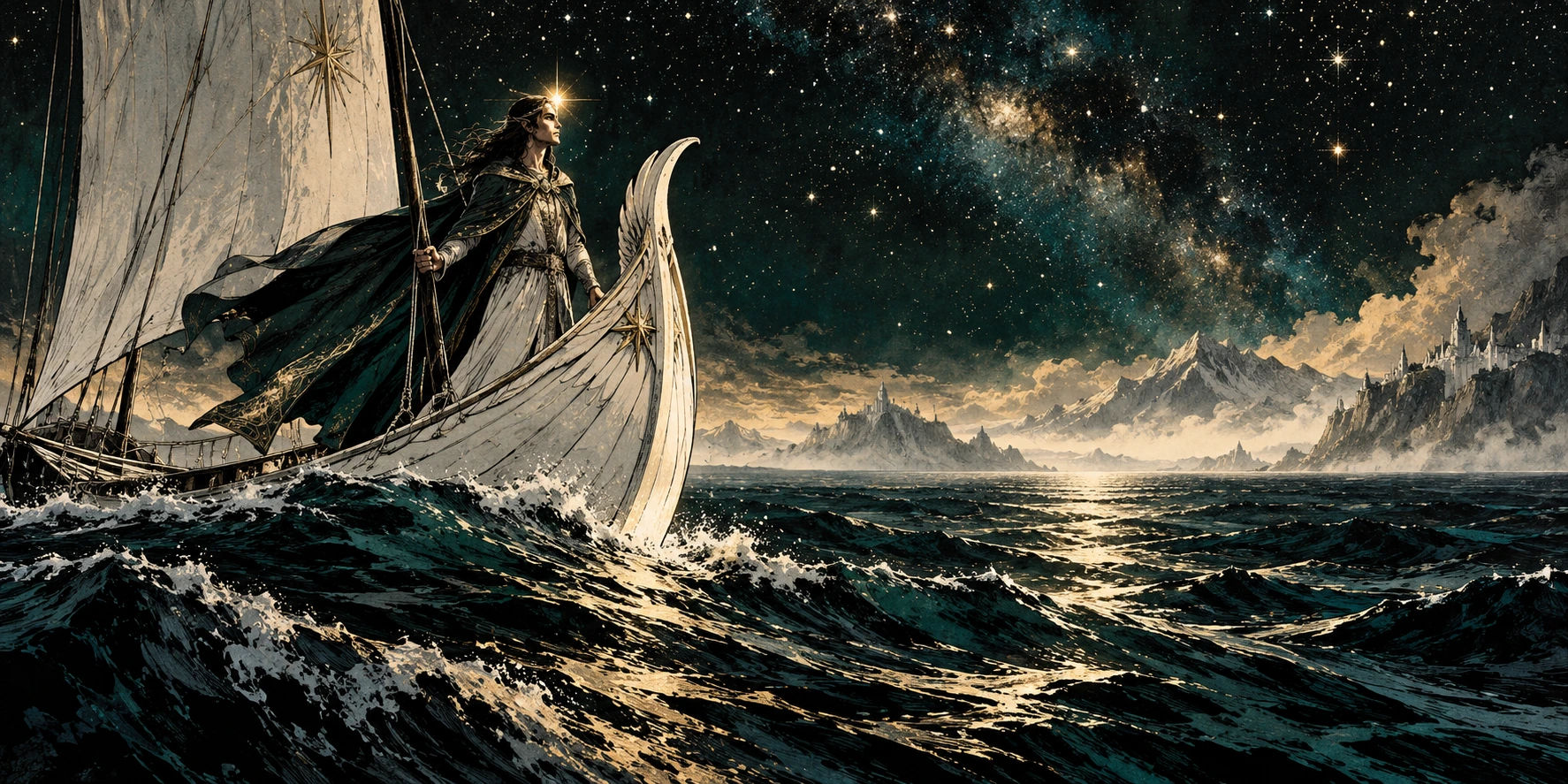
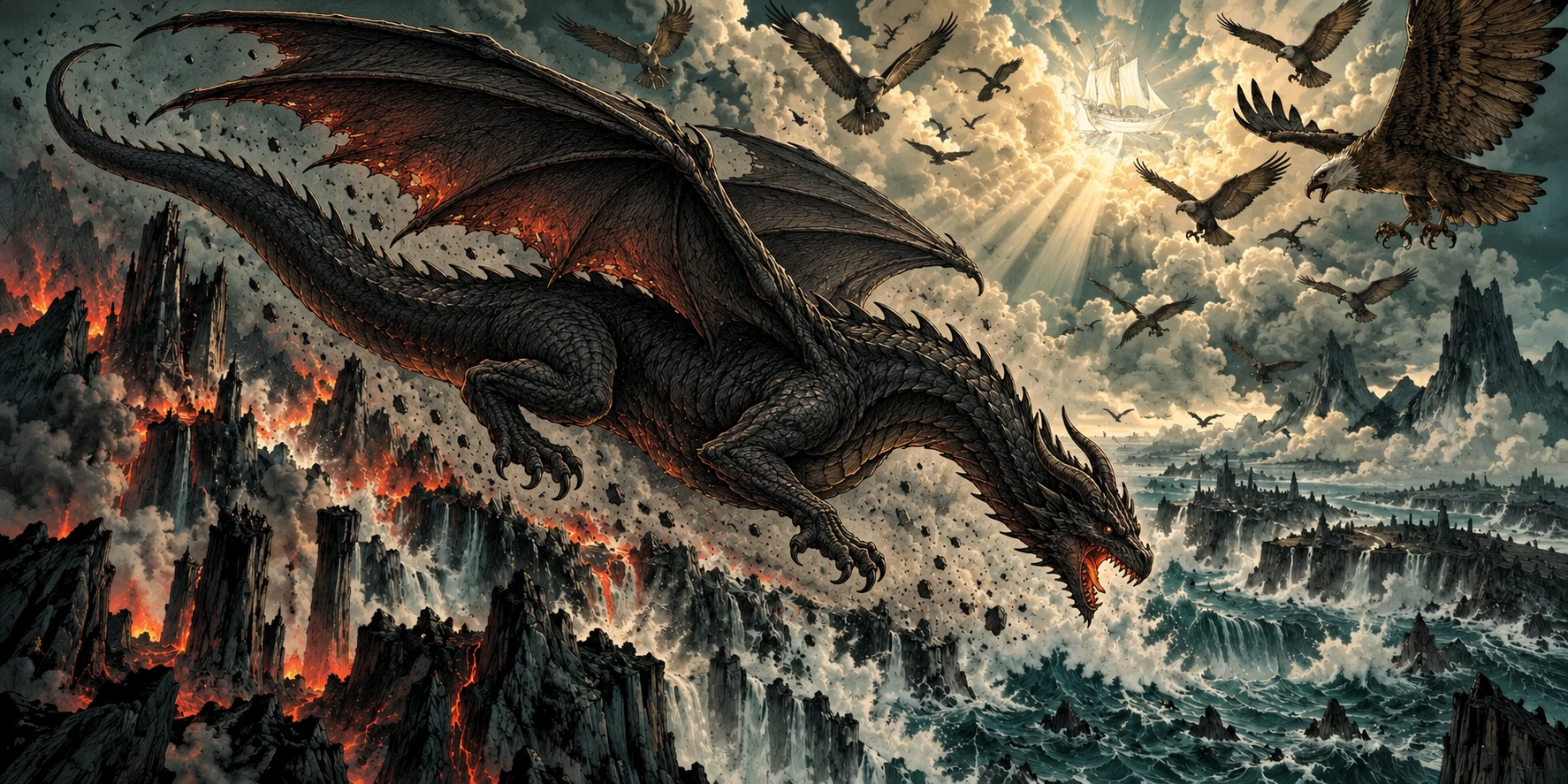
A prisoner’s release is not a restored life. His last journey closes his family’s tragedy and carries one of its consequences into the next kingdom.

The ruin of Doriath
The Oath Reaches the Woods · Doriath · Elwing
Doriath · Elwing

The Oath Reaches the Woods

Who & where

The sons of Fëanor are bound by their father’s oath to recover the three jewels.

The Silmaril recovered by Beren and Lúthien passes to their descendants. After Thingol’s death and further disaster, the sons of Fëanor attack Doriath to claim the jewel. Elwing escapes with it.

Thingol has the recovered Silmaril set in the Nauglamír, a renowned Dwarven necklace. A dispute with its Dwarven craftsmen turns violent and Thingol is killed. Melian leaves, and the power guarding Doriath ends. Beren recovers the jewel after the sack; it passes to his and Lúthien’s son Dior, who tries to restore the realm. Fëanor’s sons then demand the Silmaril and attack. Dior and his wife Nimloth are killed; their daughter Elwing escapes with the jewel. This second Kinslaying is a separate catastrophe from the earlier quarrel with the Dwarves.

The Silmaril survives, but the struggle to possess it keeps destroying the communities that preserve it.

F.A. 510
The Fall of Gondolin · The hidden kingdom
The hidden kingdom

The Fall of Gondolin

Who & where

Tuor is a Man guided to Gondolin; Idril is Turgon’s daughter. Their son is Eärendil.

The hidden city is betrayed. Amid fire and ruin, Tuor and Idril lead survivors to safety, carrying hope beyond the broken walls.

Ulmo sends Tuor to warn Turgon that concealment will no longer save Gondolin, but the king refuses to leave. Tuor marries Idril and their son Eärendil is born. Turgon’s nephew Maeglin, who desires Idril, is later captured by Morgoth and betrays the city’s location. During the assault, Turgon dies with his city. Idril’s secret escape-way allows Tuor and a remnant of its people to get out. Their survival preserves a future beyond the walls the king hoped would last forever. Glorfindel dies defending the fugitives against a Balrog during their escape. The Glorfindel later encountered near Rivendell is understood in Tolkien’s later writings as this Elf returned from death, rather than another mortal survivor walking unchanged out of the battle.

The city is lost, but its people are not entirely destroyed. Among the escapees is young Eärendil, whose future voyage will carry their plea beyond the sea.
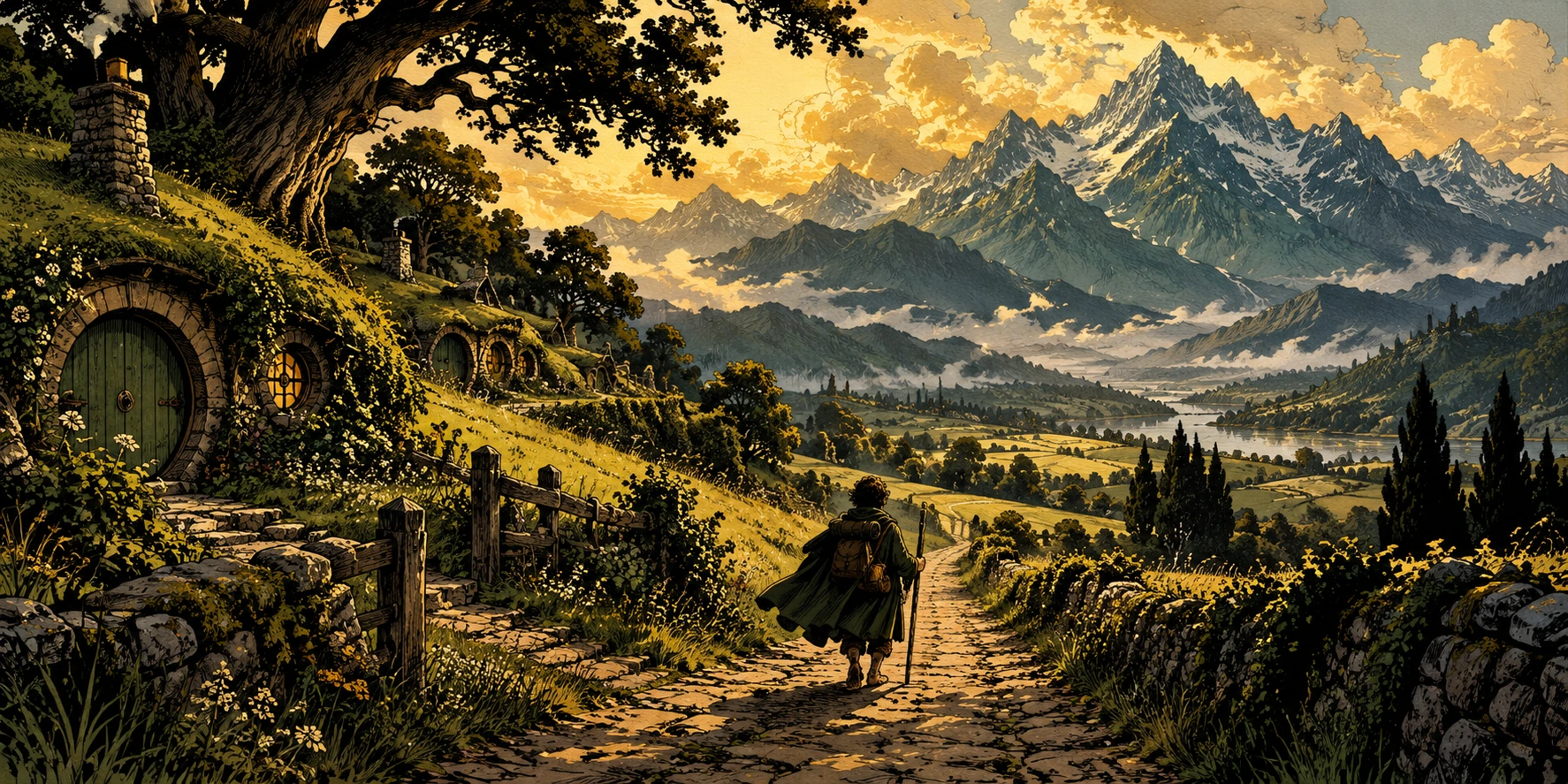
Why this matters Follow the consequences
A survivor carries the hope of a city

Tuor and Idril escape with their son Eärendil. The child saved from Gondolin will grow into the mariner who seeks aid for Elves and Men.
Continue to The Voyage of Eärendil
Sources & further reading
Within this moment · Gondolin · beyond the burning walls

What survives a city?

Three threads of the turning point

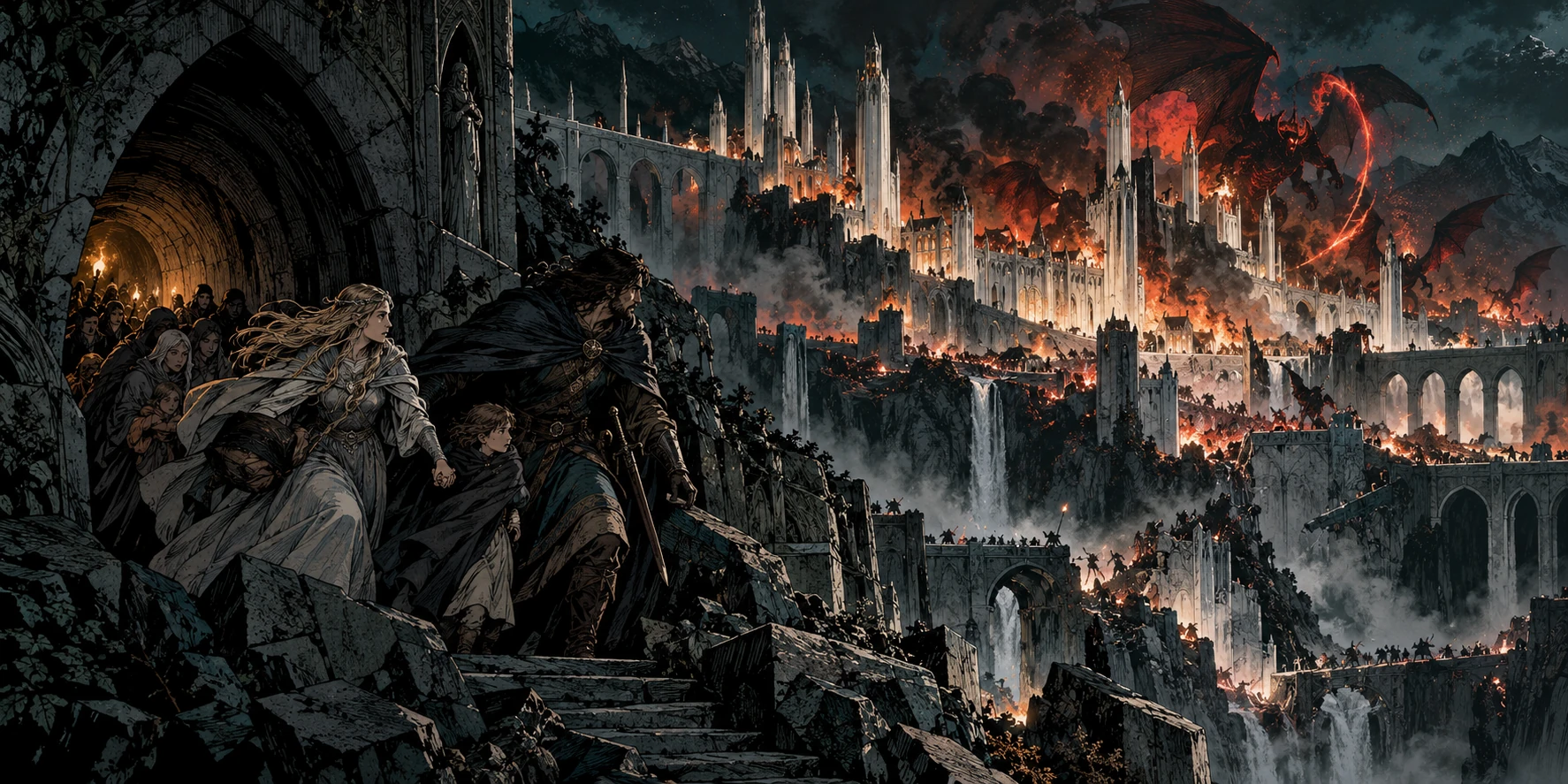
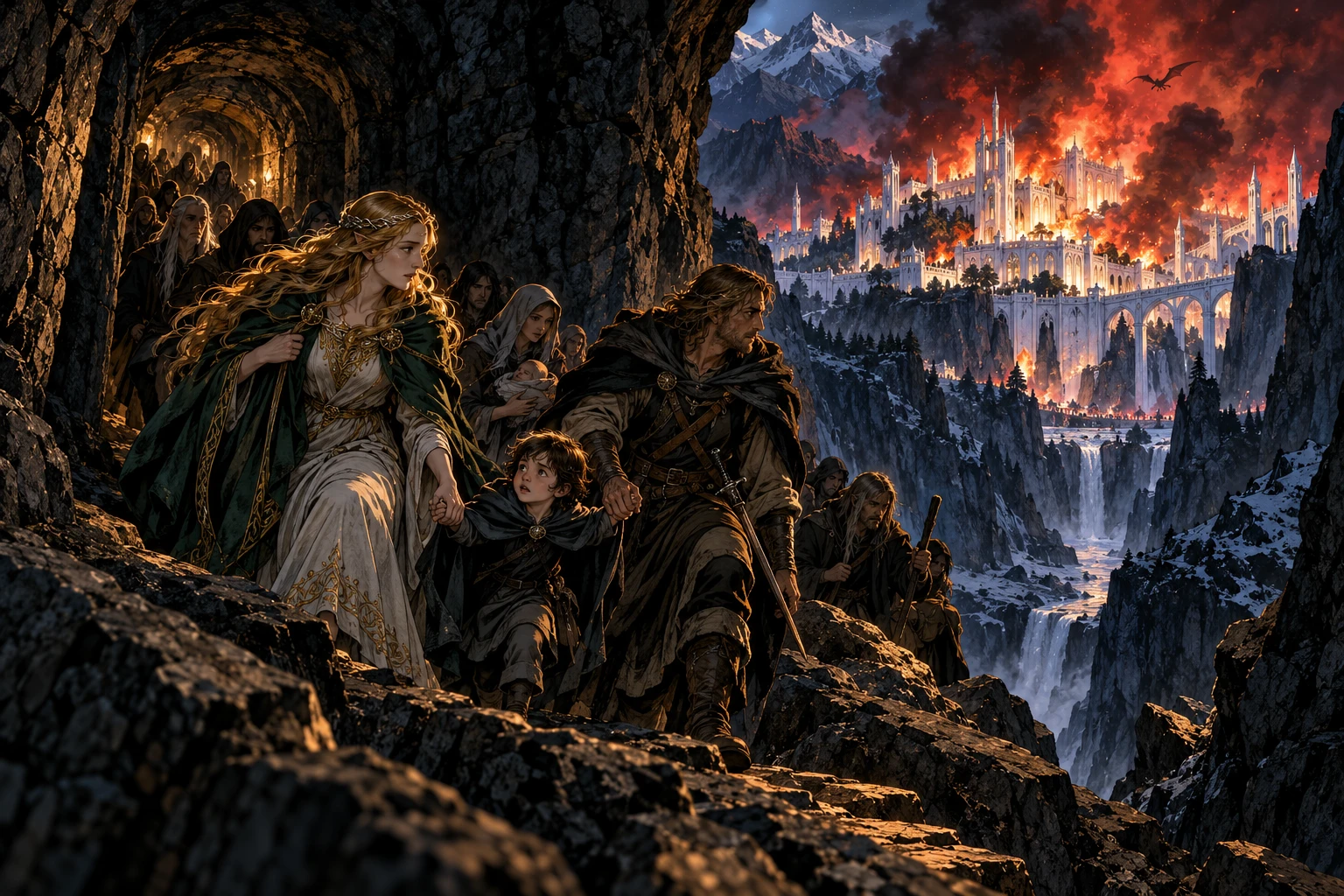
Tuor and Idril guide young Eärendil and refugees through a passage beneath the burning city of Gondolin.
Original interpretive illustration · Gondolin · beyond the burning walls
A warning left unanswered

Gondolin’s secrecy cannot protect it forever. The city falls, and the hope of its people depends on a way out rather than a final victory within its walls.

The way Idril prepared

Idril has arranged a hidden escape. She and Tuor lead survivors away with their young son Eärendil; preserving lives becomes more important than preserving the city.

A child carries the future

The refugees eventually reach the Havens of Sirion. Eärendil will grow into the mariner who sails West to seek help for Elves and Men.

The last havens of Beleriand
Elwing & the Refuge at Sirion · The Havens of Sirion
The Havens of Sirion

Elwing & the Refuge at Sirion

Who & where

Sirion is Beleriand’s great river. Its coastal havens become a meeting place for the scattered survivors.

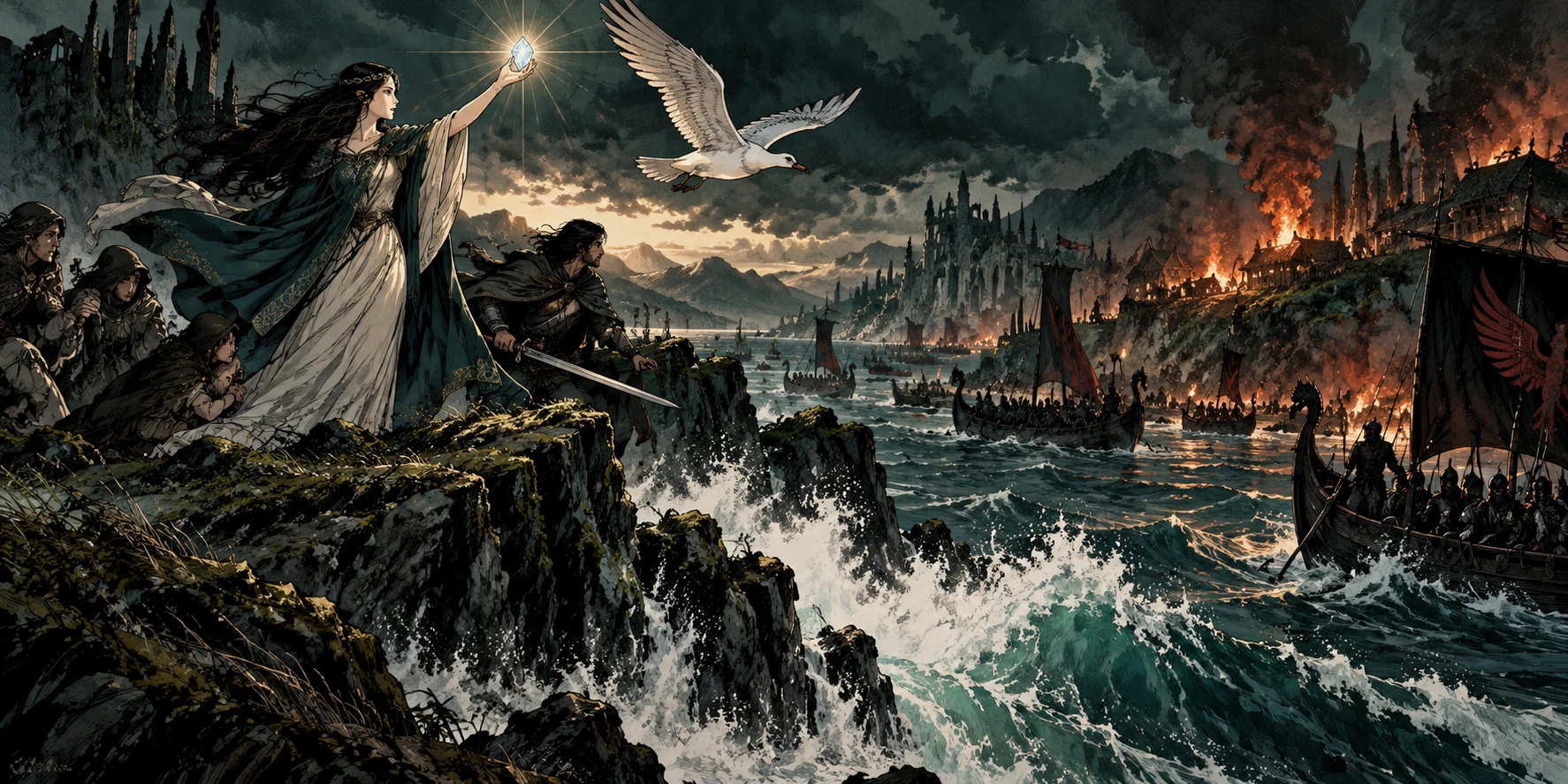
Survivors of the fallen kingdoms gather at the mouths of the River Sirion. Elwing and Eärendil make their home there, but the sons of Fëanor attack again in pursuit of the Silmaril.

Elwing, granddaughter of Beren and Lúthien, marries Eärendil, son of Tuor and Idril. Their twins are Elrond and Elros. While Eärendil is at sea, the sons of Fëanor attack the haven for the Silmaril. Elwing casts herself into the water rather than surrender it; Ulmo gives her the form of a white bird, and she reaches Eärendil’s ship. The boys remain in Middle-earth. Maglor, one of their attackers, takes them into his care and comes to love them. They survive the destruction that sends their parents toward the forbidden West.

Eärendil’s plea to the Valar is not a request for one kingdom’s restoration. He carries the need of the surviving peoples of Beleriand.

F.A. 542
The Voyage of Eärendil · The mariner & the evening star
The mariner & the evening star

The Voyage of Eärendil

Who & where

Eärendil and Elwing descend from both Elves and Men. Their sons are Elrond and Elros.

Bearing a Silmaril, Eärendil reaches the forbidden West and pleads for Elves and Men. His voyage brings the appeal of Middle-earth before the Valar.

Elwing’s Silmaril helps Eärendil cross the barriers that prevent ordinary ships from reaching Aman. He appeals for both Elves and Men, and the Valar agree to intervene. Eärendil and Elwing are permitted to choose the Elven fate, but do not return to live in Middle-earth. His ship is hallowed and set to sail the heavens bearing the jewel, the evening star seen in later ages. Their children remain behind and will receive their own choice of kindred.

The Silmaril taken from Morgoth becomes a light that guides a plea for everyone. A treasure so often fought over finally serves a purpose beyond possession.

Go deeper into the lore

Eärendil and Elwing stand at the meeting of the two kindreds. Their sons, Elrond and Elros, will choose different fates after the war. Tuor and Idril had earlier sailed west from Middle-earth. The tradition says Tuor alone among mortal Men was numbered among the Elves; it is an exceptional reported fate, not an ordinary reward available to every voyager.

First Age 545–587
The War of Wrath · The end of the Elder Days
The end of the Elder Days

The War of Wrath

Who & where

The host of the West is the force sent by the Valar. Morgoth is the first Dark Lord, distinct from his servant Sauron.

The host of the West breaks Morgoth’s power. The conflict shatters Beleriand, and much of the ancient land sinks beneath the sea.

The Valar send the host of the West against Morgoth. The war ends with Angband broken, but most of Beleriand is shattered and swallowed by the Sea. Morgoth is captured, bound, and cast beyond the world into the Void: he is not the Dark Lord who returns in the later Ring story. His servant Sauron evades judgement and remains in Middle-earth. The fighting ends in 587 under the later chronology; the First Age closes in 590 as the survivors face a new geography. Earlier annals use some different dates.

Morgoth is cast out, but victory cannot restore everything he has broken. Survivors must begin again on a coastline changed by the destruction of their old world.

Why this matters Follow the consequences
Victory makes a new homeland possible

The Edain, the peoples of Men who opposed Morgoth, receive an island home. Their descendants inherit a friendship with the West—and the difficult gift of long mortal lives.

Continue to The Rise of Númenor
The end of the First Age
The Last Fate of the Silmarils · The jewels of earth, sea, and sky
The jewels of earth, sea, and sky

The Last Fate of the Silmarils

Who & where

A Silmaril is a jewel containing the light of the Two Trees. There are three; they are not Rings of Power.

The surviving sons of Fëanor seize the remaining two Silmarils, but find that their deeds have made the jewels unbearable to them. One is lost in the depths of the earth, the other in the sea.

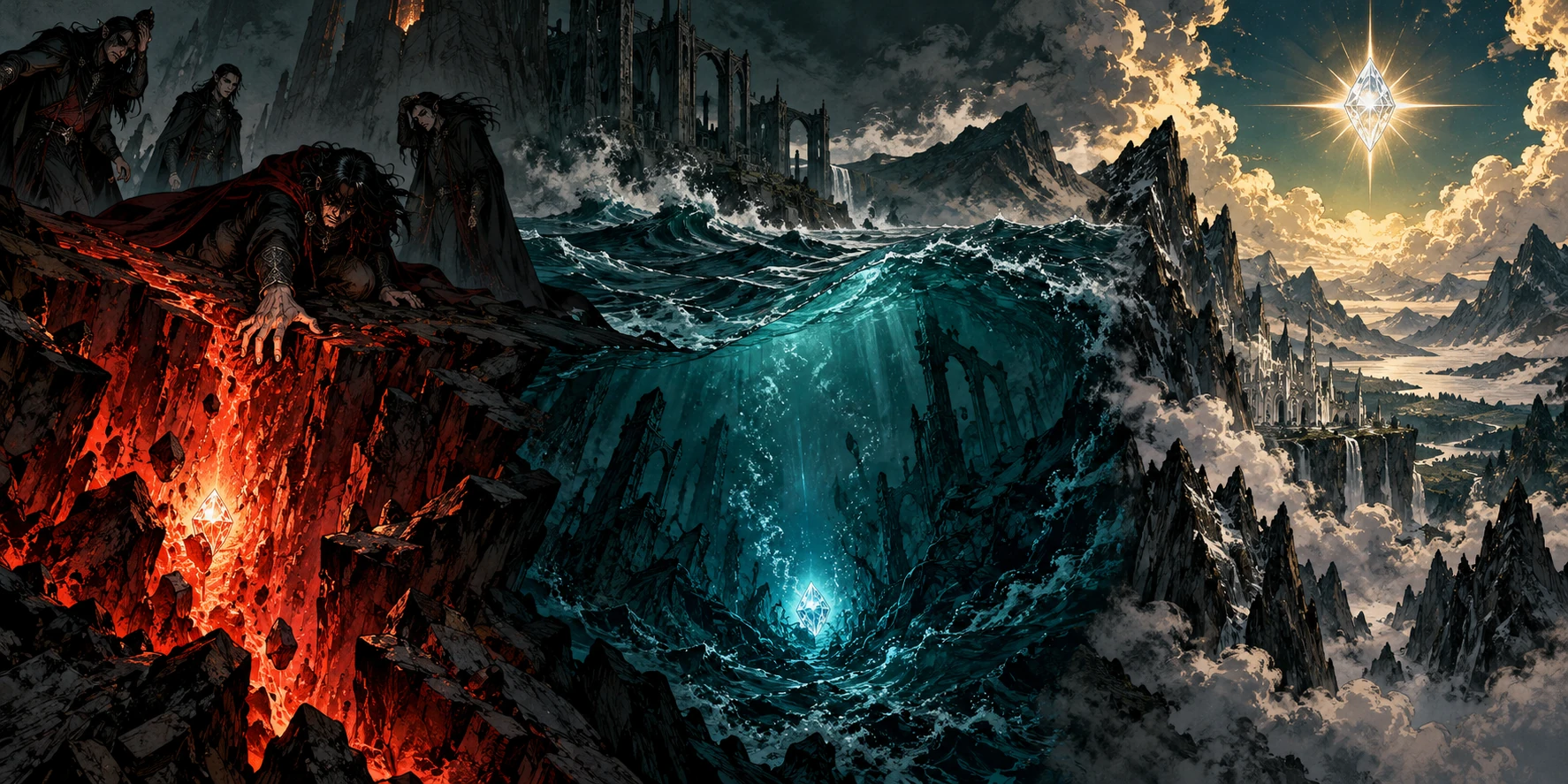
Maedhros and Maglor, the last surviving sons of Fëanor, steal the two jewels recovered from Morgoth. Their violence has forfeited their claim, and the Silmarils burn their hands. In anguish Maedhros casts himself with his jewel into a fiery chasm. Maglor throws his into the Sea and is left wandering the shores in lament. The third shines with Eärendil in the heavens. Thus earth, sea, and sky hold the jewels; no victorious ruler finally possesses all three.

The great object of the first wars passes beyond ordinary possession. The next age will build its own beautiful objects—and repeat a related temptation.

Where did the three Silmarils end up?

Eärendil carries one in the sky. Maglor casts his into the sea. Maedhros leaps into a fiery chasm with the third. These are the jewels Fëanor made from the light of the Two Trees, centuries before the Rings of Power.

And so the story turns

Morgoth is defeated. The survivors inherit a changed world—and one of his servants has escaped the reckoning.

Continue into the second age
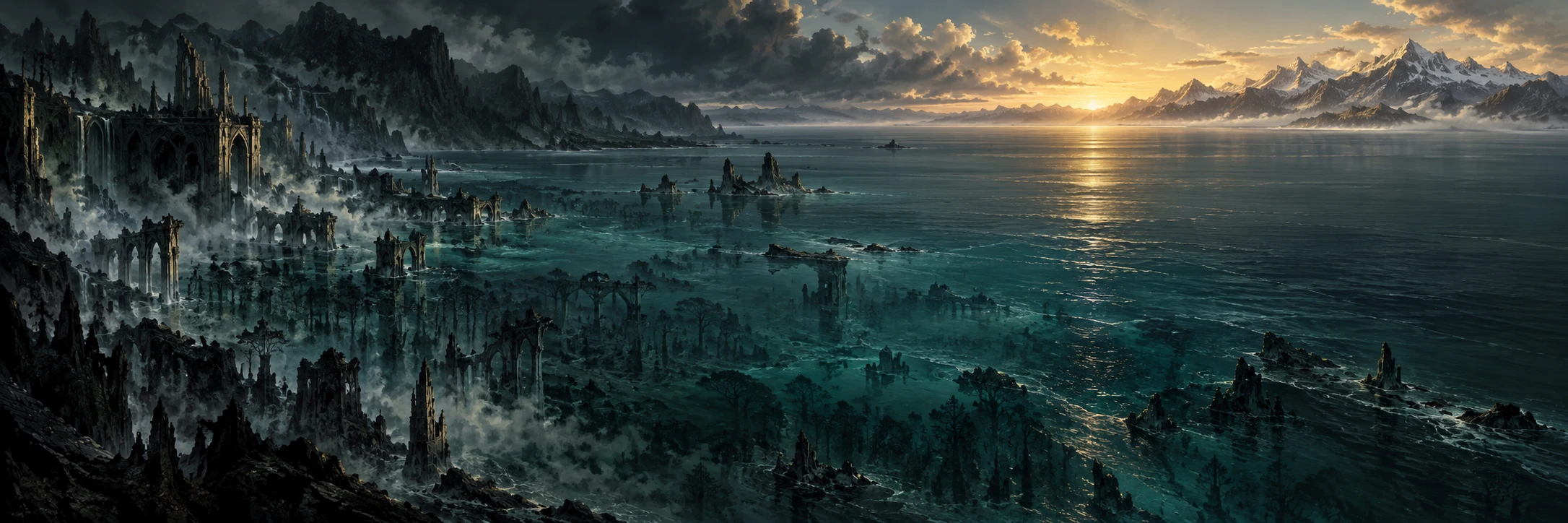
A changed coastline with submerged ruins after the destruction of Beleriand.
Between the ages

The sea remembers.

Morgoth is cast out, but the land cannot be restored. Survivors face a changed sea; the story turns toward Númenor and the kingdoms that will inherit its memory.

Enter the second age
CHAPTER II / 3,441 Years

The price of power

An island kingdom rises from the sea, while Elven smiths dream of preserving the beauty of Middle-earth. Sauron learns how to turn both desire and fear into instruments of dominion.

The Second Age
The story so far

Much of Beleriand lies beneath the sea after the War of Wrath. Gil-galad rules in coastal Lindon, and Eärendil and Elwing’s sons, Elrond and Elros, face a choice that will send them down different paths. The Edain, who fought alongside the Elves, are about to gain an island home. Morgoth is gone, but his servant Sauron has escaped judgement.

The beginning of the Second Age
Two Brothers, Two Destinies · Elrond · Elros
Elrond · Elros

Two Brothers, Two Destinies

Who & where

Elrond later founds Rivendell. Elros is the ancestor of the Númenórean royal line.

Elrond and Elros, sons of Eärendil and Elwing, are allowed to choose between the fates of Elves and Men. Elrond chooses the Elven fate; Elros chooses mortality and becomes Númenor’s first king.

The brothers descend from both kindreds through the unions of Beren and Lúthien, and Tuor and Idril. Their exceptional choice does not mean every person of mixed ancestry can freely change their nature. Elros receives an unusually long life, but remains mortal. His royal descendants eventually include Elendil, Isildur, and Aragorn.

Elrond will remain a living witness to ancient losses while generations of his brother’s descendants rise and fall.

Why this matters Follow the consequences
Two family lines meet again

Elrond chooses the life of the Elves; Elros chooses mortality and becomes Númenor’s first king. Ages later, Elrond’s daughter Arwen and Elros’s descendant Aragorn unite their lines.

Continue to Aragorn & Arwen Choose a Mortal Life
S.A. 32
The Rise of Númenor · The land of the gift
The land of the gift

The Rise of Númenor

Who & where

Elros, Elrond’s brother, becomes the first king. The Edain are the human allies of the Elves in the earlier wars.

The Edain sail to a star-shaped island raised from the sea. Under Elros, its first king, Númenor begins an age of wisdom and maritime splendour.

The island’s people receive long lives and an extraordinary opportunity to build without immediate fear of Morgoth. They remain mortal. Their story turns on whether a gift can be received without becoming a demand for still more. The island’s eventual survivors will bring their royal traditions and White Tree to Middle-earth.

The island is a reward for the Men who fought beside the Elves. Over time, its kings begin to measure their gifts against the one thing they have not received: immortality.

Where is Númenor in relation to Valinor and Middle-earth?

Númenor is an island in the Great Sea. Middle-earth lies to its east. Aman, the western continent containing Valinor, lies to its west. Long life is part of the gift to the Númenóreans, who remain mortal.

S.A. 600 onward
The Sea-roads Open · The mariners of Númenor
The mariners of Númenor

The Sea-roads Open

Who & where

The Undying Lands are the dwelling of the Valar and many Elves. Their name describes their inhabitants, not a cure for human mortality.

Númenórean mariners return to Middle-earth. Their early voyages renew friendships with Elves and bring knowledge and aid to coastal peoples. The island’s ships connect lands divided since the old wars.

Númenor lies west of Middle-earth, closer to the Undying Lands, but its people are forbidden to sail there. The boundary is not intended to punish mortals: residence in that land would not itself make them immortal. As the island grows stronger, exploration and friendship will increasingly give way to taxation, settlements, and imperial ambition.

The same ships that begin as links of friendship can become instruments of power when their purpose changes.

S.A. 750
The Jewel-smiths of Eregion · Celebrimbor · Khazad-dûm
Celebrimbor · Khazad-dûm

The Jewel-smiths of Eregion

Who & where

Eregion is an Elven realm west of the Misty Mountains. Khazad-dûm is the neighbouring Dwarven kingdom within them.

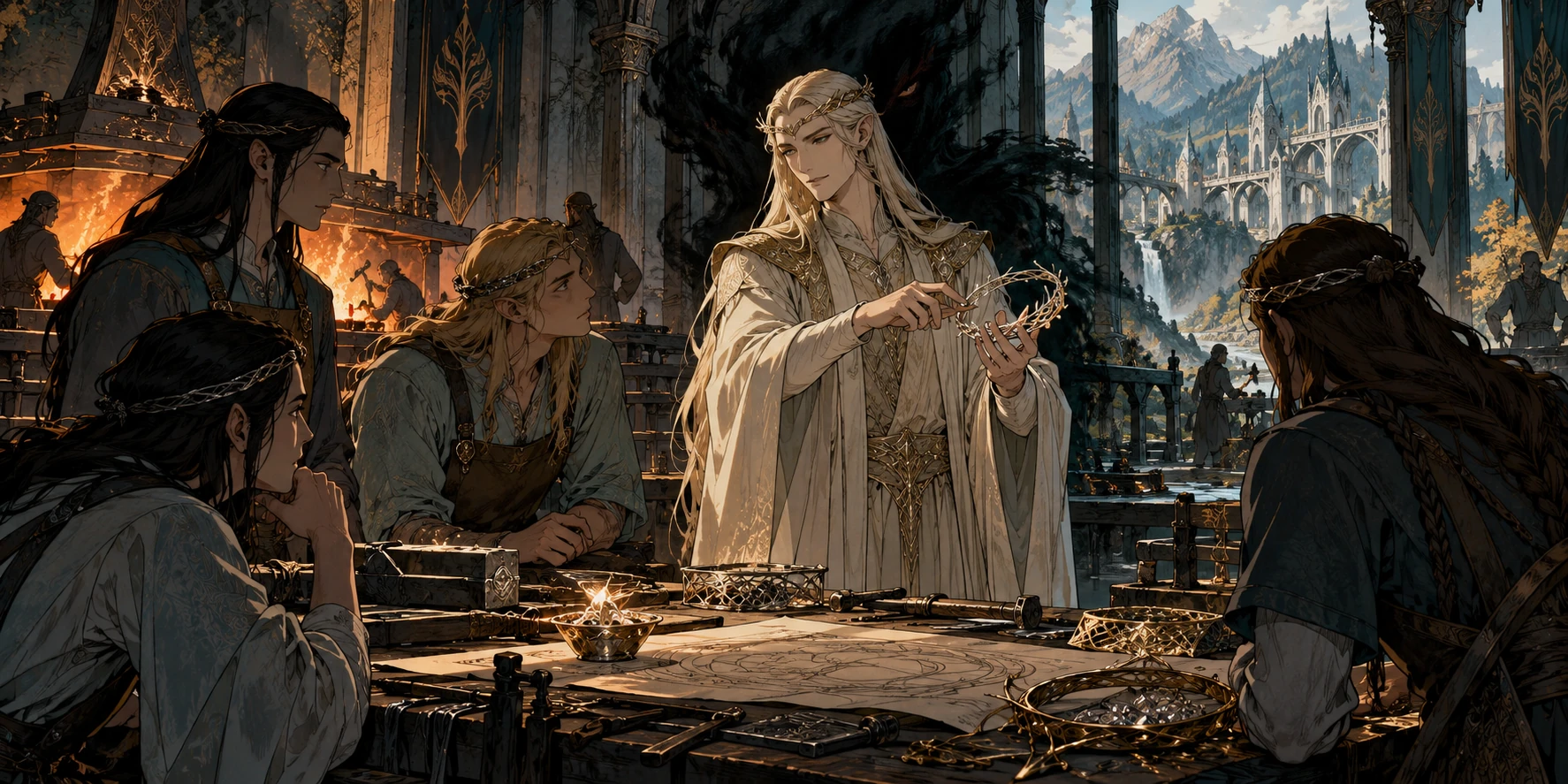
The Noldor establish Eregion beside the Misty Mountains. Trade and friendship with Khazad-dûm nurture an extraordinary flowering of craft.

Celebrimbor leads its celebrated smiths. Trade and shared craftsmanship allow Elves and Dwarves to cooperate across differences that later stories sometimes foreground. The Rings emerge from a real artistic ambition: to preserve beauty against time. Sauron exploits that wish by presenting himself as a teacher with knowledge they desire.

Friendship across the mountain gates brings Elves and Dwarves together through craft. The desire to make enduring beauty also leaves the smiths open to a dangerous teacher.

Second Age c. 1000
Mordor · the foundations of Barad-dûr · Sauron Chooses Mordor
Mordor · the foundations of Barad-dûr

Sauron Chooses Mordor

Who & where

Sauron is Morgoth’s surviving servant, now seeking his own dominion. Mordor is the mountain-enclosed land southeast of the Elven and human realms.

Long after Morgoth’s defeat, Sauron gathers strength again. Alarmed by Númenor’s growing power, he chooses Mordor as a stronghold and begins building the Dark Tower, Barad-dûr.

The surrounding mountains offer defence, while the fires of Orodruin will serve his craft. His later appearance as the generous teacher Annatar is therefore part of a larger design: he is building a realm of coercion while offering the Elves knowledge. The tower takes centuries to complete, and its foundations become bound to the power of the One Ring. Sauron is not Morgoth returned under a new name; a surviving lieutenant is turning the old desire to dominate into a new political and magical system.

Before the Ring is forged, the land in which it must one day be destroyed is already becoming the enemy’s fortress.

Second Age · ninth century
Erendis and Aldarion beside a sailing ship at the harbour of Rómenna
Númenor · Rómenna and Emerië

Aldarion & Erendis

Who & where

Aldarion is the seafaring son of King Meneldur. Erendis comes from the Westlands of Númenor, and their daughter Ancalimë will become the island’s first ruling queen.

At first Erendis honours Aldarion’s voyages, even bringing a green bough to his ship when the king withholds the customary farewell. They marry and have a daughter, Ancalimë. Then a voyage keeps Aldarion away for years beyond the time Erendis expected him home. She withdraws to Emerië and raises their daughter there. When he comes to see her, neither can bring themselves to offer the reconciliation the other is waiting for.

Aldarion returns with a letter from Gil-galad of Lindon asking for help against a growing power in Middle-earth. Meneldur has to weigh the danger of sending his people into a foreign war against the danger of leaving Lindon to face it alone. He decides to surrender the sceptre early and let Aldarion take responsibility for the policy he has set in motion.

The ties Aldarion builds across the sea help prepare Númenor to aid Lindon in a later war. At home, the years apart have already changed his family.

Go deeper into the lore

Tolkien tells their story in Aldarion and Erendis: The Mariner’s Wife, an unfinished narrative published in Unfinished Tales.

Sources & further reading
c. S.A. 1200
The Lord of Gifts · Annatar
Annatar

The Lord of Gifts

Who & where

Annatar, meaning Lord of Gifts, is the identity Sauron uses to approach the Elven smiths.

Sauron approaches the Elven smiths in a fair form, offering knowledge. In Eregion, the promise of making and preserving beautiful things gives him a way in.

Sauron was once a Maia associated with Aulë’s service before becoming Morgoth’s follower. His interest in order and making has become a demand that others submit to his design. Some Elven leaders distrust him, but Eregion accepts his instruction. His deception works because it attaches itself to something its victims sincerely value.

Sauron does not begin by demanding surrender. He offers a way to preserve the things the Elves fear losing, turning a longing for beauty into an opening for control.

Go deeper into the lore

His persuasion works through a real desire: to preserve Middle-earth from weariness and loss. The deception makes that longing a path to domination.

Why this matters Follow the consequences
A promise of preservation conceals control

Sauron helps the Elven smiths develop their craft. He then makes a ruling Ring intended to dominate the bearers of the other Rings.

Continue to The One Ring
c. S.A. 1590
Three Rings to Preserve Beauty · Celebrimbor · the Three
Celebrimbor · the Three

Three Rings to Preserve Beauty

Who & where

Celebrimbor is an Elven craftsman, not a follower who knowingly sets out to serve Sauron.

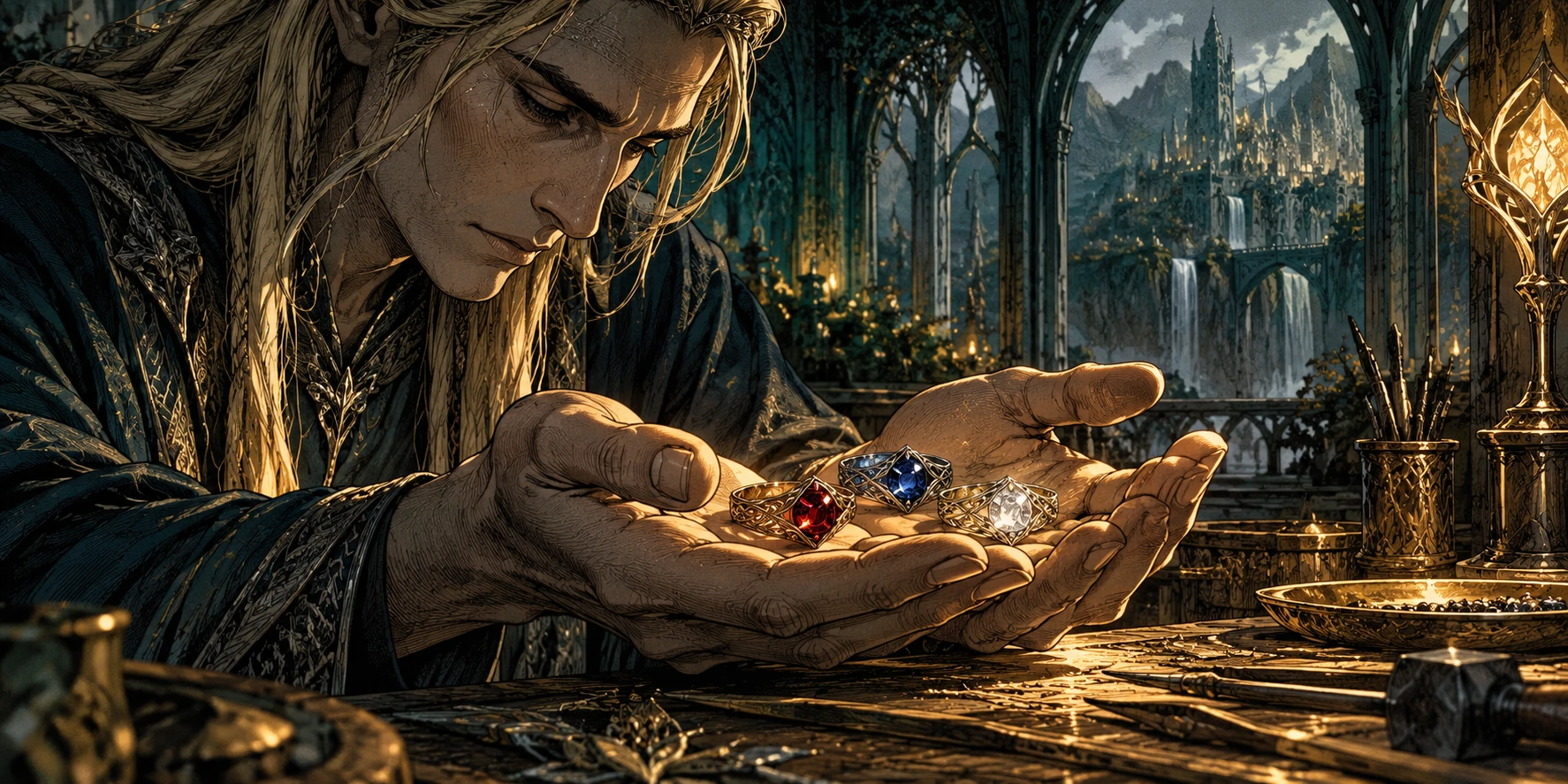
Celebrimbor, leader of Eregion’s smiths and a grandson of Fëanor, makes the Three Elven Rings without Sauron’s direct participation. They are intended for preservation and healing rather than conquest.

The Three are Narya, Nenya, and Vilya. Sauron never touches them, but Celebrimbor uses the same ring-lore, leaving them subject to the ruling Ring Sauron is making. They are hidden when his design is revealed. Much later, in the Third Age, Galadriel bears Nenya and Elrond bears Vilya. Narya passes through Círdan of the Grey Havens to Gandalf. These are the Three whose keepers finally depart at the end of the Third Age; their different purposes do not free them from the One’s fate.

The preservation of beautiful realms becomes entangled with an enemy’s method of control. That dependence will matter even after Sauron is defeated.

c. S.A. 1600
The One Ring · The forging of the Ring
The forging of the Ring

The One Ring

Who & where

Sauron forges the One in Mount Doom, a volcano also called Orodruin, within Mordor.

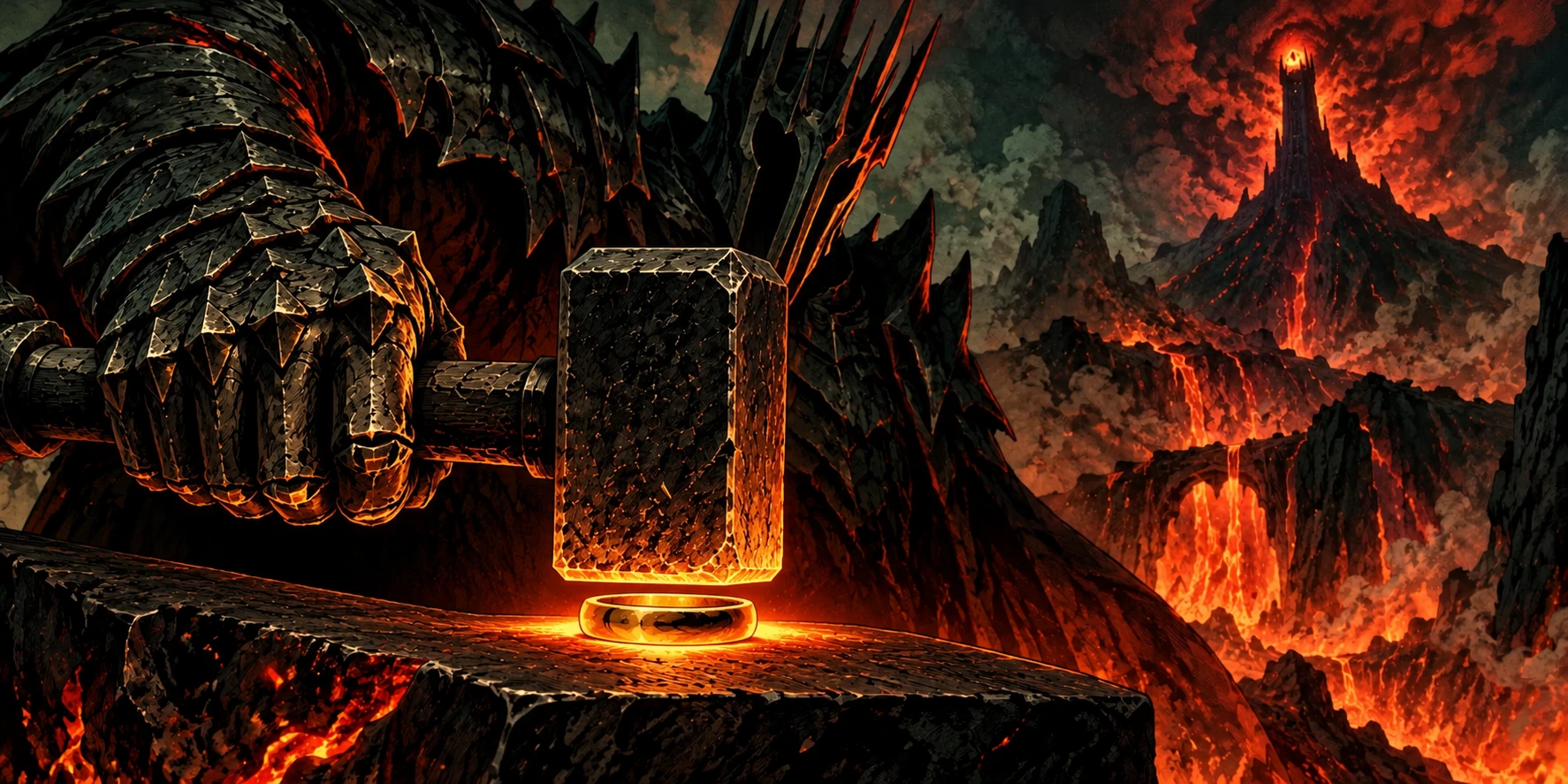
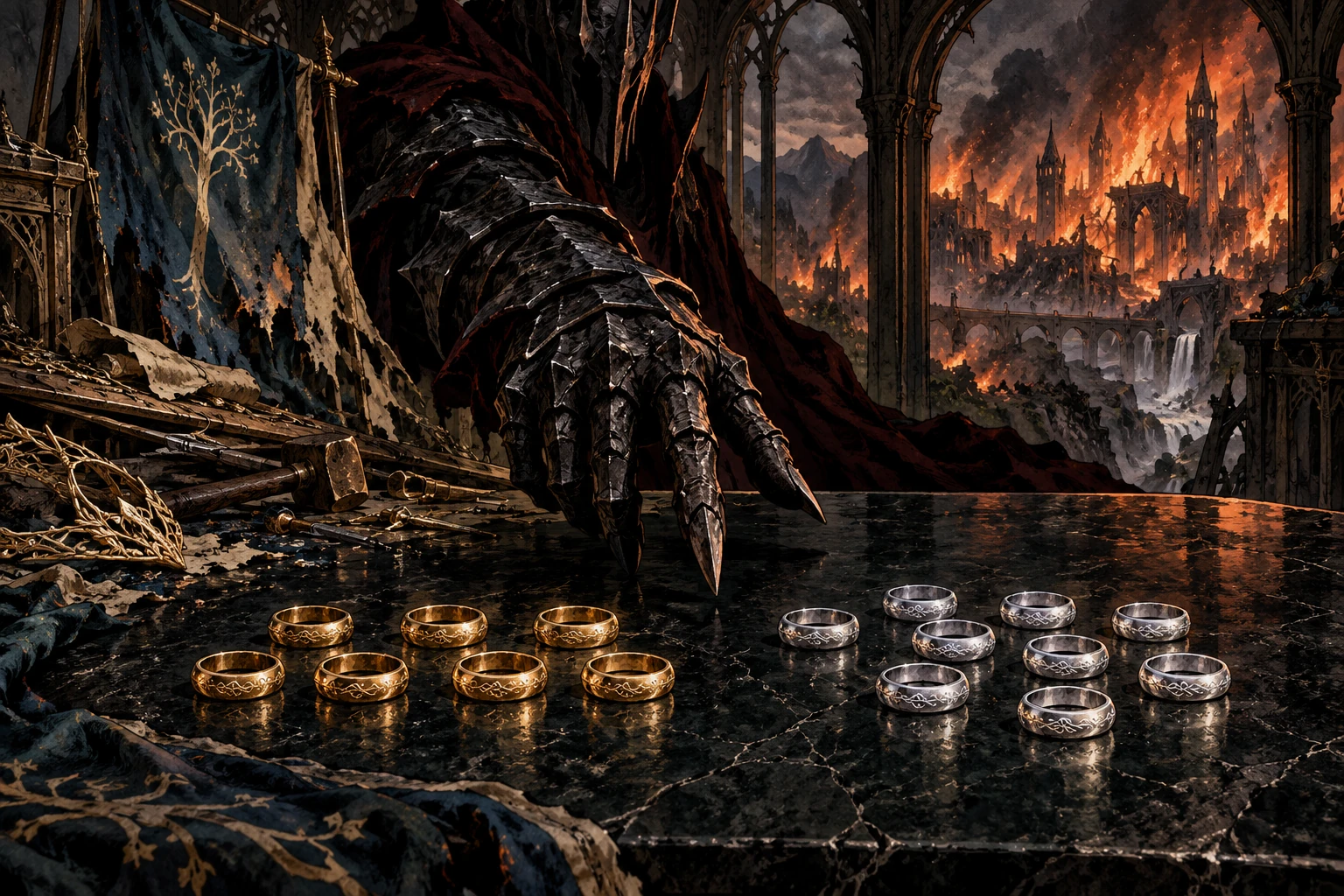
In the fires of Orodruin, Sauron forges a ruling Ring. Into it he pours his power, seeking dominion over the other Rings and their bearers.

The Ring is intended to govern other Rings and expose the purposes of their wearers. When Sauron first uses it, the Elves become aware of his design and remove theirs. The resulting conflict transforms gifts and craft into open war. The Ring also creates a future weakness: destroy it, and the power Sauron has placed within it is lost.

The Ring is more than a weapon he carries: it contains power he has invested outside himself. That makes him terrifying while it endures—and vulnerable if it can be destroyed.

Go deeper into the lore

The Elven smiths of Eregion had made Rings of Power with knowledge shared by Sauron in a fair disguise. His ruling Ring reveals the betrayal.

Why this matters Follow the consequences
Power invested becomes a weakness

Sauron places much of his own power in the Ring. Destroying it will undo that power, making a small hidden quest decisive in a war of armies.

Continue to The Fire at the World’s Heart
How many Rings are there, and who gets them?

The familiar count is nineteen Great Rings and the One. Celebrimbor makes the Three for the Elves. The Seven and the Nine pass into the hands of Dwarves and Men through Sauron’s interventions. Durin’s Folk held a different tradition about their own Ring: they said it came directly from the Elven smiths. The Nine become Ringwraiths. The Dwarves resist that kind of domination, though their Rings feed the pursuit of wealth.

S.A. 1697
The Refuge of Rivendell · The fall of Eregion
The fall of Eregion

The Refuge of Rivendell

Who & where

Elrond is the Half-elven son of Eärendil. His refuge is also called Imladris.

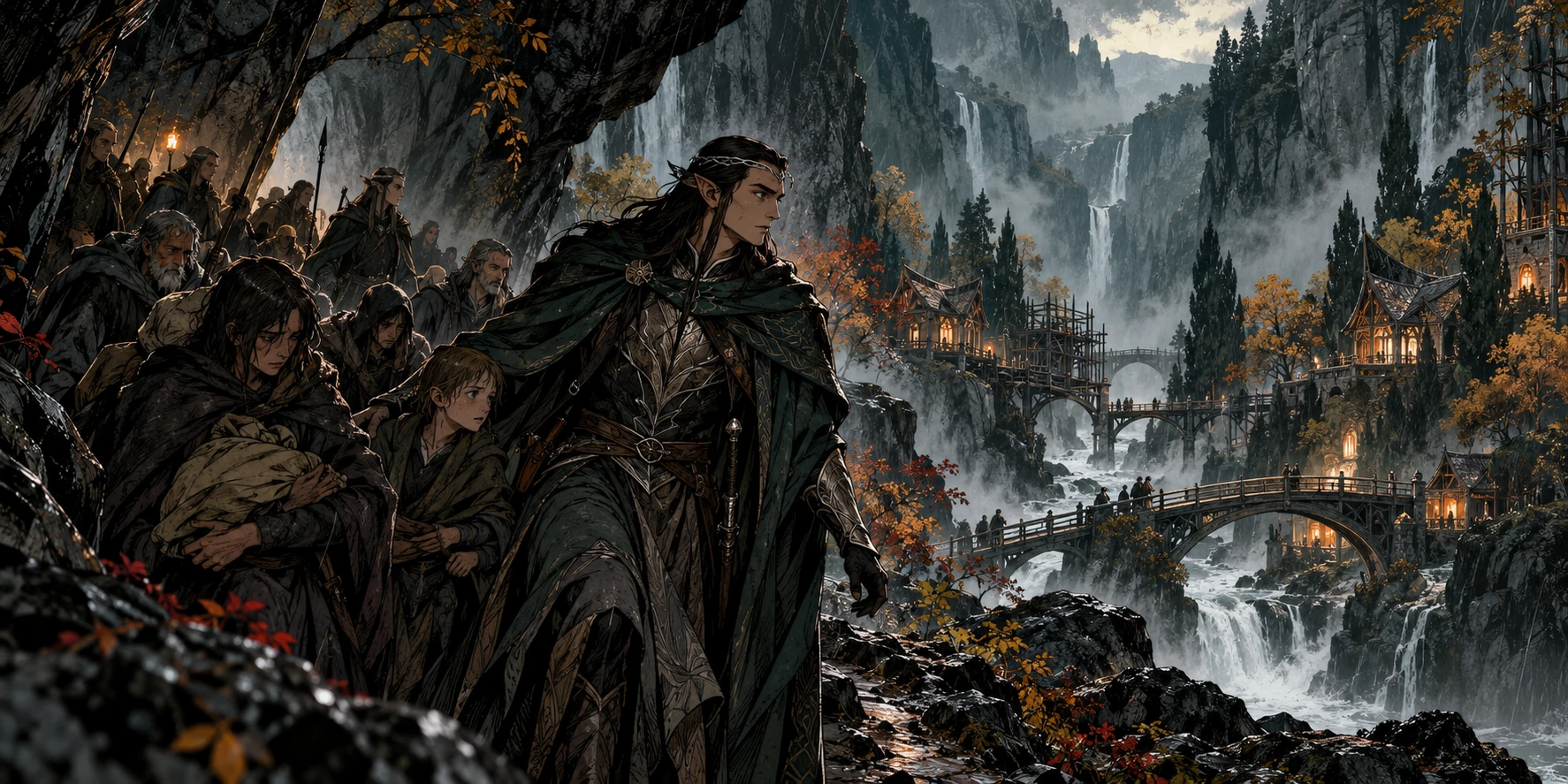
Sauron overruns Eregion. Elrond withdraws with survivors and establishes Imladris, a hidden refuge that will endure far into the next age.

Sauron captures Celebrimbor and tortures him for the whereabouts of the Rings. Celebrimbor dies without revealing the hiding places of the Three. Elrond’s force cannot save Eregion, but its withdrawal creates the refuge of Imladris, or Rivendell. The loss of the smiths explains both why captured Rings fall into Sauron’s hands and why the surviving Three remain entrusted to guarded Elven leadership. Rivendell preserves people, knowledge, and living memory across the ages. Círdan keeps the Grey Havens in Lindon, on the changed western coast. They remain a place of refuge and departure through the Second and Third Ages.

A defeat gives rise to a sanctuary. The knowledge and people saved here will eventually help a very different company decide the fate of Sauron’s Ring.

S.A. 1700–1701
Númenor Turns the War · Lindon · Eriador · Númenor
Lindon · Eriador · Númenor

Númenor Turns the War

Who & where

Gil-galad is the High King of the remaining Noldor in Middle-earth. Lindon lies beside the western sea.

After Eregion’s ruin, Sauron threatens the remaining Elven strongholds in the west. Númenor sends a powerful fleet, and the alliance forces him back from Eriador.

Eriador is the northwestern region that will later contain Rivendell, Bree, and the Shire. Gil-galad rules the Elven realm of Lindon on its western coast. Their survival is not secured by Elven strength alone: aid from the sea changes the course of the war. Sauron learns to hate Númenor’s power long before he discovers a subtler means of defeating it.

The island saves others from domination, then spends later centuries becoming more vulnerable to the desire for domination itself.

Second Age · after the war in Eregion
Sauron seizes many of the Rings made by the Elven smiths and distributes them as tools of domination. Seven become associated with Dwarven kings and Nine with powerful mortal men.
Middle-earth

The Rings Are Scattered

Who & where

The Rings began as an Elven undertaking. Their familiar division among different peoples is a consequence of Sauron’s later strategy.

Sauron seizes many of the Rings made by the Elven smiths and distributes them as tools of domination. Seven become associated with Dwarven kings and Nine with powerful mortal men.

The Nine extend their bearers’ lives until they fade into Ringwraiths. Dwarves resist being reduced to wraiths or obedient puppets, but their Rings inflame possessiveness and the pursuit of wealth. The Three remain hidden: Sauron never touched them, yet their making still binds their fate to the One.

One instrument of control produces different kinds of ruin in different hands.

S.A. 2251
The Shadow of the Nine · The Ringwraiths
The Ringwraiths

The Shadow of the Nine

Who & where

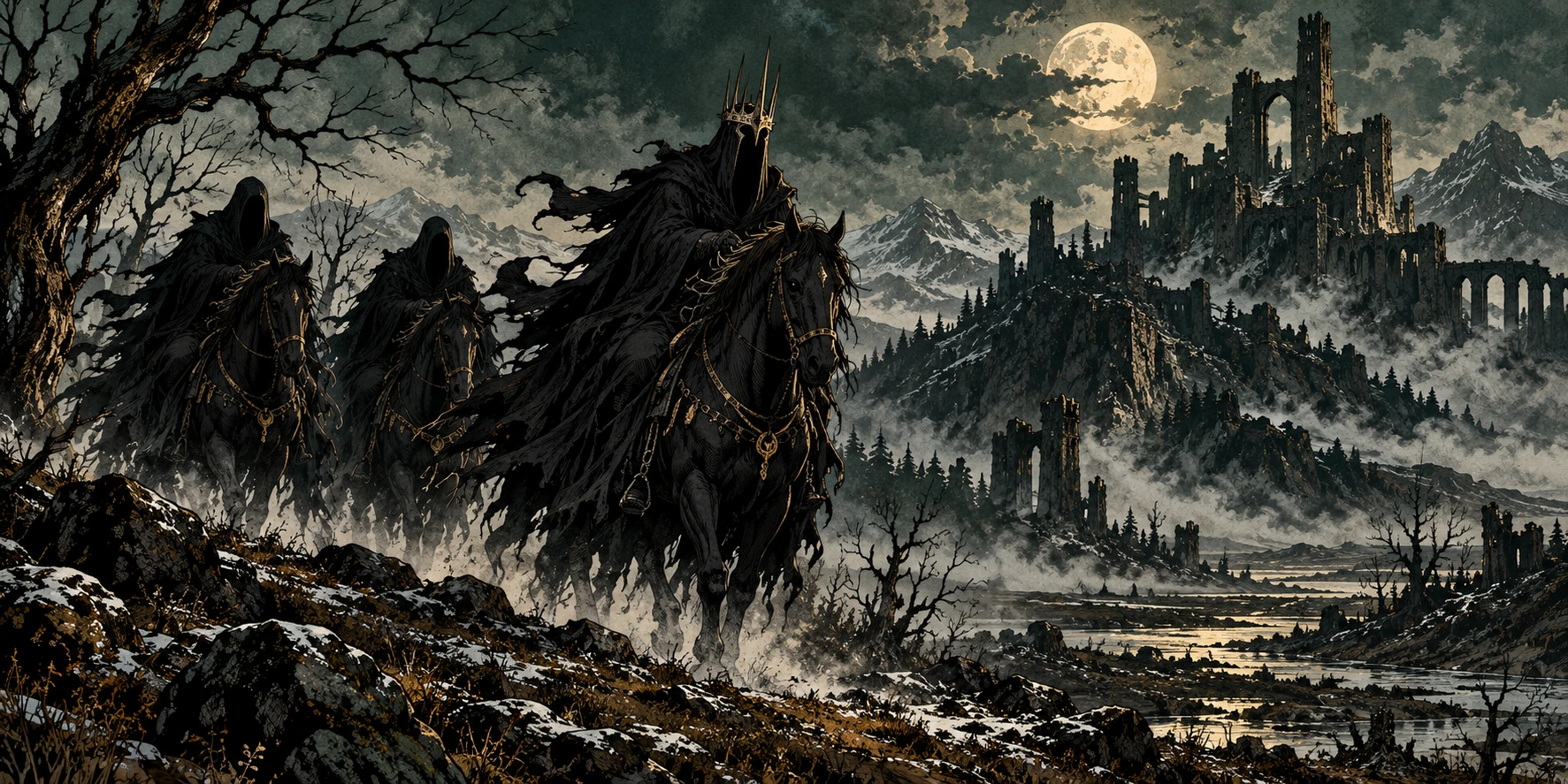
The Nazgûl are nine mortal Men enslaved through Rings of Power. Their chief is later called the Witch-king.

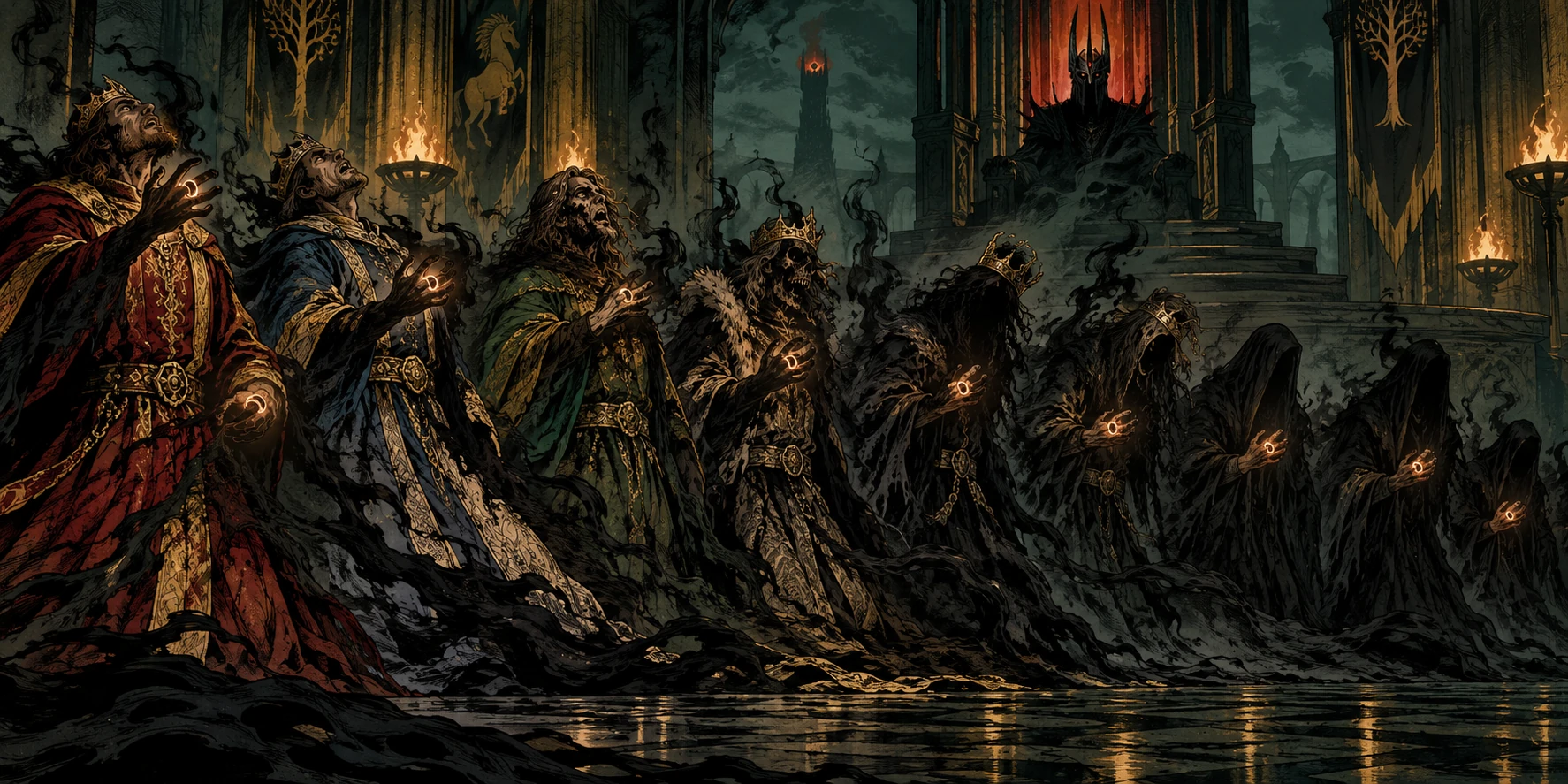
The Nazgûl first appear in the recorded histories. Mortal bearers of the Nine Rings have faded into servants bound to the will of Sauron.

The Rings offer strength and unnaturally extended life, but their bearers fade and become dependent on Sauron. They are not a separate people born as monsters. Their history gives a concrete picture of what it means to exchange freedom for power. Their later hunt for Frodo brings that ancient bargain into the peaceful Shire.

The promise of greatness has ended in the loss of self. The Ringwraiths show what Sauron’s gifts can become when power is accepted without freedom from its giver.

Overview · Second Age c. 1800–3261
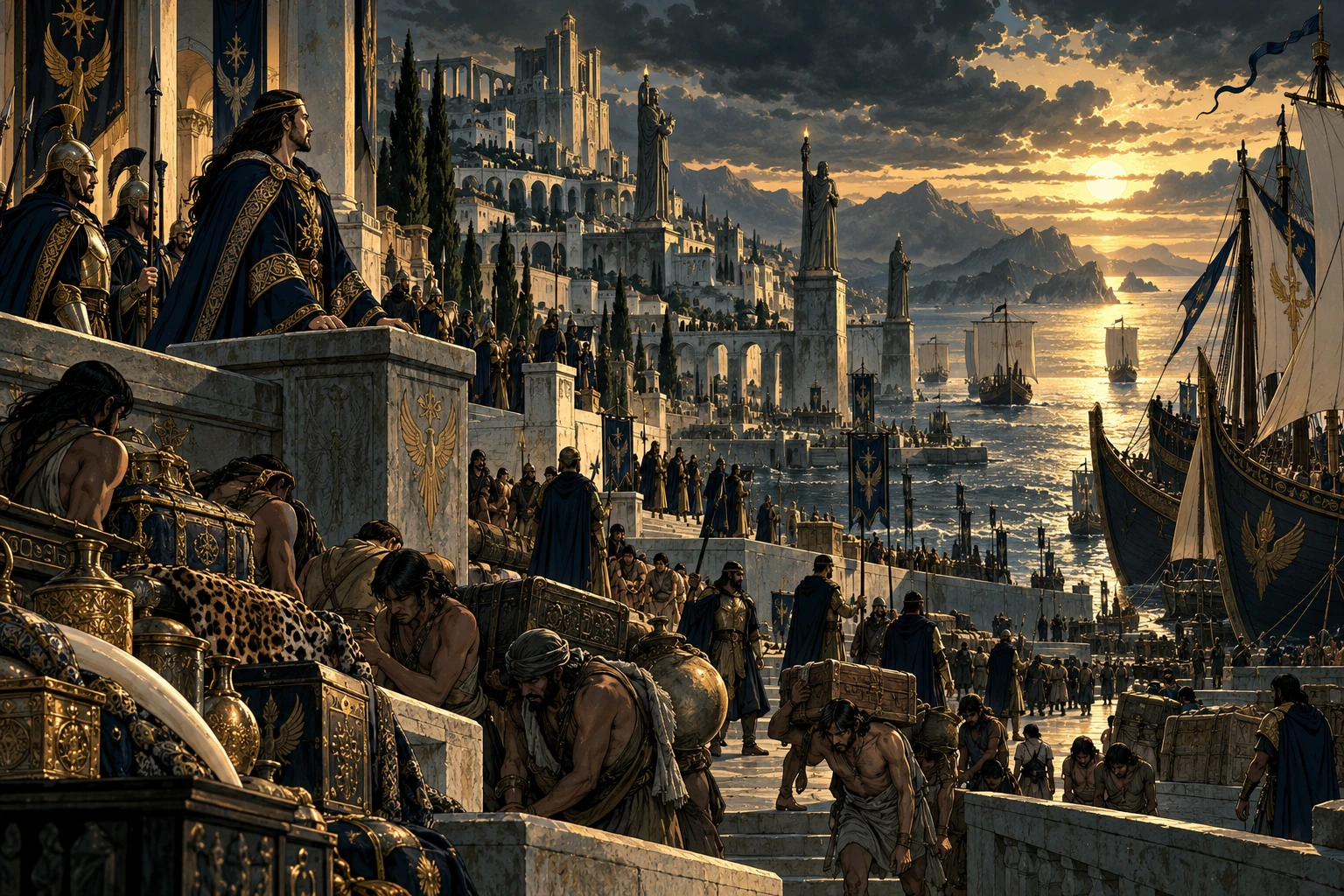
Númenor’s voyages change from friendship and teaching to the taking of tribute, timber, and territory. Its coastal settlements become centres of power over other peoples.
Númenor & the coasts of Middle-earth

The Gift Becomes an Empire

Who & where

The Númenóreans live longer than other Men, but still die. Increasing power does not remove that limit.

Númenor’s voyages change from friendship and teaching to the taking of tribute, timber, and territory. Its coastal settlements become centres of power over other peoples.

Under Tar-Ciryatan and Tar-Atanamir, Númenor demands tribute from the peoples of Middle-earth. Communities that once received help from visiting mariners now owe wealth to rulers across the sea. Farther south, the fortified harbour of Umbar gives Númenor a permanent base on the mainland. At home, fear of death hardens into resentment of the immortal Elves and the Valar. The Faithful preserve friendship with the West while royal policy turns against it. Sauron will exploit a pride and fear that have already grown over generations.

The island’s fall begins before Sauron arrives as its captive.

Late Second Age · before S.A. 3255
Tar-Palantir looks west from the heights near Andúnië
Númenor · Andúnië and the Meneltarma

Tar-Palantir & the Faithful

Who & where

The Faithful keep friendship with the Elves and honour Eru. Tar-Palantir, born Inziladûn, takes a royal name in the Elven tongue.

Tar-Palantir gives the Faithful a respite from persecution. He returns to worship on the Meneltarma, tends the White Tree, and watches for sails from the West from a tower near Andúnië. His brother Gimilkhâd leads opposition to him, and the island remains divided.

Tar-Palantir’s daughter Míriel should inherit the sceptre. Instead her cousin Pharazôn takes her as his wife against her will and seizes the throne. Amandil, lord of Andúnië and father of Elendil, belongs to the Faithful. Tar-Palantir’s warning that the royal line will end with the White Tree later helps explain why Pharazôn hesitates to let Sauron destroy it.

The respite ends when Pharazôn takes the sceptre. The Faithful endure through families and loyalties that will survive the island itself.

S.A. 3262
The Captive Who Becomes a Counsellor · Ar-Pharazôn · Sauron
Ar-Pharazôn · Sauron

The Captive Who Becomes a Counsellor

Who & where

The Faithful include Elendil and his sons Isildur and Anárion, who will found the kingdoms in exile.

Ar-Pharazôn, Númenor’s proud king, brings Sauron to the island as a prisoner. Unable to overcome its military power directly, Sauron gains influence through flattery, fear, and promises.

Númenórean kings have increasingly resented death and the restrictions on sailing west. Sauron exploits that resentment rather than creating it from nothing. He encourages the persecution of the Faithful, those who preserve friendship with the Elves and reverence for the old traditions. His apparent defeat becomes his opportunity to poison the kingdom from within. He promotes worship of Morgoth as a giver of freedom and life, with a great temple and human sacrifice. The promises invert the truth: the old enemy who marred the world is presented as an escape from its mortal limits.

The downfall begins when a frightened ruler mistakes an enemy’s promises for a way to escape the limits of human life.

Late Second Age · before the Downfall
Armenelos · Númenor · Isildur Saves the White Tree
Armenelos · Númenor

Isildur Saves the White Tree

Who & where

Isildur is Elendil’s elder son. Nimloth is a living gift from the Elves, not a Silmaril and not one of the original Two Trees.

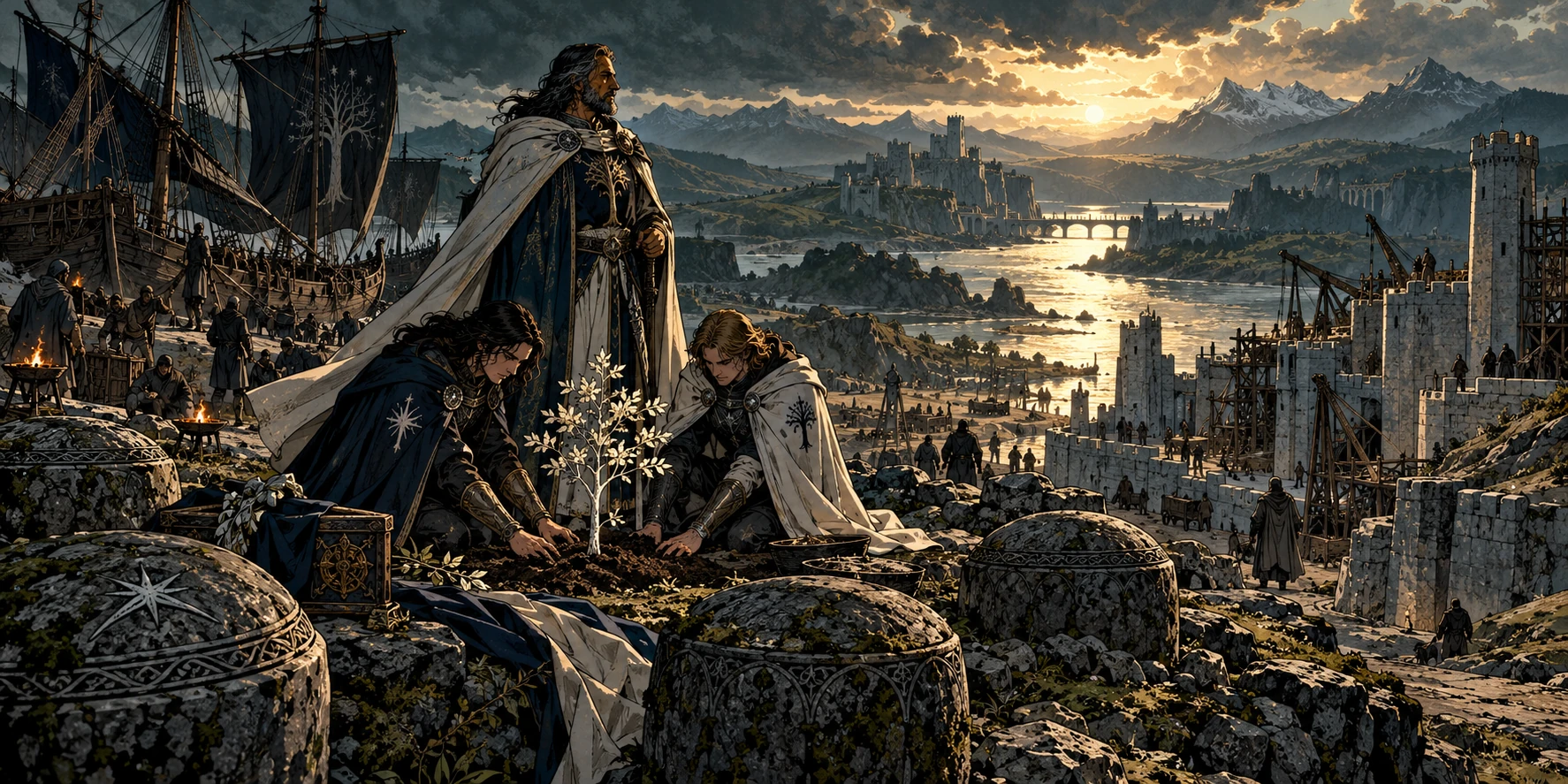
As Sauron gains power in Númenor, he urges the king to destroy Nimloth, the White Tree. Isildur enters the guarded royal court in disguise and takes a fruit before the tree can be cut down.

The guards wound Isildur badly, but he escapes and the fruit is planted in secret. When its young shoot puts out its first leaf, he recovers. Nimloth is later burned, yet its line survives. Isildur carries the seedling away in the ships of the Faithful. Its descendants become the White Trees of Gondor, giving the later royal emblem a history of risk and preservation rather than merely decoration.

The man who will fail to surrender the Ring first risks his life to save something that cannot give him dominion.

Why this matters Follow the consequences
A living symbol survives the fall

Isildur saves fruit from Númenor’s White Tree. Its descendants become a sign of Gondor’s continuity, renewed when Aragorn finds a new sapling.

Continue to The Return of the King
S.A. 3319
The Downfall of Númenor · The world is changed
The world is changed

The Downfall of Númenor

Who & where

Ar-Pharazôn commands the doomed assault. Elendil leads the Faithful who survive in ships.

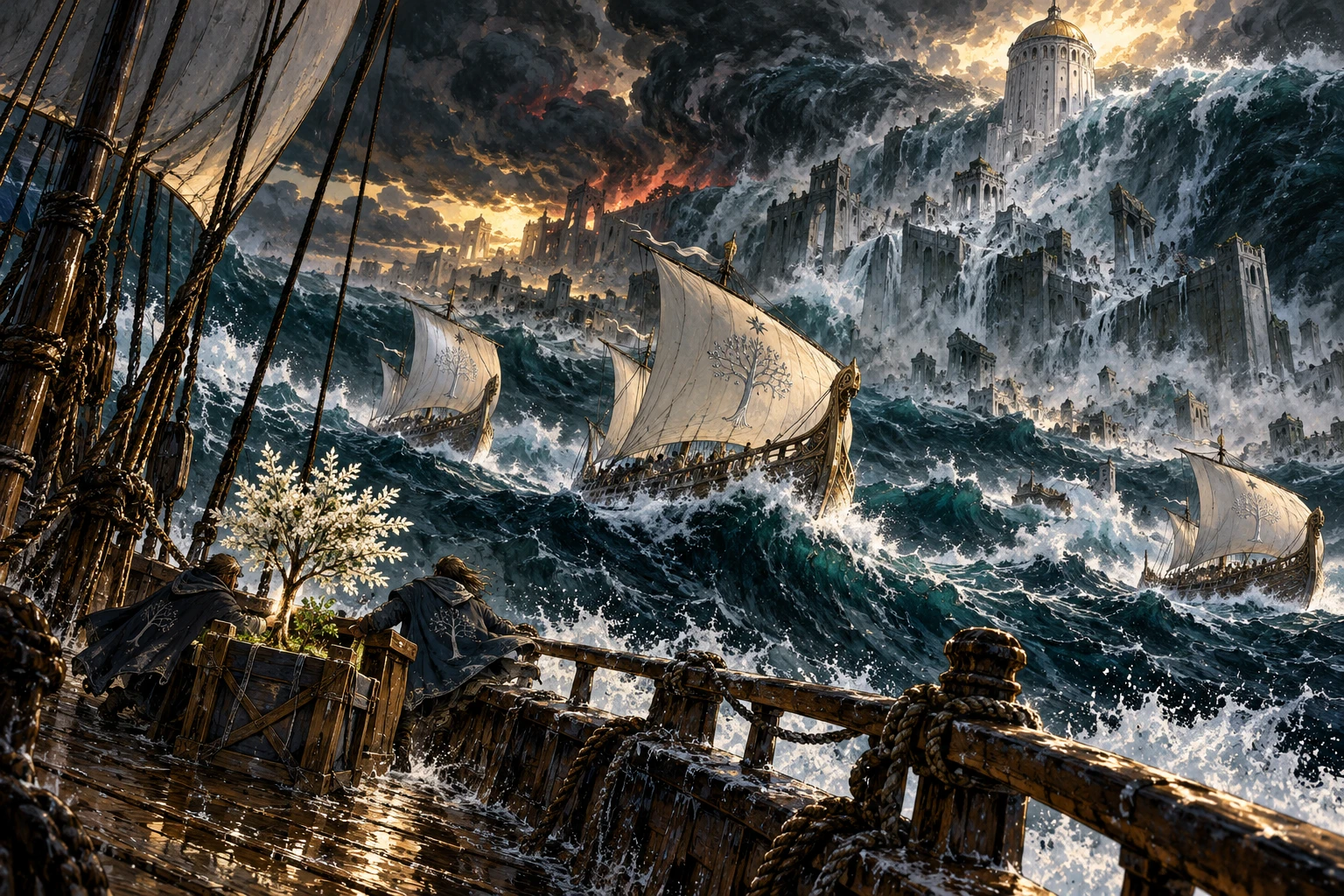
Led astray by Sauron, the king challenges the Undying Lands. Númenor is swallowed by the sea; the Faithful escape to Middle-earth.

Sauron persuades Ar-Pharazôn that a landing in Aman can overcome mortality. The Valar appeal to Ilúvatar; the king’s invading host is buried and Númenor is drowned. The world is changed, and Aman is removed from the ordinary voyages of mortal ships. Sauron’s body is destroyed, but his spirit escapes and returns to Middle-earth. The One Ring is not destroyed with the island. He can no longer use the beautiful appearance with which he deceived the island. Elendil’s surviving ships carry people and living inheritance rather than a rescued empire.

Sauron turns the fear of death into a challenge to the West. The island falls, but Elendil’s ships preserve a remnant of its people and a different account of its legacy.

Why this matters Follow the consequences
Refugees carry a civilisation forward

Elendil and his sons escape the disaster. They establish Arnor and Gondor, preserving Númenórean traditions without recovering the lost island.

Continue to The Realms in Exile
Within this moment · Númenor · the ships of the Faithful

An island falls. A memory escapes.

Three threads of the turning point

Ancient sailing ships flee the storm overwhelming Númenor, carrying survivors and a young White Tree.
Original interpretive illustration · Númenor · the ships of the Faithful
Power cannot abolish death

Sauron persuades Ar-Pharazôn to attack the Undying Lands. The king seeks freedom from mortality through conquest, bringing catastrophe on his own people.

The Faithful take to the sea

Elendil and his sons survive aboard their ships. Their escape carries people, heirlooms, and the living line of the White Tree into a world transformed.

A beginning on another shore

Arnor and Gondor will preserve a remnant of Númenor’s culture in Middle-earth. The island is lost; its history continues through the choices of its survivors.

S.A. 3320
The Realms in Exile · Arnor · Gondor
Arnor · Gondor

The Realms in Exile

Who & where

Elendil founds the northern realm of Arnor; his sons Isildur and Anárion establish Gondor in the south.

Elendil and his sons establish Arnor and Gondor. Seeds, stones, memory, and the White Tree carry a fragment of lost Númenor into a changed world.

The survivors carry palantíri, the seeing-stones, and a seedling of the White Tree. These are links to a homeland they cannot recover. The new realms are not replacements untouched by grief: they must build relationships and institutions in lands already inhabited. Sauron soon threatens them, forcing another alliance with the Elves. In Gondor, Isildur holds Minas Ithil, the Tower of the Moon, and Anárion holds Minas Anor, the Tower of the Sun; Osgiliath is their chief city. Those names will change as the war moves back across the land.

The new kingdoms inherit Númenor’s memory, not its invulnerability. Their towers and lineages will carry that inheritance through the long struggle against Sauron.

Second Age 3430–3441
The Last Alliance · The siege of Barad-dûr
The siege of Barad-dûr

The Last Alliance

Who & where

Gil-galad leads the Elven hosts; Elendil leads the human kingdoms. Isildur is Elendil’s surviving son.

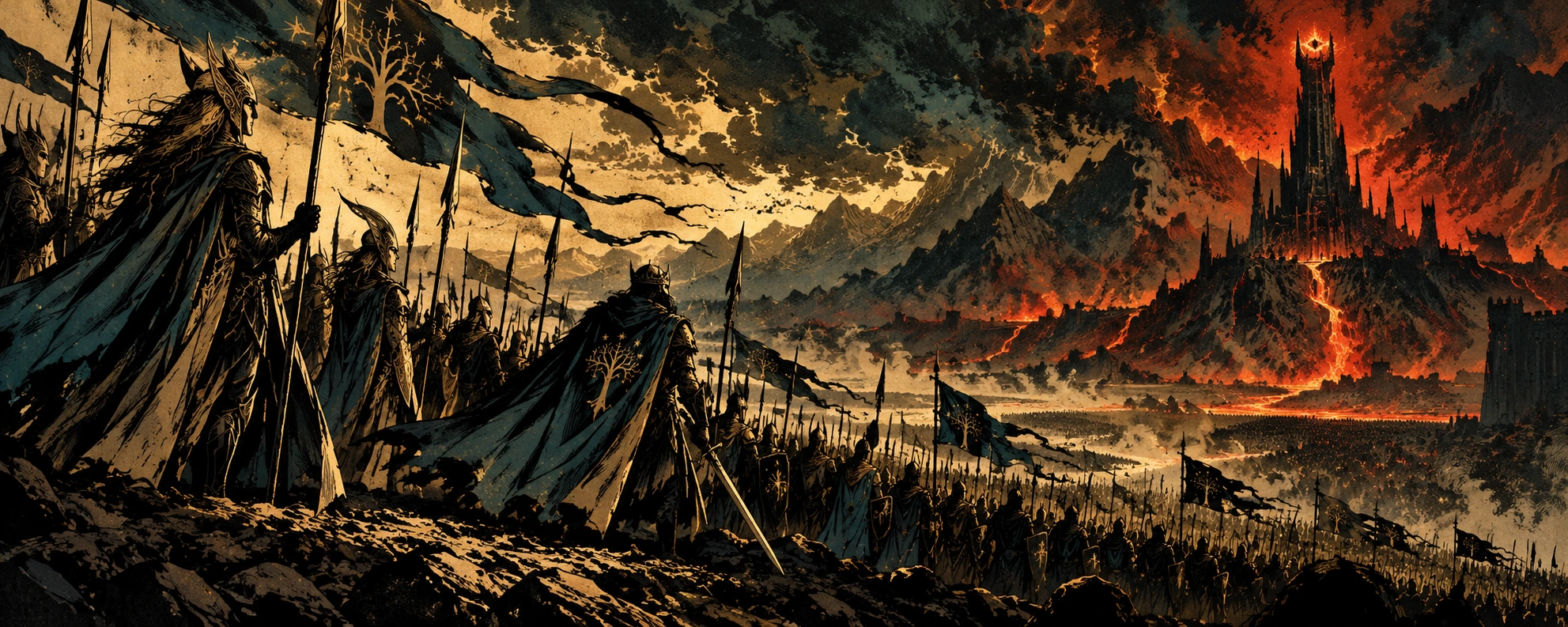
Elves and Men overthrow Sauron at a terrible cost. Isildur cuts the Ring from his hand, but keeps it. One age ends; its shadow remains.

Sauron attacks Gondor and takes Minas Ithil. Isildur escapes north while his brother Anárion helps hold the southern realm. Elendil and Gil-galad form their alliance in 3430; its armies win at Dagorlad in 3434 and begin a long siege of Barad-dûr. Anárion dies during the siege. At the final confrontation in 3441, Gil-galad and Elendil die overthrowing Sauron. Isildur cuts the Ring from his hand and keeps it as compensation for his father and brother, despite counsel to destroy it. Victory ends the age, but grief and the Ring’s temptation leave the enemy’s deepest power intact.

Sauron loses his body and the Ring, but the power he placed in it remains. The victory ends the age without ending the danger.

Why this matters Follow the consequences
A victory leaves its deepest danger intact

Sauron is overthrown, but Isildur keeps the Ring. Its survival prevents the triumph of the Alliance from becoming a final end to Sauron’s power.

Continue to The Ring Is Lost
Within this moment · The Last Alliance · the siege of Barad-dûr

The years before the last blow.

Three threads of the turning point

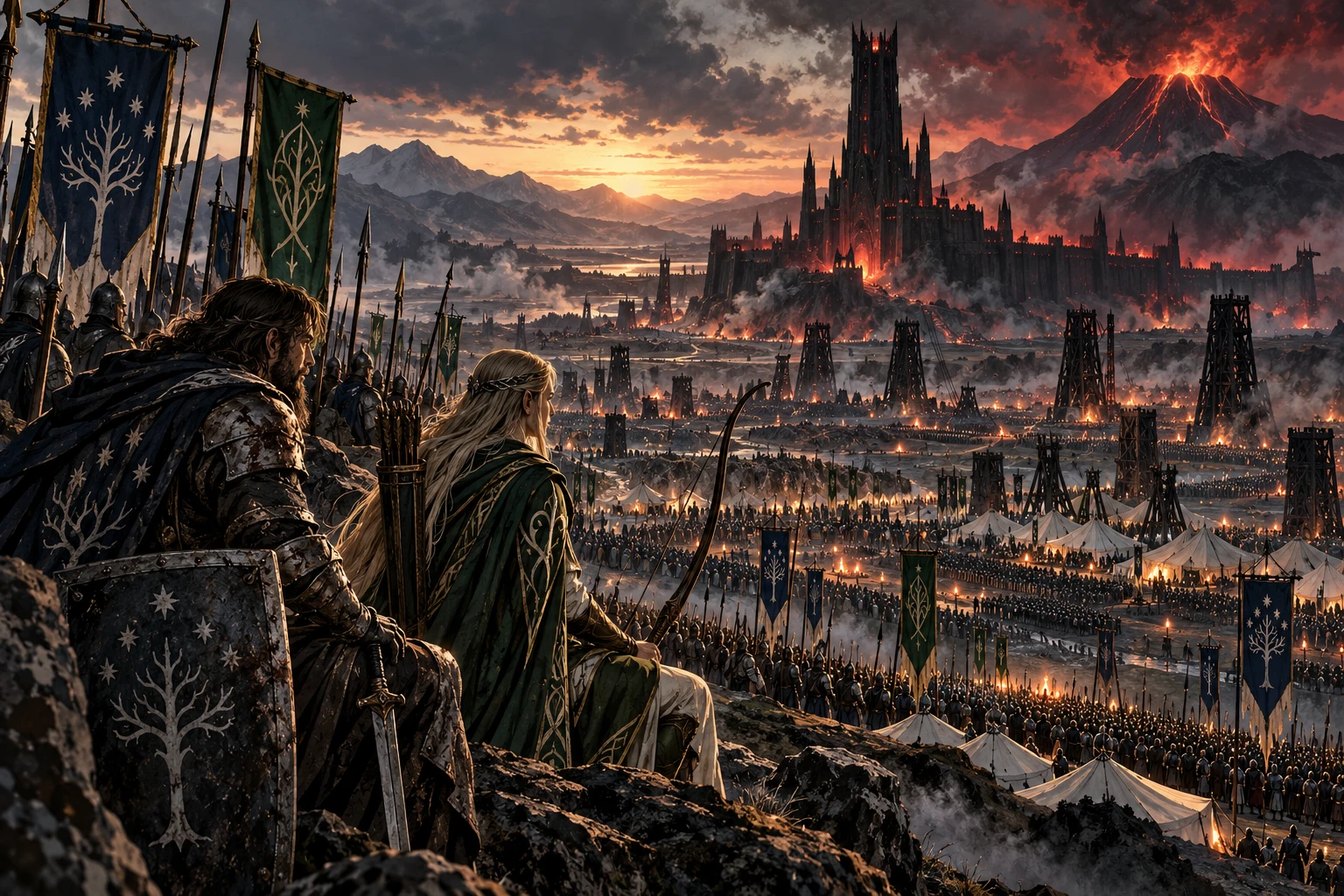
Human and Elven soldiers share a watch during the long siege of Barad-dûr beneath an ashen sky.
Original interpretive illustration · The Last Alliance · the siege of Barad-dûr
Two peoples stand together

Gil-galad and Elendil bring Elves and Men into a common war against Sauron. Their victory at Dagorlad opens the way into Mordor.

Endurance at the dark tower

The siege of Barad-dûr lasts seven years. Anárion, Elendil’s younger son, dies during it. The final confrontation costs the lives of both Gil-galad and Elendil.

A victory with an unfinished ending

Sauron is overthrown and Isildur takes the Ring. Its destruction is left undone, carrying the deepest danger of the Second Age into the Third.

And so the story turns

The enemy falls, but his Ring is kept. The Third Age begins with a victory whose most important choice has been left unfinished.

Continue into the third age
A symbolic broken sword and unmarked ring beside a dark river.
Between the ages

The long watch begins.

Sauron’s body has fallen. His Ring is kept, then lost: a victory becomes a long vigil.

Enter the third age
CHAPTER III / 3,021 Years

The courage of the small

Kingdoms fade, old dangers return, and the Ring passes into hands the powerful have barely noticed. At last, the fate of the great turns on friendship, endurance, and pity.

The Third Age
The story so far

The survivors of Númenor founded Arnor in the north and Gondor in the south. Both kingdoms survive the Last Alliance’s war against Sauron, though Elendil, his son Anárion, and the Elven king Gil-galad are dead. Elrond still holds Rivendell. Isildur leaves the war with the One Ring in his possession, and its survival leaves Sauron a way back to power.

T.A. 2
The Ring Is Lost · The Gladden Fields
The Gladden Fields

The Ring Is Lost

Who & where

Isildur is the king who cut the Ring from Sauron’s hand. The Anduin is the great river running east of the Misty Mountains.

Orcs ambush Isildur at the Gladden Fields. The Ring slips away into the Anduin, vanishing from the knowledge of the great for centuries.

On his northward journey, Isildur’s company is ambushed near the Gladden Fields. His three elder sons die, and the Ring slips from him as he tries to escape through the river. His youngest son Valandil survives at Rivendell. Isildur’s squire Ohtar also escapes with the shards of Narsil, the sword of Elendil. Both a living heir and a broken royal inheritance therefore survive the king. The Ring remains in the Anduin for centuries, missing from the knowledge of the great but not destroyed.

No kingdom knows where the Ring has gone. Its disappearance allows people to forget that Sauron’s defeat was unfinished, while the Ring waits beyond their plans.

How can Sauron return when Isildur has his Ring?

Sauron is a Maia. The Last Alliance overthrows his physical form, but his spirit survives and eventually rebuilds its strength. Much of his power remains bound up in the Ring while it exists, even when he cannot wield it.

c. T.A. 1000
The Coming of the Wizards · The Grey Pilgrim
The Grey Pilgrim

The Coming of the Wizards

Who & where

The five Istari are Gandalf, Saruman, Radagast, Alatar, and Pallando. They are Maiar sent in the bodies of old men to counsel the peoples resisting Sauron.

The Istari arrive from the West to help the peoples of Middle-earth resist Sauron. Among them is Gandalf, a wanderer with a deep faith in hope.

The Wizards are Maiar in the form of old Men, exposed to weariness, fear, and temptation. They are sent to encourage resistance, not to rule through power or match Sauron as another Dark Lord. Círdan recognises Gandalf’s purpose and entrusts him with Narya, the Ring of Fire, to help sustain courage against despair. Saruman leads the order but increasingly studies the enemy’s instruments of domination. Their later choices grow out of these different understandings of their task. Gandalf (Olórin, called Mithrandir by the Elves) receives Narya from Círdan and travels widely. Saruman (Curumo, called Curunír) leads the order and later the White Council, but his study of the Rings becomes a desire to wield their power. Radagast (Aiwendil) lives at Rhosgobel near Mirkwood and knows the birds and beasts. Alatar and Pallando travel into the East in the account in Unfinished Tales. That account places the Wizards’ arrival in the Third Age, while Tolkien’s late notes send the Blue Wizards to Middle-earth in the Second Age.

Their task is to inspire resistance, rather than to rule the peoples they help. Gandalf’s trust in the overlooked will prove more useful than any desire to command.

Go deeper into the lore

In Unfinished Tales, Oromë chooses Alatar, who takes Pallando as his companion. Saruman travels east with the pair and returns west. In Letter 211 Tolkien conjectures that the two may have failed and founded magical traditions. In the much later Last Writings he calls the pair Morinehtar and Rómestámo, places their arrival in the Second Age, and credits their work against Sauron in the East with weakening the forces he could send west. The published narrative gives neither a settled fate. Radagast passes Saruman’s message to Gandalf in good faith. Gandalf’s request that Radagast enlist birds and beasts for news helps bring Gwaihir to Orthanc. Radagast’s later fate is unrecorded. Gandalf returns to the West after the war; Saruman dies in the Shire.

Sources & further reading
T.A. 1300
The Witch-king in the North · The rise of Angmar
The rise of Angmar

The Witch-king in the North

Who & where

Angmar is a hostile northern kingdom. Its ruler is the chief of Sauron’s Ringwraiths.

Angmar rises beyond the northern kingdoms. Its ruler wages a long war against the divided heirs of Arnor, wearing down a realm already fractured by rivalry.

Arnor has split into smaller realms, leaving its people vulnerable to a long campaign of pressure and war. The Witch-king aims at the destruction of the descendants of Elendil. Centuries later the same enemy will command the assault on Minas Tirith, linking the fall of the northern kingdom to the final crisis of the southern one.

Arnor’s divisions make a united defence harder to sustain. The northern war steadily strips away the visible power of Isildur’s heirs.

T.A. 1601
The Founding of the Shire · A small corner of the world
A small corner of the world

The Founding of the Shire

Who & where

Hobbits are a small, mortal people who love settled communities, food, gardens, and familiar paths.

Hobbits settle west of the Baranduin. A quiet country of gardens and green hills takes root, far from the counsels of the mighty.

Their settlement is authorised by the king of Arthedain, a surviving part of Arnor. Long after the northern kingdom disappears, the Shire’s people retain customs without much understanding of the history behind them. Their peace is not total isolation: it depends in part on watchfulness beyond their borders, including the Rangers’ protection.

The story’s quietest country grows while greater powers struggle elsewhere. Its ordinary freedoms will give the Ring-bearers something concrete to protect.

T.A. 1974–1975
The End of the North-kingdom · The Dúnedain
The Dúnedain

The End of the North-kingdom

Who & where

Arthedain is the last major remnant of Arnor. The Dúnedain are the descendants of the Númenórean Faithful.

Arthedain falls and Fornost is taken. An allied army later defeats Angmar, but the northern kingdom is gone; its heirs will survive as wandering chieftains.

The last northern king dies after fleeing the ruin. His surviving line continues through chieftains instead of crowned rulers. Elrond’s refuge helps preserve their children and heirlooms. Aragorn will grow up within this hidden history, inheriting both a claim and the obligation to protect people who do not know his name.

Royal authority becomes a hidden inheritance. The Rangers protect lands whose inhabitants often know little of the people keeping watch over them.

Why this matters Follow the consequences
A kingdom becomes a hidden lineage

Arnor’s royal line survives among the northern Rangers. Aragorn inherits its claim while growing up under Elrond’s protection.

Continue to The Heir Raised in Rivendell
T.A. 1980
The Terror Beneath the Mountain · Durin’s Bane
Durin’s Bane

The Terror Beneath the Mountain

Who & where

Khazad-dûm later becomes known as Moria. A Balrog is a spirit corrupted in Morgoth’s service during the ancient wars.

Delving deep for mithril, the Dwarves awaken a Balrog. Durin VI is killed, and Khazad-dûm begins its transformation from a glorious home into Moria, the Black Pit.

The Dwarves’ search for mithril, a rare and valuable silvery metal, reaches the hidden creature. King Durin VI and his successor die, and the population abandons the kingdom. This is not the original founding of an evil realm but the ruin of a great home. The Fellowship later enters halls whose splendour and loss Gimli deeply understands.

The richest Dwarf-realm loses its home to something older than its deepest workings. Centuries later, the Fellowship will have to pass through the consequences.

Why this matters Follow the consequences
An ancient danger waits on a later road

The Balrog drives the Dwarves from Khazad-dûm. Centuries later, the Fellowship encounters the same terror while attempting to cross Moria.

Continue to The Bridge of Khazad-dûm
Third Age 2002 · after centuries of decline
Minas Ithil becomes Minas Morgul · The Tower of the Moon Falls
Minas Ithil becomes Minas Morgul

The Tower of the Moon Falls

Who & where

Minas Ithil is a city of Gondor east of the Anduin. The Nazgûl are Sauron’s Ringwraiths, led by the Witch-king.

After a two-year siege, the Ringwraiths capture Minas Ithil and its seeing-stone. The city becomes Minas Morgul, a stronghold of terror facing Gondor across the river.

This reversal follows generations of damage. The Kin-strife, a civil war in the fifteenth century of the Third Age, weakens Gondor and leaves lasting hostility around Umbar. The Great Plague of 1636 empties settlements and breaks the watch on Mordor. When Minas Ithil falls in 2002, its captured palantír gives Sauron another instrument for confronting people who use the other stones. Minas Anor is renamed Minas Tirith, the Tower of Guard. Frodo will later pass beneath the enemy city, while Denethor rules the western city still trying to hold the frontier.

The map’s opposing towers were once sister cities. Their divided fate explains how the enemy comes to stand so close to Gondor’s heart.

T.A. 2050 onward
Gondor Waits for a King · Gondor · the Stewards
Gondor · the Stewards

Gondor Waits for a King

Who & where

Denethor, Boromir, and Faramir belong to the ruling family of the Stewards during the War of the Ring.

Gondor’s king Eärnur disappears after accepting a challenge from the Witch-king. With no accepted royal successor, the kingdom is governed by hereditary Stewards, who preserve its rule in the king’s absence.

Gondor is the southern kingdom founded by Númenórean survivors. Its companion kingdom, Arnor in the north, has already fallen. Aragorn will descend from Arnor’s line of kings, while Gondor continues through a different political history. The Stewards are rulers with real responsibilities, not temporary caretakers who do nothing while waiting. Eärnur’s fatal challenge comes from Minas Morgul, the fallen city now held by the Witch-king. His disappearance ends the line of reigning kings in Gondor without erasing the more distant northern heirs of Isildur.

The question of a returning king will later involve both a claim of ancestry and the practical need to earn trust in a threatened kingdom.

T.A. 2463
Déagol Finds the Ring · Déagol · Sméagol
Déagol · Sméagol

Déagol Finds the Ring

Who & where

Gollum and Sméagol are the same person; Déagol is the companion he kills to obtain the Ring.

A river-dweller named Déagol discovers the lost Ring. His companion Sméagol wants it, murders him, and takes it. Rejected by his community, Sméagol eventually retreats beneath the mountains.

Sméagol belongs to a people related to the Hobbits. The Ring unnaturally prolongs his life while his isolation and possessiveness deform it. He becomes known as Gollum, after the sound he makes in his throat. He does not know the full identity of the treasure he calls his Precious, but it becomes the centre of his existence.

The Ring’s history shifts from kings and battlefields to one hidden life. Its effects are intimate before they become world-shaping again.

T.A. 2463
The Wise Form a Council · The White Council
The White Council

The Wise Form a Council

Who & where

The Istari, or Wizards, are Maiar sent in bodily form to help the peoples of Middle-earth resist Sauron.

Leading Elves and Wizards establish the White Council to consider the growing Shadow. Saruman becomes its head, while Gandalf remains a wandering member rather than a settled ruler.

Galadriel, Elrond, Gandalf, and Saruman are among the key figures of the Council. They do not yet have a complete picture of Sauron’s movements or the fate of the Ring. Their different temperaments matter: Gandalf works through relationships and observation, while Saruman increasingly trusts expertise, secrecy, and his own authority.

Resistance requires shared knowledge, but a council is only as trustworthy as the purposes of the people within it.

T.A. 2510
The Ride of Eorl · The oath of Cirion & Eorl
The oath of Cirion & Eorl

The Ride of Eorl

Who & where

Eorl leads the Éothéod, ancestors of the Rohirrim. Cirion governs Gondor as Steward.

The riders of the north come to Gondor’s aid at the Field of Celebrant. In gratitude, Cirion grants them the land that becomes Rohan.

After Eorl’s riders rescue Gondor’s army, Cirion grants them the land of Calenardhon. It becomes Rohan. The agreement includes an oath of mutual aid, making the two kingdoms allies rather than one a simple province of the other. The promise supplies the historical foundation for Rohan’s ride to Minas Tirith in the War of the Ring.

A rescue becomes a friendship between kingdoms. The oath made here will be answered when Gondor calls for aid in the last war.

Why this matters Follow the consequences
An old promise is answered

Eorl’s aid to Gondor establishes the friendship of Rohan and Gondor. Théoden’s ride to Minas Tirith renews that alliance at terrible cost.

Continue to The Battle of the Pelennor
Third Age 2758–2759
Rohan · the refuge at Helm’s Deep · Helm & the Long Winter
Rohan · the refuge at Helm’s Deep

Helm & the Long Winter

Who & where

Helm Hammerhand is an earlier king of Rohan. Wulf leads an invasion; Fréaláf is Helm’s nephew and the ancestor of Théoden’s royal line.

Rohan is overrun while a terrible winter deepens hunger and siege. Helm retreats to the mountain refuge later called Helm’s Deep, where he becomes a feared figure in the snow but cannot save his own life.

The conflict grows out of political rivalry and old hostility between Rohan and the Dunlendings. Wulf seizes Edoras; Helm and his sons die during the catastrophe. In the spring Fréaláf retakes the Golden Hall and becomes king. Saruman then receives the keys of Orthanc and permission to dwell in Isengard. A future guardian is welcomed beside a kingdom that will one day need protection from him. The old fortress and its names carry this earlier loss into Théoden’s later defence.

The stronghold that shelters Théoden has sheltered a desperate king before; the neighbour once welcomed as a protector will become its next besieger.

T.A. 2770
The Desolation of Smaug · The Lonely Mountain
The Lonely Mountain

The Desolation of Smaug

Who & where

Smaug is a dragon who takes Erebor, the Lonely Mountain. Thorin Oakenshield is the heir of its displaced Dwarven king.

Smaug descends on Erebor, driving the Dwarves into exile and ruining Dale. Beneath the Lonely Mountain, a dragon coils around a stolen kingdom.

The neighbouring human town of Dale is also ruined. Refugees carry different claims and memories from the disaster. Gandalf later sees the danger in leaving a powerful dragon near lands Sauron may attack. Thorin’s desire to regain his home and Gandalf’s strategic concern help bring about the quest that hires Bilbo.

The exiles cannot forget the home and treasure beneath the mountain. Their attempt to reclaim it will eventually draw an unlikely burglar into the larger history.

Third Age 2790–2799
Azanulbizar · outside Moria’s East-gate · Thorin’s Shield of Oak
Azanulbizar · outside Moria’s East-gate

Thorin’s Shield of Oak

Who & where

Thrór is Thorin’s grandfather; Thráin is his father. Dáin Ironfoot is their younger kinsman, not Thorin’s son.

The Orc-chief Azog kills Thrór in Moria, provoking a war fought by the Dwarven houses. At its final battle, Thorin uses an oak branch as a shield and earns the name Oakenshield.

The Dwarves win at Azanulbizar in 2799, but their losses are devastating. Dáin kills Azog, yet warns against entering Moria: Durin’s Bane still waits inside. Victory cannot restore that ancestral home, while Smaug still holds Erebor. Thráin and Thorin eventually lead their people west to the Blue Mountains, surviving through labour and craft. Thráin later vanishes on a journey; Sauron captures him, takes his Dwarven Ring, and leaves him dying in Dol Guldur, where Gandalf will find him. Thorin’s quest grows from several lost homes and generations of grief.

The oak shield is born in a victory that cannot give its survivors what they most want: a safe way home.

T.A. 2850
The Necromancer Is Unmasked · Dol Guldur · southern Mirkwood
Dol Guldur · southern Mirkwood

The Necromancer Is Unmasked

Who & where

The Necromancer is a name used for Sauron while his identity at Dol Guldur remains uncertain.

Gandalf enters Dol Guldur and confirms that its mysterious master is Sauron, not merely one of his servants. The ancient enemy has been rebuilding strength while much of the world looks elsewhere.

Dol Guldur is a fortress in the great forest east of the Misty Mountains. Its evil helps turn Greenwood into the feared Mirkwood. Gandalf also encounters the dying Dwarf Thráin, father of Thorin Oakenshield, and receives the map and key that will help open a way into Erebor. The northern Dwarf quest and the larger struggle are already connected.

What will seem like a small adventure grows out of Gandalf’s attempt to understand and oppose a much wider danger.

T.A. 2941
An Unexpected Journey · The quest of Erebor
The quest of Erebor

An Unexpected Journey

Who & where

Bilbo Baggins is a comfortable Hobbit with little experience of the outside world. Thorin leads thirteen Dwarves seeking their lost home.

Gandalf recruits Bilbo Baggins as burglar for Thorin’s company of thirteen Dwarves. A comfortable Hobbit leaves Bag End to help reclaim a lost home, with little understanding of the road or the dragon at its end.

Thorin seeks the kingdom taken by Smaug; Gandalf also fears what an unchallenged dragon might mean for the wider struggle against Sauron. Bilbo seems an unlikely choice, but the journey will demand resourcefulness as well as strength. After a dangerous encounter with trolls, the travellers recover old Elven weapons from their hoard, including the short blade Bilbo will later name Sting. At Rivendell, Elrond reads the hidden moon-letters on Thorin’s map, giving the company a clue to Erebor’s secret door.

Bilbo brings the Ring home without knowing what it is. More quietly, he spares Gollum’s life—a choice whose consequences will reach the Crack of Doom.

Far over the misty mountains cold

The Dwarves’ song at Bag End · The Hobbit · An Unexpected Party
T.A. 2941 · beneath the mountains
Riddles in the Dark · Bilbo · Gollum
Bilbo · Gollum

Riddles in the Dark

Who & where

Bilbo is the Hobbit hired as a burglar by Thorin’s company. He is Frodo’s older relative and later guardian.

Lost beneath the Misty Mountains, Bilbo encounters Gollum and stakes his escape on a contest of riddles. Bilbo has already found the Ring, though neither he nor Gollum understands its full significance.

Bilbo learns that the Ring makes its wearer invisible. To ordinary eyes that seems like a useful magic trick, but the effect is part of its deeper connection to the unseen world. During his escape, Bilbo has a chance to kill Gollum and chooses pity instead. Gandalf will later recognise this as a decision with consequences beyond anything Bilbo could then know.

Bilbo’s most important discovery is paired with a choice to spare a vulnerable enemy. The second action will prove as consequential as the first.

Why this matters Follow the consequences
Mercy reaches farther than foresight

Bilbo spares Gollum when he has the chance to kill him. Gollum survives to play the unforeseen part that brings the Ring to its end.

Continue to The Fire at the World’s Heart
Third Age 2941
While Bilbo travels with the Dwarves, Gandalf joins the White Council’s assault on the dark fortress in southern Mirkwood. The Necromancer is Sauron himself.
Dol Guldur

The White Council Moves Against Dol Guldur

Who & where

The Council unites some of the chief opponents of Sauron, including Gandalf, Galadriel, Elrond, and Saruman.

While Bilbo travels with the Dwarves, Gandalf joins the White Council’s assault on the dark fortress in southern Mirkwood. The Necromancer is Sauron himself.

Sauron has prepared his withdrawal and retreats to Mordor rather than being destroyed. In 2951 he declares himself openly there. Bilbo’s adventure and the growing war are therefore connected parts of the same history. Earlier, Saruman had resisted Gandalf’s call for action while privately seeking the One Ring. He finally agrees in 2941 partly because Sauron’s search near the Anduin threatens his own hopes. The Council’s cooperation already conceals a division that will become open betrayal.

Driving the shadow from one fortress does not end the power behind it.

Third Age 2941 · Mirkwood
Mirkwood · the Forest River · Through the Dark Forest
Mirkwood · the Forest River

Through the Dark Forest

Who & where

After the goblin tunnels, Eagles rescue the travellers from wolves; Beorn, a man who can take a bear’s form, shelters them before the forest. Gandalf leaves to deal with Dol Guldur.

With Gandalf away, Bilbo must act for himself. He frees the Dwarves from giant spiders in Mirkwood, using his blade and the Ring, then secretly follows when the Wood-Elves imprison the company.

The Elvenking is Thranduil, Legolas’s father. He is suspicious of armed strangers in his troubled forest, not an ally of Sauron. Invisible, Bilbo explores the halls, steals the keys, and packs the Dwarves into empty barrels sent down the river. He must escape clinging to the outside himself. The company reaches Lake-town exhausted but alive. Bilbo has become the person who repeatedly rescues his employers, not simply baggage they must protect.

The Ring helps him move unseen; courage and practical imagination make the rescue work.

Third Age 2941 · Durin’s Day
Erebor · the secret entrance · The Hidden Door & the Dragon’s Secret
Erebor · the secret entrance

The Hidden Door & the Dragon’s Secret

Who & where

Gandalf obtained the map and key from the dying Thráin, Thorin’s father, in Dol Guldur. Smaug is the dragon sleeping on the kingdom’s treasure.

At Erebor, the last light of Durin’s Day reveals the keyhole foretold by the moon-letters. Thorin’s key opens the hidden entrance, and Bilbo enters the dragon’s hall alone.

Bilbo first steals a cup, waking Smaug’s suspicion. On another visit he speaks in riddles and flatters the dragon into displaying his armoured underside. He notices a bare patch on Smaug’s left breast and reports it to the Dwarves. A thrush overhears. Smaug infers help from the people of Lake-town and flies out to punish them. The observation made by one small burglar will reach an archer far from the Mountain.

Getting inside is only the beginning: knowledge, carried by an unexpected messenger, becomes the dragon’s weakness.

T.A. 2941 · Erebor and Lake-town
Smaug Falls, but Peace Does Not Follow · Bard · Thorin · Erebor
Bard · Thorin · Erebor

Smaug Falls, but Peace Does Not Follow

Who & where

Bard is a descendant of the rulers of ruined Dale and a defender of Lake-town. The Elvenking is Thranduil of northern Mirkwood.

After Bilbo’s intrusion, Smaug attacks Lake-town. Bard kills the dragon, leaving the treasure and the ruined lands around Erebor to become the centre of a new dispute.

The thrush brings Bard word of the bare patch Bilbo discovered. Bard understands its speech and kills Smaug with his last black arrow, but the dragon’s fall leaves Lake-town devastated. Its survivors need shelter and aid, while Thorin guards the recovered hoard and refuses their demands. Thranduil’s Elves help the refugees and join the negotiations. Bilbo secretly gives Bard the Arkenstone, Thorin’s most coveted jewel, as leverage for peace. His act risks his place among his friends to prevent a war over what they have recovered.

Removing a great enemy does not automatically resolve the rival claims of those who survive him.

T.A. 2941 · the Battle of Five Armies
A Treasure Cannot Replace a Friend · The Battle of Five Armies
The Battle of Five Armies

A Treasure Cannot Replace a Friend

Who & where

Wargs are the hostile wolf-like allies of the Orcs. The battle concludes the main conflict of The Hobbit.

The quarrel at Erebor is interrupted by an assault of Orcs and Wargs. Dwarves, Elves, and Men fight together. Thorin is mortally wounded, and his final reconciliation with Bilbo changes the meaning of their adventure.

The approaching Orcs and Wargs force the quarrelling peoples into alliance. Eagles and Beorn help turn the battle, but Thorin and his nephews Fíli and Kíli die. Before his death Thorin makes peace with Bilbo and regrets valuing gold above friendship. His kinsman Dáin Ironfoot becomes King under the Mountain; Bard later restores Dale. These restored northern kingdoms will help resist Sauron decades later. Bilbo returns home changed by both the generosity he has learned and the friends he has lost.

The northern lands are stronger when the War of the Ring comes, and Bilbo carries home both a dangerous object and the memory of costly friendship.

Go deeper into the lore

Bilbo’s return is not a ceremonial triumph. He finds his belongings being auctioned because he has been presumed dead. He buys back much of his own home and keeps friendships with the wider world, even as many neighbours decide that he is no longer quite respectable.

Third Age 2951
Rivendell · the hidden heir · The Heir Raised in Rivendell
Rivendell · the hidden heir

The Heir Raised in Rivendell

Who & where

Aragorn’s father is the Ranger-chieftain Arathorn; his mother is Gilraen. Elrond raises him in Rivendell after Arathorn is killed, but is not his biological father.

At twenty, the young Man called Estel learns that his true name is Aragorn and that he descends from Isildur. Elrond reveals the ancestry that has been hidden to keep him safe and gives him the Ring of Barahir and the shards of Narsil.

Estel means hope. His childhood among the Elves protects the heir of a kingdom whose line Sauron would destroy. Around this revelation he also meets Arwen, Elrond’s daughter. Their later love links the royal inheritance to a personal cost: she must accept mortality to remain with him, and Elrond will consent only to a husband who restores the kingship of both Arnor and Gondor. Aragorn’s later service in Rohan and Gondor, travels with the Rangers, and friendship with Gandalf prepare him for that burden.

Strider’s hidden name is not a sudden reward at the end of the quest; it is a responsibility carried for most of his life.

Go deeper into the lore

Arwen’s mother Celebrían, daughter of Galadriel and Celeborn, had been captured by Orcs and wounded with poison in 2509. Her sons rescued her and Elrond healed her body, but she could not recover her peace and sailed west the next year. Arwen’s family has already suffered a separation that helps explain the cost of her later choice.

Third Age 2957–2980
Rohan · Gondor · the haven of Umbar · Thorongil, the Captain Without a Crown
Rohan · Gondor · the haven of Umbar

Thorongil, the Captain Without a Crown

Who & where

Thorongil is Aragorn travelling under another name. Thengel is Théoden’s father; Ecthelion II is Denethor’s father and Gondor’s ruling Steward.

Long before the Fellowship, Aragorn serves the rulers of Rohan and Gondor as Thorongil, the Eagle of the Star. He earns trust as a captain while keeping his royal ancestry hidden.

After serving Thengel in Rohan, he comes to Gondor and advises Steward Ecthelion. His success and the favour he receives trouble Ecthelion’s son Denethor, who sees a rival in the stranger. Thorongil urges the Steward to trust Gandalf rather than Saruman. With permission, he leads a small force to Umbar, burns much of the Corsair fleet, and defeats its captain. Instead of returning to claim the rewards of his victory, he leaves. The future king has learned the kingdoms’ people, warfare, and rivalries through service, but will not yet reveal himself as their heir.

When Aragorn later reaches Gondor with a captured fleet, he is returning to a struggle and a country he already knows.

Go deeper into the lore

Appendix B places Aragorn’s great journeys and service as Thorongil between 2957 and 2980. The Umbar raid belongs to the end of this period. Its enemies are the Corsairs, not Sauron’s army appearing as an invented invasion of Rohan.

Third Age 2980 · midsummer
Lothlórien · the hill of their betrothal · The Promise on Cerin Amroth
Lothlórien · the hill of their betrothal

The Promise on Cerin Amroth

Who & where

Aragorn is the mortal heir of Isildur. Arwen is Elrond’s daughter; Galadriel, whose country shelters them, is her grandmother.

After his years of wandering, Aragorn meets Arwen again in Lórien. On the hill of Cerin Amroth they promise themselves to one another, accepting that their love must face both the war and the division between their kindreds.

Arwen now returns the love first awakened in Aragorn at Rivendell. He gives her the Ring of Barahir, the ancient heirloom tracing back to Finrod’s promise to Beren’s father. It is a token of fidelity, not a Ring of Power. Elrond’s condition remains: Aragorn must become king of both Gondor and Arnor before they can marry. Arwen’s decision also brings a parting from her father beyond an ordinary separation by sea. Their wedding still lies decades away. When Arwen returns alone to this same hill after Aragorn’s death, the place already holds their freely chosen hope.

The hill at the end of Arwen’s life is first a place of promise. Remembering both visits gives the final farewell its full weight.

T.A. 3001
Bilbo Leaves the Ring Behind · Bilbo · Frodo · Gandalf
Bilbo · Frodo · Gandalf

Bilbo Leaves the Ring Behind

Who & where

Bag End is the comfortable Hobbit home where Bilbo and Frodo live. Frodo is Bilbo’s adopted heir. Frodo’s parents, Drogo and Primula, drowned when he was a child; Bilbo later brought him to Bag End. Their bond is a chosen household as well as a family relationship.

At his 111th birthday celebration, Bilbo astonishes the Shire by disappearing. Before departing for Rivendell, he leaves Bag End and the Ring to Frodo, with Gandalf’s firm encouragement.

Bilbo finds parting with the Ring far harder than parting with his other possessions. His ability to relinquish it is unusual, and Gandalf recognises the struggle as a warning. Frodo inherits the burden without choosing it. Years pass before Gandalf can establish exactly what the Ring is; the book’s long interval differs from the rapid transition familiar from the films.

An apparently harmless inheritance becomes the point at which the hidden history of the Second Age enters Frodo’s ordinary life.

The Road goes ever on and on

Bilbo’s walking song · The Fellowship of the Ring · A Long-expected Party
Third Age 3009–3017
The Dead Marshes · Aragorn finds Gollum
The Dead Marshes · the long road to Mirkwood

The Hunt for Gollum

Who & where

Aragorn is the Ranger later known to the Hobbits as Strider. Gollum is Sméagol, the Ring’s former bearer; Thranduil is Legolas’s father and king of the northern Wood-elves.

While Frodo lives quietly at Bag End, Gandalf and Aragorn renew their search for the creature Bilbo met beneath the mountains. Gollum knows where the Ring came from—and his knowledge may already have reached the enemy.

The search ranges through the Anduin country, Mirkwood, and toward Mordor. Gollum has meanwhile fallen into Sauron’s hands: under torment he gives up the names Baggins and Shire. Released from Mordor, he is finally caught by Aragorn near the Dead Marshes. The Ranger takes the resisting captive north to Thranduil’s Elves, where Gandalf questions him. What Gandalf learns about Déagol and the finding of the Ring can be compared with Isildur’s written record. Two investigations—one among old documents, the other on dangerous roads—bring the unknown ring at Bag End within reach of identification.

Before Frodo takes the road, another traveller has spent years finding the witness who can reveal what his inheritance really is.

Go deeper into the lore

This dating follows The Lord of the Rings, Appendix B: the renewed search begins in 3009 and Aragorn captures Gollum in 3017. Material in Unfinished Tales places the capture differently, so no exact day is asserted here. In June 3018 Gollum escapes Thranduil’s guards during an Orc attack; Legolas brings that news to the Council of Elrond. The hunt recovers a witness, not permanent control over him.

Why this matters Follow the consequences
A secret becomes a destination

Gollum’s capture and interrogation in Mordor give Sauron the words “Shire” and “Baggins.” Gandalf’s later questioning helps confirm the Ring’s identity, while Sauron’s servants search for its bearer.

Continue to The Nine Ride for the Shire
April · T.A. 3018
The Writing in the Fire · Bag End · the identity of the Ring
Bag End · the identity of the Ring

The Writing in the Fire

Who & where

Sauron is the maker of the One Ring. Gollum’s captivity has connected the words Shire and Baggins to its trail.

Gandalf tests the Ring in the hearth at Bag End. Fiery writing appears, confirming that Frodo possesses Sauron’s ruling Ring. The enemy has also learned enough from Gollum to begin looking for the Shire.

Gandalf now has two kinds of evidence: Isildur’s description of the Ring and the story obtained from Gollum. Heating Frodo’s ring reveals the inscription Isildur recorded, confirming that it is Sauron’s ruling Ring. Sauron has already heard the names Shire and Baggins from his former prisoner, so the danger is no longer hidden simply because the Shire seems unimportant. Frodo agrees to leave rather than trust his home’s obscurity; Gandalf must also discover how far the enemy’s search has progressed.

The quest begins with knowledge. A mystery is solved, and the solution makes remaining at home impossible.

Third Age · summer–September 3018
The search in the North · Sarn Ford · The Nine Ride for the Shire
The search in the North · Sarn Ford

The Nine Ride for the Shire

Who & where

The Nine are the Nazgûl, Sauron’s Ringwraiths. The Rangers guarding the Shire are Aragorn’s people; Saruman also wants the Ring for himself.

Sauron has learned the names Shire and Baggins, but must discover where they lead. The Ringwraiths ride in secret, seeking the apparently insignificant country that holds his lost Ring.

Their search moves from the Anduin country toward the west. Saruman conceals what he knows about the Shire and tries to serve his own ambition while evading Sauron’s servants. Their competing searches turn traders, spies, roads, and old place-names into pieces of the pursuit. In September the Riders force the crossing at Sarn Ford, scattering the Rangers who have helped protect the Shire. They then divide to search for Baggins. Frodo’s departure comes as that hidden protection fails: the danger reaching his doorstep has travelled through a wider contest of knowledge and deception.

The Shire’s peace has depended on watchfulness beyond its borders. The reader now sees the moment that watch is broken.

Go deeper into the lore

Unfinished Tales preserves differing versions of the Riders’ dealings with Saruman and the information they obtain on the road. This account keeps their shared outline without combining every alternative meeting into one itinerary. The Nine do not travel as an inseparable group through every later episode.

Sources & further reading
Overview · Third Age 3018–3019
The War of the Ring · The Fellowship
The Fellowship

The War of the Ring

Who & where

This is the name for the linked conflicts surrounding Frodo’s quest, not just one battle.

Nine companions set out from Rivendell. As kingdoms face the returning Shadow, Frodo and Sam carry the Ring toward the fire where it was made.

Sauron is preparing military attacks while searching for the Ring. Saruman pursues a competing ambition from Isengard. Gondor, Rohan, northern kingdoms, and Elven realms all face danger. The detailed events that follow show how a secret attempt to destroy the Ring depends on people holding ground, sharing knowledge, and resisting temptation elsewhere.

The struggle reaches every scale, from armies at city walls to hunger on a mountain path. The battles matter because they leave a little room for the hidden quest.

Go deeper into the lore

On 25 March 3019, the Ring is destroyed in Mount Doom. Sauron falls, and Aragorn is crowned king of the reunited realm.

Third Age · July–September 3018
Gandalf seeks Saruman’s help and discovers that the head of his order now wants power for himself. Saruman urges him to join his plans, then imprisons him atop Orthanc when he refuses.
Isengard

The Betrayal at Orthanc

Who & where

Saruman is the White Wizard. Orthanc is his tower in Isengard; Gwaihir is the Eagle who carries Gandalf away.

Gandalf seeks Saruman’s help and discovers that the head of his order now wants power for himself. Saruman urges him to join his plans, then imprisons him atop Orthanc when he refuses.

Saruman’s use of a palantír has exposed him to Sauron’s pressure and deception, but he also hopes to obtain the Ring himself. The seeing-stones are not inherently evil. Gandalf’s escape explains his failure to meet Frodo in the Shire and reveals that an expected ally has become an enemy. Radagast delivers Saruman’s summons in good faith. At Gandalf’s request he asks birds and beasts to carry news to Orthanc. Gwaihir comes with news and finds Gandalf imprisoned on the tower.

The quest begins with the Wise divided and the road less protected than anyone hoped.

Third Age · 23 September 3018
The Road Leaves the Shire · Frodo · Sam · Merry · Pippin
Frodo · Sam · Merry · Pippin

The Road Leaves the Shire

Who & where

Frodo carries the Ring. Sam, Merry, and Pippin are his friends and fellow Hobbits, with different reasons for refusing to let him go unsupported.

Frodo sets out from Bag End with the Ring. Ordinary lanes become a road into a much larger history, as the Black Riders close behind.

Frodo leaves Bag End on 23 September with Sam and Pippin; Merry prepares their next refuge at Crickhollow. Their friends have discovered more of the secret than Frodo realised and refuse to let him face it alone. He has sold Bag End to his relative Lotho Sackville-Baggins, intending his departure to look ordinary. After crossing the Brandywine they choose the Old Forest to evade the Riders, entering dangers older and stranger than the pursuit behind them. Fredegar Bolger stays at Crickhollow to keep up the appearance that Frodo lives there. When the Riders come to the house, he escapes and raises the alarm in Buckland.

Frodo is leaving more than a comfortable house. Each familiar field makes the cost of failure imaginable: a home can be lost even by people who never asked to join a war.

Third Age · 26–28 September 3018
Goldberry and Tom welcome the Hobbits to supper by the Withywindle
The Withywindle · Tom and Goldberry’s house

In the House of Tom Bombadil

Who & where

Tom Bombadil lives beside the Withywindle with Goldberry, the River-woman’s daughter. She welcomes the travellers and speaks of Tom’s mastery of the country around their home.

In the Old Forest, Old Man Willow traps Merry and Pippin. Tom Bombadil frees them with words and song, then leads the four Hobbits to the house he shares with Goldberry. Rain gives them a day to rest while Tom tells them about the forest and the ancient peoples of the downs.

Tom asks to see Frodo’s Ring. He puts it on and stays visible, then makes it disappear with a trick and hands it back. When Frodo slips it on to test him, Tom can still see Frodo. At Rivendell, the Council will consider whether this makes Tom a suitable guardian.

Before they leave, Tom teaches them a song to call him if they are in danger. They will need it sooner than they think.

Go deeper into the lore

Tom calls himself Eldest and remembers the world before the first dark lord came from Outside. Elves call him Iarwain Ben-adar, Dwarves call him Forn, and northern Men call him Orald. Goldberry calls him master of wood, water, and hill, and says the land and its creatures belong to themselves. His true nature and origin remain undisclosed. At the Council of Elrond, Gandalf says Tom would make a poor guardian for the Ring because he would not understand the need to keep it, and Glorfindel warns that Tom would eventually fall if all else fell. After the war Gandalf goes to visit him, but Tolkien leaves their conversation untold. Tom also appears in two poems in The Adventures of Tom Bombadil, presented as Hobbit traditions. The title poem gives a different, playful account of his encounters with Goldberry, Willow, and a barrow-wight. Bombadil Goes Boating takes him down the Withywindle to the Brandywine and to Farmer Maggot. Outside the fiction, Tom began as a Dutch doll belonging to Tolkien’s son Michael and appeared in a poem in 1934. In Letters 19, 144, and 153, Tolkien connects him with the Oxfordshire and Berkshire countryside, explains his interest in things for their own sake, and defends leaving him an enigma. These comments give insight into the character without establishing a species or divine identity.

Sources & further reading
Third Age · 28 September 3018
The Old Forest · the Barrow-downs · The Old Forest & the Barrow-blades
The Barrow-downs

The Old Forest & the Barrow-blades

Who & where

A barrow is an ancient burial mound. A barrow-wight is the hostile spirit inhabiting one.

After leaving Tom and Goldberry, the Hobbits lose their way in fog on the Barrow-downs. A barrow-wight captures them. Frodo resists the temptation to escape alone and sings for Tom, who breaks the spell and brings his friends into daylight.

Tom brings out the barrow’s treasures and gives the Hobbits blades made by the Dúnedain in their wars with Angmar. Merry will carry one to the Pelennor. Tom accompanies them to the road and turns back at the boundary of his country.

A frightening detour places an old enemy’s blade in the hands of someone no king could have planned to send.

Why this matters Follow the consequences
An overlooked blade finds its purpose

The Hobbits receive blades made by the enemies of Angmar. Merry later strikes the Witch-king with one, breaking the spell that protects his unseen sinews and allowing Éowyn’s killing blow.

Continue to The Battle of the Pelennor
September · T.A. 3018
Strider at the Prancing Pony · Bree · Aragorn
Bree · Aragorn

Strider at the Prancing Pony

Who & where

Bree is a settlement where Hobbits and Men live together. The Black Riders are the Nazgûl.

In Bree, the Hobbits meet a weathered Ranger known as Strider. He offers to guide them, but appearances give them little reason to trust a stranger while the Black Riders are searching for them.

Strider is Aragorn, descendant of Isildur and heir of the northern kings. He has spent his life guarding lands whose people rarely understand the work of the Rangers. A message from Gandalf helps establish his identity, but the Hobbits still learn trust through his actions. His hidden kingship is introduced as service and watchfulness before it becomes a public claim.

The road brings an ancient royal line into friendship with people who have almost no reason to care about royal history.

Third Age · 6–20 October 3018
The Wound on Weathertop · Weathertop · the Witch-king
Weathertop · the Witch-king

The Wound on Weathertop

Who & where

A Morgul blade is a sorcerous weapon used by the Ringwraiths. Rivendell is Elrond’s sanctuary and a place of healing.

The Ringwraiths attack at the ruined watchtower of Weathertop. Their chief wounds Frodo with a Morgul blade. Aragorn drives the attackers back, but the injury continues to draw Frodo toward the wraith-world.

The blade leaves a fragment working toward Frodo’s heart. Aragorn slows the wound’s effects, but the company must reach Elrond’s healing. Glorfindel finds them and lends Frodo his horse for the flight to the Ford of Bruinen. Elrond commands the flood that sweeps away the pursuing Riders; Gandalf shapes its crests like white horses. In Rivendell Elrond removes the fragment, saving Frodo from becoming a wraith. The injury nevertheless leaves lasting pain that no victory can simply erase.

The Ring’s danger reaches Frodo’s body as well as his choices, foreshadowing the lasting cost of the quest.

25 October · T.A. 3018
The Council Chooses Destruction · The Council of Elrond
The Council of Elrond

The Council Chooses Destruction

Who & where

Elrond is Eärendil’s son. Boromir is the elder son of Denethor, the ruling Steward of Gondor.

Representatives of different peoples gather in Rivendell and discover that their separate troubles belong to one conflict. They reject using the Ring against Sauron and decide it must be destroyed in Mount Doom.

Boromir seeks the meaning of a dream from Gondor. Glóin and his son Gimli bring Dáin’s concerns from Erebor; Legolas brings Thranduil’s news that Gollum has escaped. Their different missions reveal one conflict. Elrond, a survivor of the Last Alliance, rejects using the Ring: a would-be liberator who commands it would risk becoming another tyrant. The fire of Mount Doom is the only known means of destroying it. Frodo volunteers to carry it, though he does not know the road. Gimli also seeks news of Balin’s attempt to settle Moria, from which no message has come for years. The later discovery of the colony’s fate answers a question carried to the Council, rather than introducing an unrelated tomb. Legolas explains that the Elves had allowed their prisoner guarded time in the trees. During an Orc assault, Gollum’s guards were killed or taken and he escaped. The report does not mean the Elves willingly handed him to Sauron: his freedom makes him a danger and an unknown factor again. He will eventually find the Fellowship’s trail in Moria.

The company’s goal is defined by renunciation. Winning will require surrendering the very thing that seems to offer an easy victory.

Why not send the Ring west or drop it in the sea?

At the Council, Elrond says those beyond the Sea would not receive it. Gandalf warns that even the sea might eventually give it back. Destroying it in the fire where it was made removes the danger for good.

All that is gold does not glitter

Bilbo’s verse about Aragorn · The Fellowship of the Ring · The Council of Elrond
25 December · T.A. 3018
The Fellowship Sets Out · The Nine Walkers
The Nine Walkers

The Fellowship Sets Out

Who & where

The Nine are Frodo, Sam, Merry, Pippin, Gandalf, Aragorn, Boromir, Legolas, and Gimli.

From Rivendell, nine walkers depart against the Nine Riders. Their company joins Hobbits, Men, an Elf, a Dwarf, and a wizard in one uncertain purpose.

Before departure, the shards of Narsil are reforged as Andúril for Aragorn: the sword is his from Rivendell, rather than delivered later in Rohan. Bilbo gives Frodo Sting and his mithril coat. The company cannot force its way through Mordor, so secrecy matters. Snow defeats the attempted crossing of Caradhras, and wolves threaten the western road. At Moria’s gate the Watcher in the Water attacks and blocks retreat. The company is driven into an ancient Dwarven home whose present condition none of them can safely assume.

The company is deliberately made of different peoples. Its strength is not uniformity, but a shared commitment to destroy a power none of them can safely possess.

15 January · T.A. 3019
The Bridge of Khazad-dûm · The breaking of a bridge
The breaking of a bridge

The Bridge of Khazad-dûm

Who & where

Gimli is a Dwarf whose people once inhabited these halls. Gandalf’s opponent is a Balrog from the wars of the First Age.

The company’s passage through Moria ends in fire and shadow. Gandalf bars the Balrog’s way and falls with it into the depths.

Balin, one of Bilbo’s companions, had tried to reclaim Moria, but the company finds his tomb and the record of the colony’s destruction. Orcs attack; a spear strikes Frodo, whose hidden mithril coat saves him. Then the Balrog, the ancient terror that drove the Dwarves out, reaches the escape route. On the narrow bridge Gandalf breaks its passage, but its whip catches him and they fall together. His sacrifice brings the others out alive while leaving Aragorn to lead the grieving company.

Gandalf’s fall leaves the company without its guide. They must continue with grief and incomplete understanding, rather than wait for certainty.

Go deeper into the lore

Balin left Erebor in 2989 and was killed in 2994. The remaining colonists were trapped and destroyed soon afterward. The Fellowship reaches Moria in 3019, so the silence has lasted decades; Gimli is hoping for answers, not arriving with certain knowledge that a thriving kingdom awaits.

The world was young, the mountains green

Gimli’s song of Durin · The Fellowship of the Ring · A Journey in the Dark
January–February · T.A. 3019
Lothlórien & the Mirror · Galadriel · Lothlórien
Galadriel · Lothlórien

Lothlórien & the Mirror

Who & where

Celeborn is Galadriel’s husband and fellow ruler. Lothlórien is an Elven woodland realm east of the Misty Mountains.

The grieving company finds shelter with Galadriel and Celeborn in Lothlórien. Frodo offers Galadriel the Ring, and she refuses the temptation to become a ruler who would impose good through overwhelming power.

Galadriel’s realm is sustained in part through Nenya. She refuses Frodo’s offer of the One even knowing that its destruction will end the power preserving Lórien. Her mirror shows possibilities and distant events, not an infallible instruction book. At departure she gives Frodo a phial holding the light of Eärendil’s star, while Sam receives earth and a mallorn seed for his garden. Elven cloaks, food, and boats help the company continue. Gimli receives three strands of her hair, a gesture of trust that helps bridge old estrangement between Elves and Dwarves.

The Elves are not asking others to bear a cost that leaves them untouched. The quest will end a form of beauty they love.

Go deeper into the lore

Fëanor had once asked Galadriel for a strand of her hair and been refused. Her gift of three to Gimli gives a quiet answer to the old hostility between peoples and to the difference between demanding a treasure and receiving a freely offered kindness.

Why this matters Follow the consequences
A gift of light answers an old darkness

Galadriel gives Frodo a phial containing the light of Eärendil’s star. Frodo and Sam use it against Shelob, carrying a remnant of the ancient light into Mordor.

Continue to Shelob & Sam’s Choice

Ai! laurië lantar lassi súrinen

Namárië · Galadriel’s farewell · The Fellowship of the Ring · Farewell to Lórien
26 February · T.A. 3019
The Breaking of the Fellowship · Different roads · one purpose
Different roads · one purpose

The Breaking of the Fellowship

Who & where

Boromir wants the Ring as a weapon to defend Gondor. Aragorn faces a choice between following Frodo and rescuing the captured Hobbits.

At Amon Hen, Boromir falls defending the Hobbits. Merry and Pippin are taken; Frodo turns toward Mordor, and Sam refuses to let him go alone.

Boromir tries to seize the Ring, then repents. Frodo concludes that keeping it within the company endangers everyone and tries to leave alone; Sam follows him across the water. During the Orc attack, Boromir dies defending Merry and Pippin, confessing his failure to Aragorn before his death. The captives are taken west by enemies seeking the Ring. Aragorn, Legolas, and Gimli send Boromir’s body down the river in an Elven boat, then choose the rescue they can still attempt rather than trying to command Frodo’s unseen road.

Boromir’s fall reveals that even the well-intentioned can be overcome. His last defence of the Hobbits also shows that a terrible failure need not be a person’s final choice.

The separate roads of T.A. 3019
The Hunters, the Ents & the White Rider · Rohan · Fangorn · Gandalf
Rohan · Fangorn · Gandalf

The Hunters, the Ents & the White Rider

Who & where

Saruman is the fallen head of the Wizards. He has made Isengard a military and industrial power.

Aragorn, Legolas, and Gimli pursue the captors of Merry and Pippin. The Hobbits escape into Fangorn and meet Treebeard, while the hunters encounter Gandalf returned in white.

The captors are destroyed by Riders of Rohan, allowing Merry and Pippin to escape into Fangorn. Treebeard is an Ent, a shepherd of trees whose people have suffered Saruman’s felling. Elsewhere Gandalf has pursued the Balrog from Moria’s depths to the mountaintop, defeated it, and died. Sent back with renewed authority, he is carried by Gwaihir to Lórien and returns clothed in white. His reunion with the Hunters turns their search toward Rohan’s endangered king. Legolas and Gimli’s growing friendship meanwhile begins to outlast the old mistrust between their peoples.

The broken Fellowship spreads knowledge and courage across the lands that will need both in the coming battles.

Which group am I following after the Fellowship breaks?

Frodo and Sam head east toward Mordor. Orcs carry Merry and Pippin away, and the two escape near Fangorn. Aragorn, Legolas, and Gimli follow their trail into Rohan, where they encounter Gandalf again. These journeys overlap in time.

On the road into Mordor
Gollum Becomes a Guide · Frodo · Sam · Gollum
Frodo · Sam · Gollum

Gollum Becomes a Guide

Who & where

Mordor is Sauron’s fortified land. Sam is Frodo’s gardener, friend, and the companion who refuses to leave him.

Frodo and Sam capture Gollum, who has followed the Ring. Frodo chooses to spare him and accept his knowledge of the roads into Mordor. Sam remains deeply suspicious.

Frodo sees in Gollum someone already damaged by the burden he now carries, and binds him to a promise rather than killing him. Gollum leads the Hobbits through the Dead Marshes to the Black Gate, but its guarded entrance makes that route hopeless. He offers another way: south through Ithilien, then a hidden pass above Minas Morgul. Frodo accepts because he sees no usable alternative, not because he thinks his guide harmless. Gollum’s attachment to Frodo and desire for the Ring pull him in opposing directions.

The quest increasingly depends on a person whose recovery is uncertain. Mercy creates a possibility, not a guarantee.

Third Age · 2 March 3019
At Edoras, Gandalf breaks the influence of Gríma Wormtongue’s counsel and calls Théoden back to his own judgement. The king takes up his sword and chooses to lead his people.
Meduseld, Edoras

The King of Rohan Rises

Who & where

Éomer and Éowyn are Théoden’s nephew and niece. Gríma serves the king while secretly advancing Saruman’s interests.

At Edoras, Gandalf breaks the influence of Gríma Wormtongue’s counsel and calls Théoden back to his own judgement. The king takes up his sword and chooses to lead his people.

Théoden has been weakened by age, grief, and Gríma’s poisonous counsel; his son Théodred has recently died defending the Fords of Isen. Gandalf restores the king’s confidence and judgement rather than performing the film’s literal exorcism. Théoden frees himself from Gríma’s advice and chooses to lead Rohan’s defence. Éomer becomes his chief surviving heir. Éowyn remains responsible for the people at home, a duty that will soon conflict with her desire to ride into the war. At Meduseld, the doorward Háma asks the visitors to leave their weapons outside. He lets Gandalf keep his staff, trusting his judgment about the traveller before him.

Rohan answers its danger through a renewed act of leadership.

3–5 March · T.A. 3019
The Two Towers Tremble · Helm’s Deep · Isengard
Helm’s Deep · Isengard

The Two Towers Tremble

Who & where

Théoden is king of Rohan. Saruman rules Isengard, while Treebeard leads the Ents of Fangorn.

Rohan fights for survival at Helm’s Deep while the Ents march on Isengard. Saruman’s machinery meets the fury of the forest he has destroyed.

Théoden and Éomer fight through the siege of Helm’s Deep. At dawn Gandalf returns with Erkenbrand and men of the Westfold; a host of Huorns, mysterious tree-like beings, blocks the enemy’s escape. In parallel, the Ents break Isengard and flood Saruman’s works. Afterward Gandalf offers Saruman a chance to turn back, then breaks his staff when he refuses. Wormtongue hurls a stone from Orthanc, and Gandalf takes it into his keeping. Pippin secretly looks into it that night. Sauron sees a Hobbit and assumes he is Saruman’s prisoner, but Pippin gives away nothing about Frodo’s mission. Gandalf recognizes the stone as a palantír and rides with Pippin to Minas Tirith, fearing that a winged Nazgûl will soon reach Isengard. Merry stays with Rohan. Treebeard later releases the defeated Saruman, leaving his last revenge still possible. Háma falls defending the gates of Helm’s Deep. Théoden later mourns him at his grave.

The defence of Rohan and the rising of Fangorn answer the same threat from different directions. People and trees refuse to become material for Saruman’s machinery.

Go deeper into the lore

Many of Saruman’s human soldiers are Dunlendings, persuaded that Rohan is their ancient enemy. After the battle, the captives learn that the victors will neither burn them nor torture them as Saruman had claimed. They are required to help repair the damage and promise not to return in arms. Mercy interrupts the story used to recruit them.

Third Age · 7–8 March 3019
In Ithilien, Frodo and Sam meet Faramir, Boromir’s brother. Learning what Frodo carries, he refuses to seize it, even for the defence of Gondor.
Henneth Annûn, Ithilien

Faramir Refuses the Ring

Who & where

Faramir commands Gondor’s rangers. He has heard of Boromir’s death but does not yet know its full story.

In Ithilien, Frodo and Sam meet Faramir, Boromir’s brother. Learning what Frodo carries, he refuses to seize it, even for the defence of Gondor.

Frodo helps save Gollum from the rangers at the Forbidden Pool, yet Gollum experiences his capture as betrayal. Faramir releases the travellers with supplies and warns against the pass they intend to use. In the book he does not take them to Osgiliath.

The choice Boromir could not sustain is made by his brother; mercy still leaves painful consequences.

Third Age · 8–13 March 3019
Aragorn takes the Paths of the Dead with Legolas, Gimli, and the northern Rangers. He summons oathbreakers who once refused to fight for his ancestor Isildur.
Erech & Pelargir

The Oath Fulfilled at Pelargir

Who & where

The Dead owe an unfulfilled oath to Isildur’s heir. Their terror drives Sauron’s allies from the captured ships.

Aragorn takes the Paths of the Dead with Legolas, Gimli, and the northern Rangers. He summons oathbreakers who once refused to fight for his ancestor Isildur.

Reinforcements from the northern Rangers bring Aragorn messages from Elrond’s household and a royal banner made by Arwen. Aragorn also looks into Orthanc’s palantír, confronts Sauron as Isildur’s heir, and learns of the southern fleet threatening Gondor. He takes the Paths of the Dead and summons the oathbreakers at Erech. Their terror drives the Corsairs from the ships at Pelargir. There Aragorn releases them: living men of southern Gondor board the fleet and bring the reinforcements to the Pelennor. The Dead do not fight on that battlefield in the book.

Aragorn wins an army by ending an ancient debt, then arrives with living reinforcements.

March · T.A. 3019
Cirith Ungol · Sam, Sting, and the light of the phial
Cirith Ungol · Shelob

Shelob & Sam’s Choice

Who & where

Cirith Ungol is the pass of the spider, a dangerous route into Mordor above Minas Morgul.

Gollum guides the Hobbits into Shelob’s tunnels. They force a way through the darkness, but the spider ambushes and stings Frodo beyond the passage. Sam fights to defend his fallen friend with Sting and the light of Galadriel’s phial.

Shelob is an offspring of Ungoliant, the ancient devourer who helped destroy the Two Trees. Against her, the phial shines with the light of Eärendil’s star: light preserved in a Silmaril from those same Trees. Frodo uses it in the tunnel and cuts the webs with Sting. After the ambush, Sam drives off Gollum, takes up Frodo’s blade, and wounds Shelob when she tries to crush him; the phial’s radiance helps force her to retreat. Her death is not recorded. Believing Frodo dead, Sam takes the Ring to continue the quest. He then overhears Orcs say that the poison has left their prisoner alive. The task changes from carrying on without Frodo to finding him inside the tower.

A light from the earliest story reaches a Hobbit in the darkest passage. The gifts carried so far become useful through his courage and love.

Go deeper into the lore

Before the trap, Gollum nearly turns back from betrayal when he sees Frodo asleep on the stairs. Sam’s harsh words interrupt that moment without his knowing what was possible. Later, as a brief Ring-bearer, Sam feels visions of grand power but remains anchored by the garden and friend he actually loves. The story joins a lost chance of repentance to a refusal to abandon someone who may still be saved.

Third Age · 14–24 March 3019
Sam discovers that Frodo is alive in the tower of Cirith Ungol. Orcs quarrel over the prisoners’ possessions, including Frodo’s mithril coat, leaving the garrison devastated by its own violence.
Cirith Ungol & Mordor

Out of the Tower, Into Mordor

Who & where

Sam briefly bears the Ring because he believes Frodo dead. Rescuing his friend means surrendering it again.

Sam discovers that Frodo is alive in the tower of Cirith Ungol. Orcs quarrel over the prisoners’ possessions, including Frodo’s mithril coat, leaving the garrison devastated by its own violence.

Sam reaches the tower, whose Orc garrison has devastated itself in a quarrel over the captives’ possessions, including Frodo’s mithril coat. The phial helps him overcome the dread at the gate’s Watchers. He finds Frodo, returns the Ring, and helps him escape in Orc clothing. Their passage across Mordor becomes a struggle for water, food, and strength. When Frodo can scarcely move, Sam carries him. The victory depends on this exhausting approach as much as on the moment at the fire.

Friendship makes the final miles possible.

Third Age · 9–15 March 3019 · parallel events
Pippin offers Denethor his service in gratitude for Boromir’s sacrifice. As Minas Tirith is besieged, Faramir returns gravely wounded from the retreat, and his father loses hope.
Minas Tirith

The Siege and the Steward’s Despair

Who & where

Denethor is Gondor’s ruling Steward and the father of Boromir and Faramir. Beregond is a guard who befriends Pippin.

Pippin offers Denethor his service in gratitude for Boromir’s sacrifice. As Minas Tirith is besieged, Faramir returns gravely wounded from the retreat, and his father loses hope.

Denethor is capable and proud, but grief and the visions he sees through a palantír deepen his despair: Sauron can manipulate what is shown without making the stone itself lie. Believing defeat certain, he prepares a funeral pyre while Faramir still lives. Pippin brings Gandalf; Beregond defies orders to protect Faramir. They save him, but Denethor dies in the fire. After the war Aragorn judges Beregond for leaving his post and killing men at the Hallows. He must leave Minas Tirith, but because he acted to save Faramir, Aragorn appoints him to command Faramir’s guard in Ithilien.

A small act of service becomes the courage to resist a disastrous command.

15 March · T.A. 3019
The Battle of the Pelennor · The siege of Gondor
The siege of Gondor

The Battle of the Pelennor

Who & where

Théoden leads Rohan’s relief force. Éowyn, his niece, rides in disguise with Merry, while Aragorn approaches by river.

Rohan rides to the relief of Minas Tirith. Théoden falls, Éowyn and Merry bring down the Witch-king, and Aragorn arrives beneath the king’s banner.

Denied a place among the riders, Merry travels with Éowyn, who is disguised as Dernhelm. Théoden is crushed beneath his falling horse, and Éowyn stands between him and the Witch-king. Merry strikes the enemy behind the knee with his old barrow-blade, a weapon made during the northern wars against Angmar. His stroke brings the Witch-king down and gives Éowyn the opening to kill him. Together a woman and a Hobbit fulfil the old warning that the Witch-king would not fall by the hand of a man. Aragorn’s arrival with the captured fleet turns the wider battle, and Éomer succeeds the fallen Théoden.

The old oath between Rohan and Gondor becomes a costly act of aid. Victory preserves the city, but it does not remove the power in Mordor.

Go deeper into the lore

Rohan reaches the battlefield with help from Ghân-buri-Ghân and the Drúedain, a human people of the forest. They guide the riders along a forgotten road past the enemy’s blocking force and ask to be left free of persecution. Gondor’s relief depends on people whom its powerful neighbours have often failed to respect. Prince Imrahil and the forces of southern Gondor also fight in the city’s defence.

March · T.A. 3019
Aragorn Heals Before He Rules · Minas Tirith · the Houses of Healing
Minas Tirith · the Houses of Healing

Aragorn Heals Before He Rules

Who & where

Minas Tirith is Gondor’s chief city. Merry is one of the four Hobbits who left the Shire.

After the battle, Aragorn enters the Houses of Healing and tends Faramir, Éowyn, and Merry. He does not immediately seize the city as a conqueror or demand a crown in the midst of its suffering.

Faramir is Boromir’s younger brother. Éowyn is a noblewoman of Rohan who fought the Witch-king with Merry’s help. Aragorn’s care recalls the tradition that the hands of the king are the hands of a healer. His claim of descent matters, but the story also tests him through restraint, mercy, and his ability to restore life after battle. Faramir and Éowyn recover in the Houses of Healing and come to love one another. Both begin to imagine lives beyond war and the shadows of their families. Faramir later becomes Prince of Ithilien, and they settle at Emyn Arnen.

The kind of kingship the story values is made visible through healing and service rather than possession of a throne.

Third Age · 18–25 March 3019
The Last March to the Black Gate · Aragorn · the Black Gate
Aragorn · the Black Gate

The Last March to the Black Gate

Who & where

The Black Gate is the heavily defended northern entrance to Mordor. Mount Doom lies deeper within Sauron’s land.

The captains of the West lead a small army toward Mordor’s main gate. They know they cannot defeat Sauron’s full strength. Their hope is to draw his attention away from Frodo and Sam.

Sauron expects rivals to try to wield the Ring. Aragorn’s open challenge encourages him to interpret events in terms of the power he understands. Meanwhile the Hobbits struggle across Mordor with almost no remaining strength. The army’s courage matters because it is directed toward giving others a chance, not toward a plausible promise of survival. At the gate, the Mouth of Sauron presents Frodo’s stolen mithril coat and other belongings, trying to make the captains believe the quest has failed and their friend is a prisoner. Gandalf takes the tokens but rejects the demand for surrender. They choose to continue without assurance that Frodo is free or that their sacrifice will succeed. Pippin fights in this last battle and is crushed beneath the troll he kills, but survives.

The most visible battle is a distraction. The decisive journey remains small, hidden, and almost beyond endurance.

25 March · T.A. 3019
The Fire at the World’s Heart · The destruction of the One Ring
The destruction of the One Ring

The Fire at the World’s Heart

Who & where

Mount Doom is the only place where the ruling Ring can be destroyed. Gollum has followed the travellers to its final chamber.

At the Crack of Doom, Frodo can no longer surrender the Ring. He claims it and puts it on. Gollum attacks, bites off the finger carrying it, and falls into the fire while exulting over his recovered treasure.

Frodo’s long endurance brings the Ring to the only place where it can be destroyed, but cannot by itself overcome its final hold. The pity that Bilbo, Frodo, and Sam have each shown Gollum leaves him alive for this unforeseen ending. With the Ring destroyed, Sauron loses the power bound into it and can never again rebuild himself as the Dark Lord. Barad-dûr collapses; the Black Gate falls and his armies break. Victory has come, but Frodo and Sam are still stranded beside an erupting mountain.

Frodo reaches the fire but cannot willingly give up the Ring. Gollum, spared more than once, takes it and falls. Mercy helps finish what strength alone cannot.

Go deeper into the lore

Frodo’s endurance brings the Ring to the brink; mercy shown to Gollum helps determine its end. The destruction of the Ring unmakes the power Sauron placed within it.

Within this moment · Mount Doom · the end of the Ring

The smallest thing. The deepest fire.

Three threads of the turning point

A tiny golden Ring falls into the volcanic gulf beneath a distant ledge where two exhausted Hobbits remain.
Original interpretive illustration · Mount Doom · the end of the Ring
The burden reaches its limit

Frodo has brought the Ring to the place where it can be destroyed, but at the last he claims it. Endurance has carried him here; it cannot make the final surrender easy.

Mercy returns unexpectedly

Gollum takes the Ring and falls into the fire. His survival—made possible by mercy shown more than once—becomes part of the outcome no army could secure.

The task becomes a homeward road

The Ring’s destruction breaks Sauron’s power. Frodo and Sam still need rescue, and the world they have helped save must now find its way into peace.

Third Age · 15–30 March 3019 · the wider war
The war also reaches Dale, Erebor, Lórien, and the Woodland Realm. King Brand and Dáin Ironfoot fall defending Dale, and the survivors take refuge inside the Lonely Mountain.
The northern kingdoms

The North Holds

Who & where

Sauron’s assaults are coordinated across Middle-earth. The southern victory depends on allies who hold other fronts.

The war also reaches Dale, Erebor, Lórien, and the Woodland Realm. King Brand and Dáin Ironfoot fall defending Dale, and the survivors take refuge inside the Lonely Mountain.

Brand of Dale is Bard the Bowman’s grandson. He and Dáin, the Dwarf-king of Erebor, fight together against the Easterlings. After both kings fall, their sons Bard II and Thorin III hold out inside the Mountain. When news of Sauron’s fall reaches them, they drive off the besiegers and free Dale. Even as Gondor fights for Minas Tirith, these allies must hold their own frontier. Lórien withstands three attacks; Thranduil’s people fight in Mirkwood. Celeborn crosses the Anduin, and Galadriel throws down Dol Guldur’s walls and lays bare its pits. The North is liberated through its own costly struggles.

The Ring’s destruction ends a war much larger than the road followed by the Fellowship.

Third Age · 25 March–8 April 3019
Gandalf flies with the Eagles into the ruin of Mordor. They find Frodo and Sam on the mountainside and carry them away from the fire.
Mount Doom & Ithilien

The Eagles and the Field of Cormallen

Who & where

The rescue comes after the Ring is destroyed and Sauron’s power collapses. The Eagles have not carried the Ring into Mordor.

Gandalf flies with the Eagles into the ruin of Mordor. They find Frodo and Sam on the mountainside and carry them away from the fire.

The Hobbits wake under the care of their friends in Ithilien. At the Field of Cormallen, Aragorn honours them before the gathered host; they are reunited with the surviving Fellowship. Before the crowning and the journey home, the story pauses to acknowledge what two small travellers have endured.

The quest ends with rescue, healing, and recognition—not with the heroes left upon the mountain.

1 May · T.A. 3019
The Return of the King · Elessar · the reunited realms
Elessar · the reunited realms

The Return of the King

Who & where

Arnor and Gondor are the northern and southern kingdoms founded by Elendil and his sons after Númenor’s fall.

Aragorn is crowned as Elessar, king of the reunited realms of Gondor and Arnor. Faramir, now Steward, recognises him publicly, and the people accept the king who has helped deliver and heal their city.

Faramir publicly recognises Aragorn, and the people accept him as king. The northern line of Isildur reunites the histories of Arnor and Gondor through public service and consent as well as ancestry. Later, before the wedding, Gandalf leads Aragorn to a living seedling of the White Tree on Mindolluin. It replaces the dead tree in the court, renewing the line Isildur once risked his life to preserve in Númenor. A royal emblem becomes a sign of living continuity rather than a relic the city can only guard.

The royal return resolves a history that began with Númenor’s survivors, but its success depends on a victory that no king could accomplish alone.

Midsummer · T.A. 3019
Aragorn & Arwen Choose a Mortal Life · Arwen · Aragorn · Elrond
Arwen · Aragorn · Elrond

Aragorn & Arwen Choose a Mortal Life

Who & where

Arwen is the daughter of Elrond and granddaughter of Galadriel. Aragorn descends from Elrond’s mortal brother Elros.

Aragorn marries Arwen, Elrond’s daughter. Their union joins lines descended from the brothers Elros and Elrond, but its personal cost is the parting between Arwen and her father.

Arwen chooses the mortal fate associated with her life with Aragorn. Elrond will leave Middle-earth; their separation reaches beyond an ordinary journey apart. The marriage echoes the earlier union of Beren and Lúthien without making its losses easy. What appears in royal history as a great reunion is also a family farewell.

The new age is built from both joy and relinquishment. An ending that is happy for one part of a story can still involve grief for another.

Go deeper into the lore

Arwen also gives Frodo her white jewel for comfort and offers her place in the West if his wounds continue to trouble him. His later departure is therefore prepared by the people who know that saving a home does not guarantee being healed within it.

Third Age · 2–3 November 3019
The Scouring of the Shire · Home must be healed too
Home must be healed too

The Scouring of the Shire

Who & where

The returning Hobbits are no longer dependent on Gandalf to solve dangers at home. Saruman’s last malice has reached their country.

The returning Hobbits find their home diminished by fear and destruction. They rouse their neighbours, reclaim the Shire, and begin the patient work of restoration.

Lotho Sackville-Baggins, who bought Bag End, has used wealth and outside support to dominate the Shire; Saruman later takes over as Sharkey and has him killed. The returning Hobbits organise resistance at Bywater. Merry and Pippin lead the fighting, Sam rallies neighbours, and Frodo tries to limit killing and protect prisoners. After the victory Frodo offers Saruman mercy, but Wormtongue turns on his master and kills him; Hobbit archers then shoot Wormtongue. The Shire must free itself and repair harms in which some of its own people have participated. Among the prisoners freed from the Lockholes is Fredegar Bolger, who led resistance after sounding the alarm at Crickhollow.

The quest does not end at a distant victory. The Hobbits must use what they have learned to free their own neighbours, then heal the place they meant to save.

Go deeper into the lore

On the journey north the companions visit friends, honour Théoden’s burial, and eventually part from Gandalf near Bree. He goes to speak with Tom Bombadil and leaves the Hobbits to handle their own country. Merry and Pippin return with the confidence of service in Rohan and Gondor; their growth becomes necessary at home.

Why this matters Follow the consequences
Saving a home includes healing it

The Hobbits free the Shire, then repair the damage. Sam’s gardening and Galadriel’s gift turn the work of restoration into part of the quest’s ending.

Continue to A Garden After the War
T.A. 3020
A Garden After the War · Sam · the healing of the Shire
Sam · the healing of the Shire

A Garden After the War

Who & where

Galadriel gave Sam a mallorn seed and earth from her garden. Rosie Cotton is a Hobbit from his home community, not a companion from the quest.

Sam uses Galadriel’s gift of soil to help restore the damaged Shire. A mallorn tree grows where the Party Tree stood, while the Hobbits rebuild homes, free their neighbours, and recover ordinary life.

Sam plants the mallorn where the Party Tree was cut down and uses Galadriel’s earth to help the Shire recover. He marries Rosie Cotton, and they make their home at Bag End with Frodo. Houses, gardens, and neighbourly trust are restored, but Frodo’s wounds and recurring distress do not heal in the same way. The country he helped save is becoming fruitful again while he struggles to feel at home within it. This difference prepares the farewell at the Havens rather than treating his departure as a sudden change of mind.

The quest’s success becomes meaningful through things people can actually live with: trees, food, freedom, family, and a home repaired.

T.A. 3021
The Grey Havens · The last ship of an age
The last ship of an age

The Grey Havens

Who & where

Frodo leaves with Bilbo, Gandalf, Elrond, and Galadriel. Sam, Merry, and Pippin return from the shore.

Frodo and Bilbo sail into the West with the keepers of the Three Rings. The Third Age closes with a farewell beside the sea.

The Three Rings lose their preserving power after the One is destroyed, bringing the great Elven refuges toward an ending. Frodo’s wounds and spiritual suffering have made peace in the Shire difficult despite its recovery. Sailing west is a special permission and hope of healing, not the ordinary fate of every mortal or a claim that mortals become immortal there. Círdan is there at the departure of the Ring-bearers. Tolkien does not give an exact date for the Shipwright’s own departure.

The Shire is saved, yet Frodo cannot fully recover within it. Sam must let his friend go, then return to the living world their journey protected.

Why this matters Follow the consequences
A farewell leaves another life to live

Frodo departs, but Sam returns to Rosie and their family. Only after a long life in the Shire does the tradition record Sam’s own departure over the Sea.

Continue to Sam’s Last Journey
Where is Frodo sailing, and what will happen to him?

He leaves from the Grey Havens for the West, where he is allowed to seek healing. The text leaves his remaining years untold. His passage is a special grace, and he remains mortal.

And so the story turns

The Ring is gone. The world can begin to heal—but those who saved it will not all be able to stay.

Continue into the fourth age
Green shoots and white flowers among abandoned war gear beside a road.
Between the ages

The work of peace.

The Ring is gone. Those who return must rebuild; those who cannot be healed must find another shore.

Enter the fourth age
EPILOGUE / The Dominion of Men

The world they saved

The great wars give way to rebuilding. The Elves depart or fade, the kingdoms of Men endure, and the people who come home must decide how to live after the legends.

The Fourth Age
The story so far

Aragorn and Arwen rule from Minas Tirith, and Éomer holds the throne of allied Rohan. Sam, Merry, and Pippin have returned to the Shire. Frodo has sailed west with Bilbo, Gandalf, Elrond, and Galadriel. With the One Ring destroyed, the Elven Rings can no longer sustain places such as Lórien, and the people who remain must decide where and how to rebuild.

The new age
The Reunited Kingdom · An age of renewal
An age of renewal

The Reunited Kingdom

Who & where

Elessar is Aragorn’s royal name. His reign joins the histories of Gondor and the lost northern kingdom of Arnor.

Under King Elessar, Arnor and Gondor are reunited. Roads reopen, wounds begin to heal, and the peoples of the West turn toward a life beyond war.

The Fourth Age opens with work that no single coronation can finish. Aragorn restores the northern and southern kingdoms, protects the Shire’s independence within his realm, and renews alliances with Rohan. His companions take different roads into this peace: some govern, some rebuild, some preserve memory. The following chapters follow those lives beyond the battlefield. Aragorn also frees the enslaved people of Mordor and grants them the lands around Lake Núrnen, makes peace with the peoples of Harad, and protects the Drúadan Forest for the Drúedain. Rebuilding includes the freedom of people beyond the victors’ own homelands.

The battles have made peace possible; they have not done the work of peace. Rebuilding roads, trust, and ordinary lives becomes the task of a new age.

After the war · into the Fourth Age
Emyn Arnen · Ithilien · Faramir & Éowyn Make a Home
Emyn Arnen · Ithilien

Faramir & Éowyn Make a Home

Who & where

Faramir is Boromir’s younger brother and Gondor’s Steward under Aragorn. Éowyn is the niece of Théoden and sister of King Éomer of Rohan.

The captain who refused the Ring and the shieldmaiden who confronted the Witch-king marry after the war. As Prince and Princess of Ithilien, Faramir and Éowyn build their household at Emyn Arnen, turning a once-threatened borderland toward life.

Their recovery began in the Houses of Healing. Éowyn asks to leave and ride to war, then meets Faramir while they are both still under the healers’ care. They walk together in the garden and watch from the city walls as the darkness over Mordor breaks. Faramir tells her he loves her even if she feels no love in return. Éowyn lets go of her longing for Aragorn and for a glorious death. She decides to become a healer and tend what grows. Faramir continues to serve the king while governing Ithilien. Éowyn chooses the work of healing and growing things. Their son Elboron carries the household into the next generation; Faramir lives until Fourth Age 82. The books leave much of their married life untold, but make clear that their story continues in the country they help restore.

Surviving the war gives them the chance to choose what their strength will protect.

The early Fourth Age
Aglarond · beneath Helm’s Deep · Gimli, Lord of the Glittering Caves
Aglarond · beneath Helm’s Deep

Gimli, Lord of the Glittering Caves

Who & where

Gimli is Glóin’s son and the Dwarven member of the Fellowship. The caves lie under the White Mountains in Rohan, not beneath Erebor or Moria.

Gimli returns to the caverns he discovered during the defence of Helm’s Deep. With Dwarves from Erebor he establishes a new home in Aglarond, the Glittering Caves, and becomes its lord.

Their wonder is the beauty of natural stone: shining columns, delicate formations, and still water. Gimli’s admiration is careful rather than possessive; his people’s craft can reveal and preserve that beauty. They also help repair Gondor’s works, including new gates of mithril and steel for Minas Tirith. He and Legolas fulfil their promise to visit each other’s marvels, the caves and Fangorn Forest, after the war.

The axe-bearer’s lasting achievement is a place to build and cherish.

The early Fourth Age
Ithilien · east of the Anduin · Legolas Brings Spring to Ithilien
Ithilien · east of the Anduin

Legolas Brings Spring to Ithilien

Who & where

Legolas is the son of Thranduil, king of the Woodland Realm in the north. Ithilien is the wooded country entrusted to Faramir in the south.

Legolas brings Elves from his father’s Woodland Realm to live in Ithilien. Their presence helps make the land fair again after years of war and watchfulness beside Mordor.

His choice brings the friendship of the Fellowship into the landscape: Elves help renew the woods while Gimli’s people work in stone. Yet Legolas has heard the gulls near the Sea, awakening a longing that does not leave him. He remains in Middle-earth through Aragorn’s reign, caring for a country he knows he will eventually leave. His departure is therefore delayed, not forgotten.

Even one who longs for the Sea can spend a lifetime tending the shore behind him.

After the war · Éomer’s long reign
Rohan · the house of Éomer and Lothíriel · Éomer Renews the Oath
Rohan · the house of Éomer and Lothíriel

Éomer Renews the Oath

Who & where

Éomer succeeds his uncle Théoden as king of Rohan. Lothíriel is Prince Imrahil of Dol Amroth’s daughter; their son is Elfwine.

Éomer leads Rohan through the years after victory and renews its alliance with Aragorn. He marries Lothíriel, joining his household to the coastal principality whose soldiers helped defend Minas Tirith.

The restoration is not an end to every war. Éomer rides beside Aragorn in later campaigns, while Rohan grows prosperous again. Their son Elfwine eventually succeeds him. In old age Éomer asks Merry, the knight of Rohan he calls Holdwine, to visit once more. That summons brings Merry and Pippin south for the last stage of their lives. The later journey is rooted in a friendship sustained across the king’s long reign, not a sudden decision without a destination.

The oath answered at the Pelennor becomes a working friendship between kingdoms, households, and old companions.

Fourth Age
The Passing of the Elves · From history into legend
From history into legend

The Passing of the Elves

Who & where

Elven departure is a gradual historical change, not a single day when all magic disappears.

The Elves diminish or take ship into the West. Their works become memories, and the great events of earlier ages pass slowly into legend.

Some sail west; others remain and slowly fade from the central histories. Places sustained by the Three can no longer be preserved in quite the same way. The change fulfils a choice made earlier by leaders such as Galadriel: the world must be freed from Sauron even at the cost of beloved realms and the end of their own familiar way of life.

The ending is a change in what the world feels like, as well as who governs it. Memory, books, and songs begin to carry what living witnesses once knew.

Go deeper into the lore

Celeborn remains after Galadriel’s departure, later living in Rivendell with Elladan and Elrohir before eventually passing over the Sea; the exact final dates are not given. Círdan remains associated with the Havens beyond the great departure of 3021. Treebeard’s Entwives are not found in the published ending, and the later lives of Radagast and the Blue Wizards are not supplied with a definite conclusion. These are limits of the record, not invitations to invent new endings.

Fourth Age 11
Buckland · the Shire · Merry Becomes Master of Buckland
Buckland · the Shire

Merry Becomes Master of Buckland

Who & where

Meriadoc is Merry’s full name. Buckland lies along the eastern bank of the Brandywine; its Master is the head of the Brandybuck family and an important local leader.

Meriadoc Brandybuck succeeds his father as Master of Buckland. The Hobbit who rode with Rohan returns to the responsibilities of a riverside homeland, with his wife Estella Bolger beside him.

Merry remains proud of his service to Théoden and his bond with Rohan, but his later life also includes family, learning, and the affairs of his neighbours. He records what he has learned about languages, calendars, and Shire customs. The king names Merry, Pippin, and Sam Counsellors of the North-kingdom. Their wider experience becomes useful at home without turning the Shire into a copy of Gondor.

The rider of Rohan becomes a keeper of his own people’s life and memory.

Fourth Age 13
The Great Smials · Tookland · Pippin Becomes Thain of the Shire
The Great Smials · Tookland

Pippin Becomes Thain of the Shire

Who & where

Peregrin is Pippin’s full name. His son Faramir Took is named after the man Pippin helped save; they are different people.

Peregrin Took succeeds his father as Thain, a leading office among the Hobbits. With Diamond of Long Cleeve and their son Faramir, he makes his home in the Great Smials while preserving his friendship with Gondor.

The young traveller who once looked into the palantír now carries lasting responsibility. He remains a knight of Gondor and helps keep the record of the quest connected to the king’s court. His son later marries Goldilocks, a daughter of Sam and Rosie, joining the families of two old companions. Pippin’s leadership lasts for fifty years before he gives the office to his heir and sets out on one more journey.

The curiosity that once led him into danger becomes a bridge between the Shire and the wider world.

The Fourth Age · a growing record
The Red Book Passes Into History · The Red Book · the keepers of memory
The Red Book · the keepers of memory

The Red Book Passes Into History

Who & where

The Red Book is the fictional manuscript tradition behind the stories of Bilbo and Frodo.

Bilbo’s and Frodo’s writings, continued and preserved by others, become part of the Red Book of Westmarch. The great events survive through a chain of readers, copyists, families, and remembered voices.

Bilbo’s memoir and his translations of Elven lore, Frodo’s account of the Ring-quest, and the material kept by Sam’s family form a manuscript tradition. Copies and later annotations carry knowledge between the Shire and Gondor. Merry’s studies of languages and customs, and the records preserved through Pippin’s household, belong to this wider labour of remembering. The framing treats the stories as inherited records with different witnesses, rather than a history preserved by one all-knowing narrator.

The final inheritance is a record that can be shared, not an object that gives its owner command over everyone else.

Go deeper into the lore

Early Fourth Age dates in the Shire’s annals and the reckoning of Gondor do not begin on the same day. This chronicle keeps the familiar year labels used for the companions’ later lives; where an exact year is not recorded, it leaves the date broad. Tolkien’s abandoned sequel, The New Shadow, is not treated as a completed history of Eldarion’s reign.

Fourth Age 61
Sam’s Last Journey · The last of the Ring-bearers
The last of the Ring-bearers

Sam’s Last Journey

Who & where

Sam married Rosie Cotton after the war and spent a long life within the restored Shire. Elanor is their eldest daughter.

After Rosie’s death, Sam entrusts the Red Book to Elanor and sets out westward. The tradition of his family tells that he came to the Havens and passed over the Sea.

Sam’s return from the quest leads to a full life with Rosie and their thirteen children. He serves seven terms as Mayor and sees the Shire flourish. After Rosie dies in Fourth Age 61, he entrusts the Red Book to their eldest daughter Elanor and leaves for the Havens. His family preserves the tradition that he passed over the Sea. Sam briefly carried the Ring while rescuing Frodo; his final voyage belongs to the special grace granted to the Ring-bearers, not a general right of mortals to sail west.

The gardener who came home has grown old in the life he helped save. Before he leaves, the Red Book passes into another generation’s keeping.

Fourth Age 63 · their remaining years
The Shire → Edoras → Minas Tirith · Merry & Pippin Take the Southern Road
The Shire → Edoras → Minas Tirith

Merry & Pippin Take the Southern Road

Who & where

Merry is about 102 and Pippin about 94 when they depart. Éomer, now an old king, is the brother of Éowyn and the successor of Théoden.

Now old, Merry and Pippin give their offices to their sons and leave the Shire together. They travel first to Rohan, answering the call of an old friendship, and then to Gondor.

Merry stays with Éomer until the king dies. The two Hobbits then spend what remains of their lives in Gondor, honoured for deeds that its people have not forgotten. When they die, they are laid in Rath Dínen among the great of the realm. Their exact death years are not given. Decades later, when Aragorn dies, their resting places are set beside his. This is the end of their recorded lives, not an unrecorded voyage to the Undying Lands.

Their last adventure is a return to the friends and countries that became part of home.

Fourth Age 120
The King Lays Down His Life · Aragorn & Arwen
Aragorn & Arwen

The King Lays Down His Life

Who & where

Arwen is Elrond’s daughter, who chose a mortal life with Aragorn. Their son Eldarion succeeds as king.

After a long reign, Aragorn willingly lays down his life. Eldarion succeeds him, and the peace of the reunited realm passes into another generation’s keeping. Arwen must now face the parting she accepted when she chose to remain with him.

Aragorn refuses to cling to power and life until both are diminished by fear. At his death in Fourth Age 120, the resting places of Merry and Pippin are set beside his in Rath Dínen. Those two friends had spent their last years in Gondor and died there earlier; their precise death dates are not recorded. The king’s passing also becomes the signal for Legolas’s long-delayed departure, while Arwen’s own final road leads away from the city.

Aragorn accepts the mortal ending his Númenórean ancestors came to fear. His farewell brings the long story of Elves and Men back to love, choice, and loss.

Go deeper into the lore

The Tale of Aragorn and Arwen connects his acceptance of death with the Númenórean inheritance. Their farewell does not make mortality painless; it shows the cost of a choice made freely.

Fourth Age 120 · after Aragorn’s death
Ithilien → the Anduin → the Great Sea · Legolas & Gimli Sail Into the West
Ithilien → the Anduin → the Great Sea

Legolas & Gimli Sail Into the West

Who & where

Legolas is an Elf answering the sea-longing awakened during the war. Gimli is a mortal Dwarf, so his passage is an extraordinary exception.

With Aragorn gone, Legolas builds a grey ship in Ithilien. He sails down the Anduin toward the Sea; the tradition says that Gimli, his friend of many years, goes with him.

The account links Gimli’s welcome to his friendship with Legolas and his love for Galadriel. It preserves the voyage as a tradition rather than narrating a new adventure in the West. It does not say that Gimli becomes immortal, nor give an account of his later death. With this ship, the last two members of the Fellowship still dwelling in Middle-earth leave its shores.

The friendship once thought unlikely becomes the final shared road of the Fellowship.

Fourth Age 121 · the winter after the king
Cerin Amroth · Lórien · Arwen’s Last Winter in Lórien
Cerin Amroth · Lórien

Arwen’s Last Winter in Lórien

Who & where

Arwen is Elrond’s daughter. Unlike her father, she chose the fate of mortal Men so that she could remain with Aragorn. Their son Eldarion now rules Gondor and Arnor.

Arwen leaves Minas Tirith after Aragorn’s death and comes to Lórien. The realm she remembers has faded; on Cerin Amroth she reaches the end of the mortal life she chose.

Galadriel has sailed away, and Lórien can no longer preserve its old beauty through the power of her Ring. Arwen returns to the place associated with her betrothal, but neither an Elven realm nor an Elven parent can release her from her choice. She dies there in the following winter. The story ends without pretending that a freely chosen love removes the grief of losing it.

The great tales close with the cost of love, and with a world entrusted to those who remain.

And so the story turns

What remains is a garden, a remembered friend, a book passed on, and the chance to begin again.

An atlas of kinship

The lives behind the legends.

Follow the families that connect the ages. Choose a house or find a character, then follow their parents, partners, children, and siblings through the ages.

Parent → childMarriageMany generations omittedAdoption

Choose a relative to follow their branch. Use About on any card to read its biography, or show the whole family to see the wider connections.

This is a selected genealogy. Unshown parents, siblings, spouses, and children are not necessarily unknown or childless. Dashed ancestry lines skip generations; they do not mean a direct parent-child relationship.

Gandalf, Saruman, Sauron, and Morgoth are spirits, not a human royal family. Sharing an order or a master does not make them siblings. Melian’s place here is different: she is Lúthien’s mother.

Sources: The Half-elven · Finwë’s house · Tooks · Frodo’s kinship · Rohan · Durin’s Folk. Selected relationships follow the published family histories and appendices; disputed parentage is not forced into a single answer.

The road goes ever on

The great tales become memory.

And still there are homes to return to, trees to plant, and stories to pass on. The world is changed by the great deeds—and kept by the small ones.

Return to the beginning ↑
A companion to the chronicle

The atlas of light & shadow

One atlas · landscapes through time

100% · Drag to explore · Scroll or pinch to zoom · Double-click to move closerUse two fingers to zoom. Tap a landmark for its story.

AI-illustrated maps · Geography and journey lines are simplified.Geography reference ↗